Apps That Surface Hidden and Forgotten Subscriptions Before You Can Cancel Them
These apps scan your bank, email, and app stores to catch subscriptions you've forgotten.
An app to cancel subscriptions works by connecting to the places recurring charges actually live, bank accounts, email inboxes, app stores, and scanning all of them in a single pass for charges a person forgot they agreed to. That's the direct answer to the search most people run when they realize their bank balance doesn't match what they think they're paying for. The subscription problem isn't a personal failing. Billing is built to stay out of sight, and the tools that fix it have to work against that design on purpose.
Why subscriptions accumulate without anyone noticing
C+R Research has found that the average person dramatically underestimates monthly subscription spend. That gap between what someone thinks they're paying and what they're actually paying is a design outcome, built by three mechanisms working together.
The first is the free trial that asks for a card up front and converts to a paid plan on a date nobody circled on a calendar. The second is the annual renewal, which fires once a year, long after the service has faded from daily use, on a statement line that gets skimmed past in two seconds. The third is the shared household account, where a subscription sits in a kind of ownership limbo: nobody tracks it because everyone assumes someone else does.
Small add-ons make the problem worse. Extra cloud storage, an ad-free tier, a premium upgrade, each one costs too little to trigger alarm on its own, but stacked together across a year they add up to a real number. These are the charges least likely to get caught in a casual scroll through a banking app.
Auto-pay compounds all of it by removing the one moment that used to force a decision: the moment of payment. When a charge used to require entering a card number by hand, a person had a natural pause to ask whether the service was still worth it. Auto-pay deletes that pause. Self Financial's 2026 survey of U.S. adults found that most respondents had several active paid subscriptions running at once, and almost three in five, 59.9%, admitted at least one of them was going unused. Among people with an unused subscription, the average came out to more than two. None of this happens because people are careless. It happens because the billing systems are built so that the easiest path is to keep paying, and the harder path is to notice, question, and cancel.
Where subscription charges hide
Forgotten subscriptions don't sit in one spot waiting to be found. They scatter across several systems that most people never check in the same sitting, and that scattering makes a manual search unreliable.
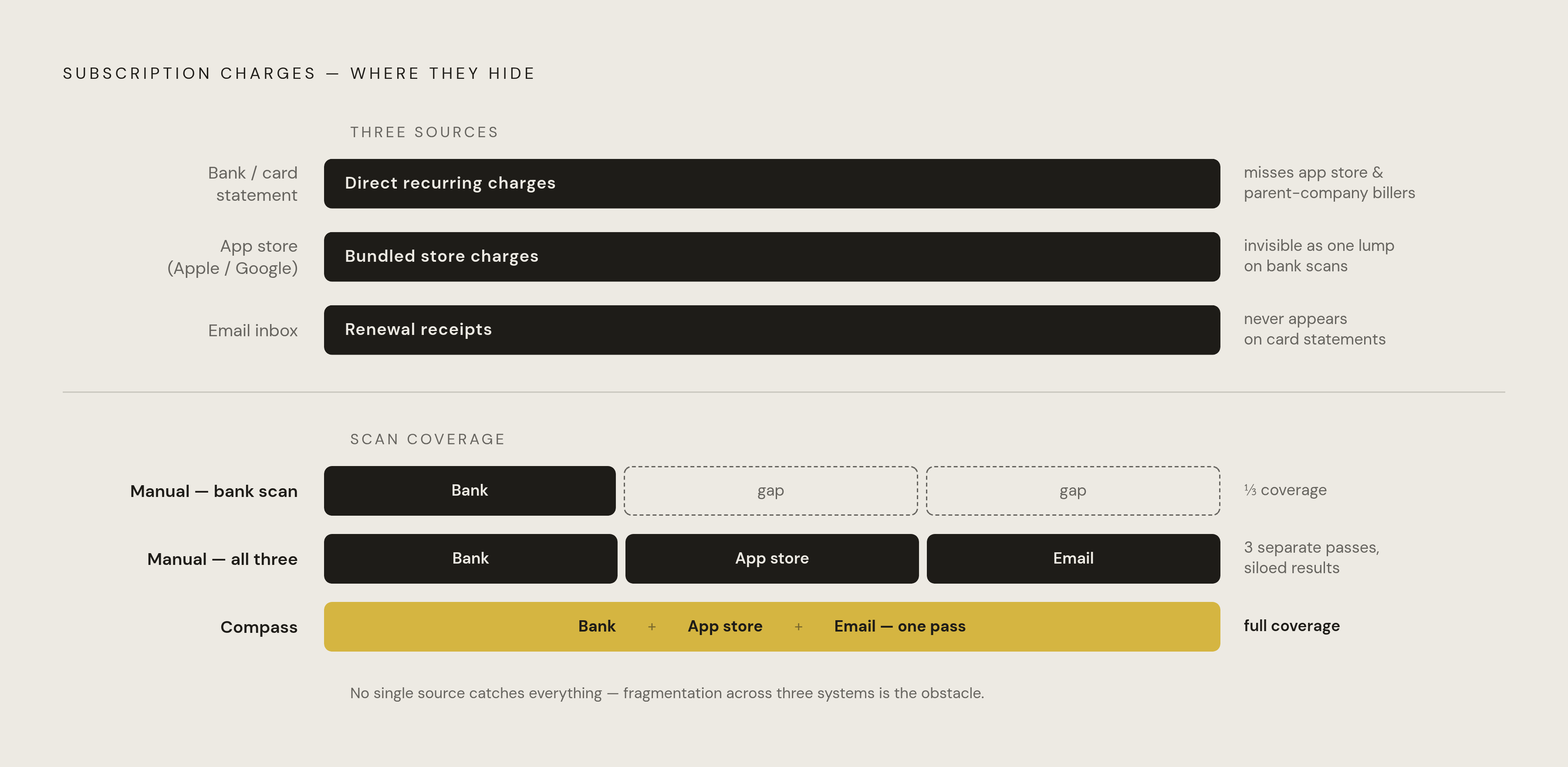
App store subscriptions are one of the biggest blind spots. A large share of forgotten consumer charges live inside Apple's or Google's billing systems rather than on a bank statement, and they show up as one lump app store charge instead of a named service, so a bank statement scan slides right past them.
Bank and credit card statements do carry recurring charges, but rarely in one clean list. They're split across multiple cards, billed on different days of the month, and often labeled with a parent company's name instead of the product the person actually signed up for.
Email inboxes hold another layer. Services billed directly, outside the app stores, send renewal receipts and billing notices straight to an inbox. Searching an inbox for terms like "subscription," "renewal," "receipt," and "billing" finds charges that never show clearly on a card statement at all, which is the audit method ReSubs uses to find them.
Streaming services are their own category of overlap. The average household pays for several at once, and the combined monthly cost adds up to more than most subscribers expect when asked to guess. Cancelling one often feels like losing access to something, even when the content hasn't been watched in months.
Fitness apps and memberships linger the longest. Digital gym and workout app subscriptions often stay active long after the equipment gathers dust or the motivation disappears, and this is a category where auto-renewal is standard and the cancellation process is often made deliberately hard to finish.
Food and delivery memberships stack in a similar way. A household can end up paying for more than one delivery membership, each one individually justified in the moment it was purchased, but together representing real redundancy.
News, media, and software trials round out the list. Introductory pricing quietly steps up to full price, and software bought for a single project keeps charging monthly long after that project wrapped.
Password managers and saved logins offer a useful secondary clue. A saved login for a service is a reasonable sign that money is still going out for it, and checking those logins catches direct-billed services that a standard bank filter would never flag.
The fragmentation is the actual obstacle. A bank statement alone misses the app store charges. Someone who checks only the app store misses the services billed directly to a card. Someone who checks only email misses any charge that never generated a receipt. This structural invisibility is why proactive monitoring across multiple account types, the core approach behind tools like Compass, is necessary to catch what manual vigilance cannot. Compass connects to bank, email, and shopping accounts at once and scans across all of those hiding places in a single pass, surfacing forgotten charges that no single-source check would ever catch.
How subscription-surfacing apps scan these locations
Apps built to surface hidden subscriptions work by linking directly to the places charges actually live and running pattern recognition across all of them at the same time. A manual audit does this same work one source at a time, slowly, and usually incompletely.
Two different approaches exist, and they come with real tradeoffs. Manual, privacy-first tracking apps like Bobby on iOS and Subby on iOS and Android ask a person to type in each subscription by hand, the name, the cost, the billing cycle, and from there calculate running totals and send renewal reminders. There's no bank connection and no data aggregator involved. This method only knows what the user already told it, but it helps track and act on that information before the next charge lands.
Bank-linked tools work differently, and the advantage is discovery. They scan actual transaction data, which surfaces charges a person genuinely forgot existed. The tradeoff is that this requires giving the tool access to a bank account.
Email scanning adds a complementary layer on top of that. Some tools connect directly to an inbox to parse renewal receipts and confirmation emails, catching direct-billed services that never appear under a recognizable name in bank transaction data.
App store scanning covers a third category on its own: charges that route through Apple's or Google's billing systems rather than straight to a card, appearing on a statement only as a single lump charge from the app store itself.
A basic recurring-charge detection technique drives all of these methods: a charge that repeats monthly or annually, even when the amount shifts slightly, gets flagged as a subscription candidate. This catches something a person would likely miss on their own, a price increase that happened quietly mid-subscription.
Banks themselves have started building this visibility directly into their own apps. Capital One's mobile app now includes subscription tracking and blocking tools built into its existing interface, which reaches customers without asking them to download anything separate or set up a new connection.
A newer category is starting to push past detection into action. A service called 19Pine.AI, named in 2026 app comparison lists, uses an AI agent that calls customer service directly on a user's behalf to negotiate bills or cancel subscriptions, charging on a pay-as-you-go basis. That's a meaningful shift in what these tools attempt to do, moving from surfacing a problem to resolving it directly, an early move within the category that is still far from an established standard.
Compass+ sits closer to the multi-source end of this spectrum. It connects to bank accounts, email, calendar, Amazon, and subscription services at the same time, all in read-only mode, covering the full map of hiding places described above in one connected system. Each finding comes with a specific dollar amount attached and a clear next action, so a user gets a scoped task to complete rather than a pile of transaction data to investigate alone.
What "read-only" bank access means
Read-only access stops an app from moving money out of an account, but it says nothing about whether that app's data could be exposed somewhere else. Those are two separate risks, and treating them as one is what leads people to either trust these tools blindly or avoid them entirely out of vague unease.
What read-only access genuinely guarantees: no aggregator or app running on a read-only connection can initiate a transfer, pay a bill, or move funds anywhere. The connection only observes transaction data. It cannot act on an account.
The real risk sits somewhere else, in how that transaction data is stored and handled once it's been pulled. In April 2026, Plaid began mailing breach notices dated April 27, 2026, covering a data exposure window that ran from sometime after December 25, 2024 through April 22, 2026, with the scope of the exposure finalized around April 22, 2026. The data potentially exposed included names, dates of birth, addresses, driver's license numbers, Social Security numbers, bank names, and bank account numbers. Online banking usernames and passwords were not part of the exposure.
A second risk exists independent of any single breach: connections tend to outlive the apps that created them. A person who connected a bank account through Plaid for an app downloaded in 2022, then deleted that app soon after, may still have a live read connection sitting active years later in 2026, quietly able to pull transaction history the person forgot they ever granted access to.
There's also a question of scope. An aggregator connecting a bank account may pull far more transaction history than the specific app requesting it actually needs. The app itself only sees what it asked for, but the aggregator sitting between the app and the bank sees everything it pulled, which is more than the visible feature set would suggest.
For anyone who finds this tradeoff unacceptable, manual tools like Bobby sidestep the entire category of risk by design. There's no bank-connection feature built into the app at all, so there's no aggregator to plug into and no transaction data sitting anywhere to expose. The cost of that safety is real too: a manual tool only knows about the subscriptions a person takes the time to type in themselves.
Connecting more financial accounts to more tools is a tradeoff between how much a tool can discover and how much data exposure a person is willing to accept to get that discovery. Understanding what a given connection can and cannot do, and checking periodically which old connections are still active, does more for security than refusing every connection on principle. Compass+ operates in read-only mode specifically, able to see account activity to surface potential savings but never able to move money, which fits the job a tool like this should actually do: watch and notify, not act.
Regulatory changes affecting what companies are allowed to do
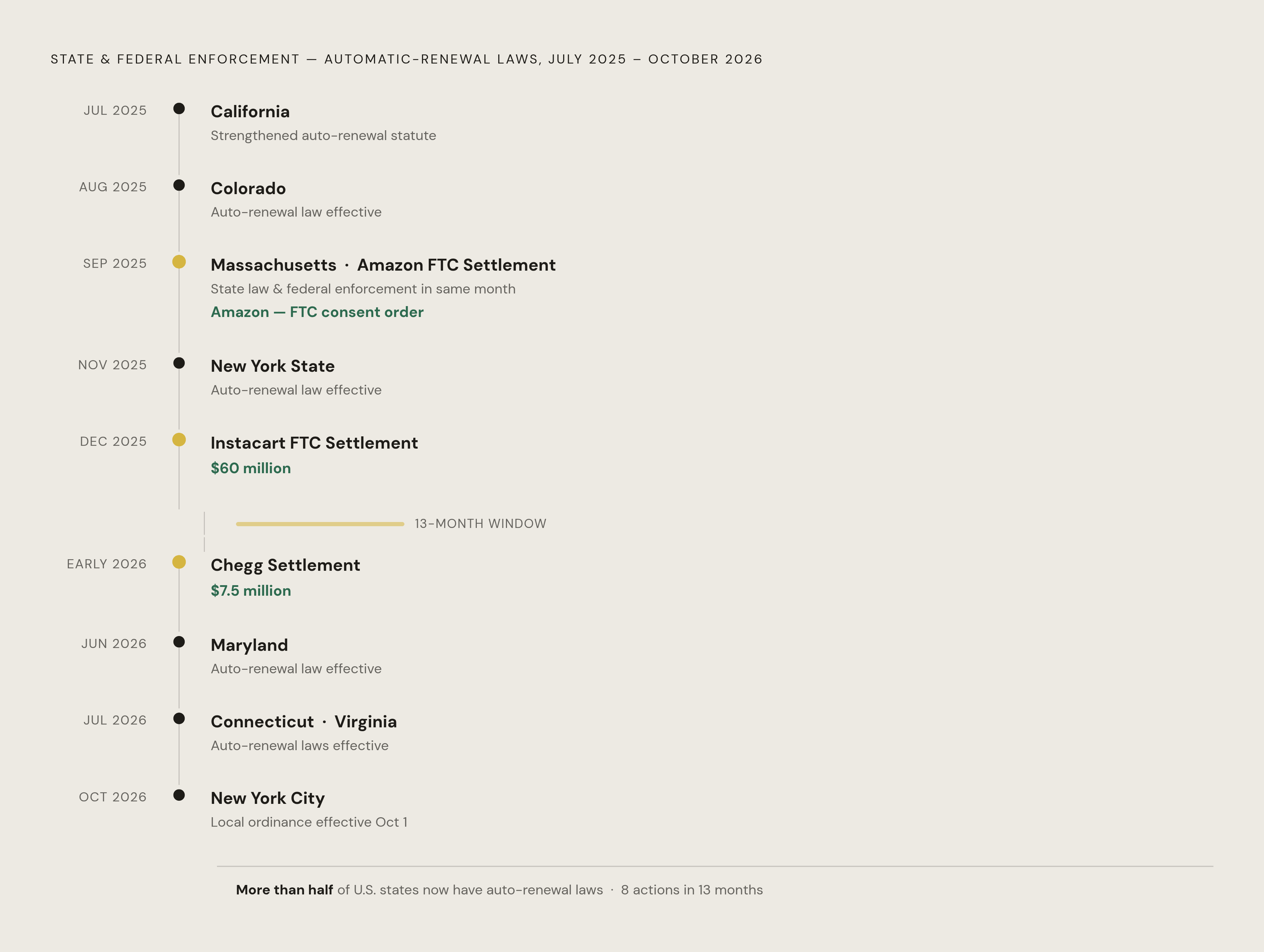
Enforcement against deceptive subscription practices has not slowed down, even while broader federal rulemaking has stalled. Amazon agreed in September 2025 to pay a substantial civil penalty along with substantial consumer refunds, after the FTC alleged the company used manipulative design to enroll users in auto-renewing Prime memberships and built a cancellation process that required passing through many separate screens and actions. The FTC announced that Instacart agreed in December 2025 to pay $60 million in consumer refunds over automatically enrolling free-trial users into paid annual subscriptions. Chegg agreed to pay $7.5 million after continuing to charge consumers who believed they had already canceled, in a case the FTC said affected nearly 200,000 consumers going back to October 2020, and after building a cancellation process the FTC described as extremely difficult to complete.
State legislatures have moved faster than federal rulemaking to close the gap directly. California expanded its automatic-renewal law in July 2025. New York State's amended law took effect in November 2025. Massachusetts acted in September 2025, Colorado in August 2025, and Maryland in June 2026. Connecticut and Virginia both put expanded automatic-renewal rules into effect in July 2026. New York City's own rule took effect October 1, 2026. More than half of all states now have automatic-renewal laws on the books, and some of them set stricter standards than the federal rule that was vacated.
None of this changes what a consumer still has to do first. Enforcement only reaches companies after the fact, and only the ones that get caught. A stronger click-to-cancel law makes it easier to walk away from a subscription once someone knows it exists and decides to act on it, but the law does not surface a forgotten charge sitting quietly on a card statement. A person still has to find the subscription before any legal right to cancel it easily becomes useful.