Autopay and the Invisibility of Recurring Charges
Autopay was designed to hide the moment you decide whether a charge is worth paying.
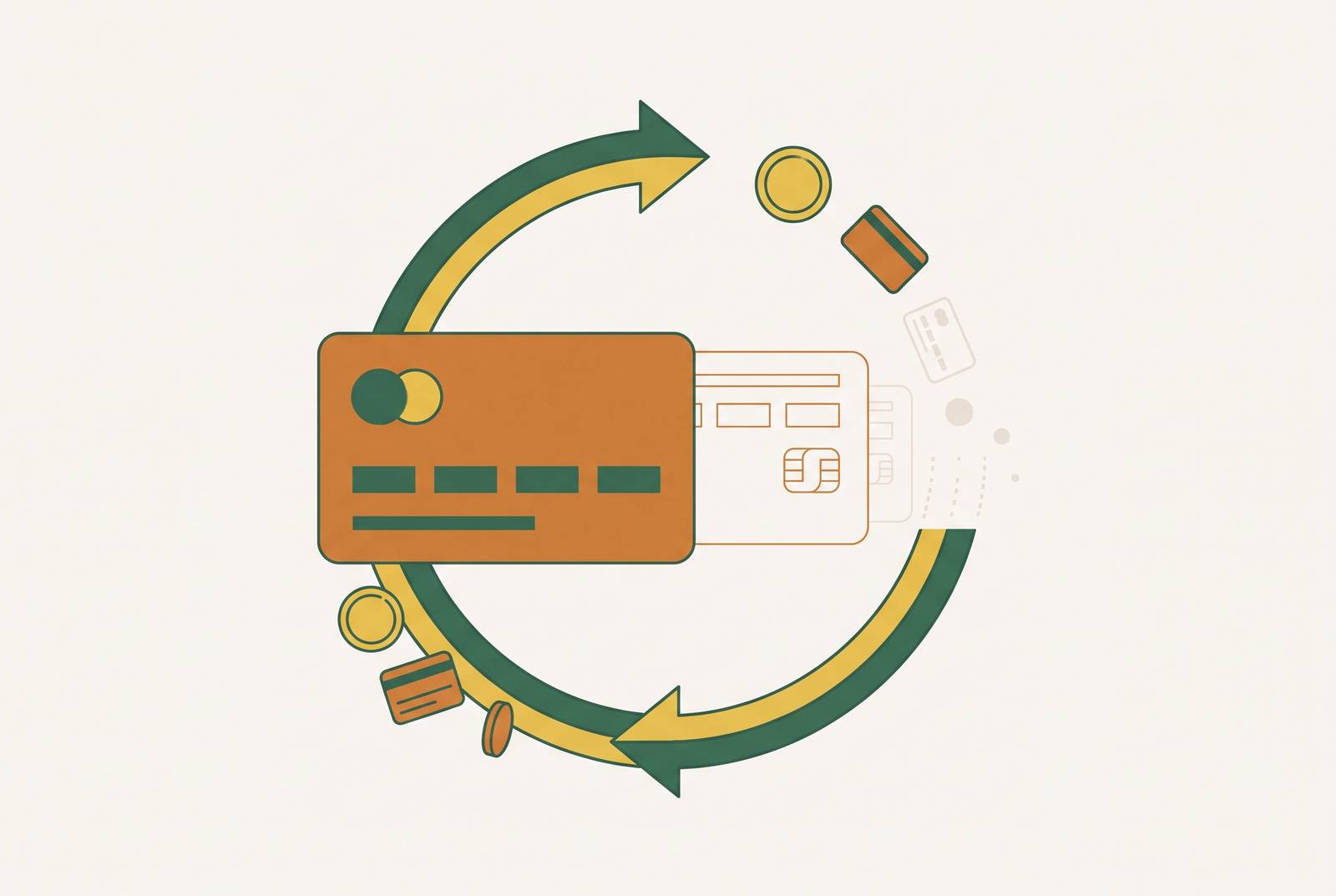
Autopay was built to remove one specific thing: the moment where you look at a charge and decide whether it's worth paying. That's the whole design, and it works exactly as intended. The trouble is that the friction it eliminates was also the only mechanism forcing a regular reckoning with what you're actually spending money on. Take that away, and a charge no longer functions as an active commitment but fades into background noise. Ted Rossman, an analyst at Bankrate, said it directly: "set it and forget it can be a ticket to overspending." It's a description of the tradeoff baked into autopay itself. It's a description of the tradeoff baked into it.
Autopay deserves the credit it gets. It stops late fees, protects credit history, and kills the mental overhead of tracking a dozen due dates scattered across a month. Rossman's own advice narrows the use case correctly: autopay works best for "bills that stay the same every month." Rent, a car payment, a fixed loan installment. Anything with a number that doesn't move.
Almost nothing else fits that description anymore. Most of what runs on autopay today is variable by design: subscriptions, carrier plans, insurance premiums, all of it drifting quietly and almost always upward.
The scale of what's now running silently in the background
Roughly 78% of adults worldwide hold at least one paid subscription, with the average consumer carrying 5.6 active subscriptions running at any given time, a real chunk of household finances multiplied across nearly six separate billing relationships. That's a real chunk of household finances, not pocket change. That's a real chunk of household finances sitting on autopilot, multiplied across nearly six separate billing relationships.
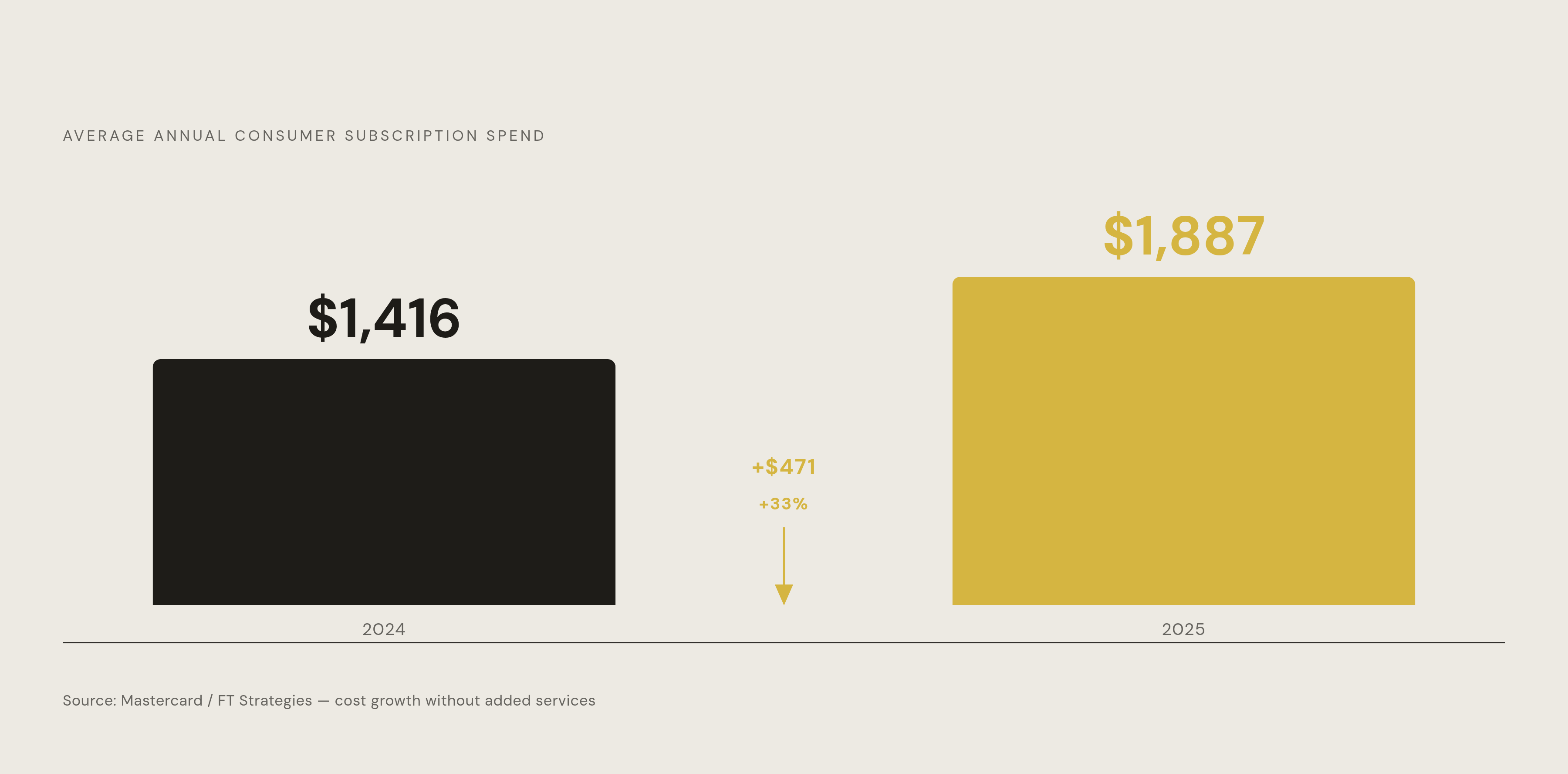
The dollar figure backs it up. A Mastercard report done with FT Strategies found that the average consumer spent $1,887 on subscriptions in 2025, up from $1,416 in 2024. That's a substantial jump in a single year, and what actually matters is where the increase came from, a rise that hit even consumers who weren't necessarily adding new services.
Each one of those 5.6 subscriptions typically sits on autopay, which means each one renews every month without a single decision getting made. Subscribing isn't the bad habit here. The charges disappear from view the second autopay takes over, and that disappearance is the entire mechanism this piece is about.
How charges change after the initial signup goes unnoticed
Rossman names the exact risk: "hidden charges creep up, surcharges get added, or a fee goes up," and on autopay, the next payment clears before anyone has a chance to notice any of it.
Insurance premiums are the textbook case. Rates creep upward a few dollars at a time, and a policyholder on autopay can overpay for months before the increase even registers. Cellphone carriers run the same play: a $2 or $3 bump per line sounds trivial in isolation, but multiply it across a family plan and across twelve billing cycles, and it adds up fast. Carriers depend specifically on that inattention for the play to work at all.
The sneakiest version of this is the so-called "regulatory recovery fee," a charge that sounds like a government tax while actually being set entirely at the carrier's discretion, typically $1 to $5 per line per month. It almost never gets flagged by someone on autopay, because it's designed to read as unavoidable. Administrative fees follow the same pattern: one national provider raised its admin fee by roughly $40 a year per customer, buried in fine print while autopay kept clearing the new, higher amount without triggering a second look.
Regulators have caught on. The FCC's Broadband Nutrition Labels, which took effect April 10, 2024 for large internet providers and October 10, 2024 for smaller ones, now require ISPs to display the real cost of service, including what happens after a promotional rate expires. That requirement exists because promotional-rate expiry is one of the most common autopay traps there is: sign up at a low introductory price, let the window lapse, and autopay absorbs the new, higher rate without asking permission.
None of this is bad luck. Whoever sits on the receiving end of an autopay charge has no incentive to flag a change to the person paying it. The payment clears either way, flagged or not.
The specific fees designed to be invisible rather than merely unnoticed
There's a real gap between "technically disclosed" and actually noticed, and most fee structures live entirely on the wrong side of it. Burying a fee in fine print satisfies a legal requirement. It does nothing to make sure anyone actually sees it, which is precisely the point. A Consumer Reports survey found that 85% of Americans got hit with an unexpected or hidden cost in the past two years. At that rate, it's standard practice. It's standard operating procedure.
Bank fees alone cover a lot of ground: monthly maintenance charges run $5 to $15, overdraft fees hit $35 a pop, and out-of-network ATM withdrawals tack on another $3. All of it runs quietly against accounts that are, ironically, set up on autopay specifically to avoid extra charges. That creates a strange loop: a bill on autopay draws from an account nobody's watching closely, the balance dips too low, and the result is a $35 overdraft fee. The tool meant to save money ends up generating a brand-new charge instead.
Phone bills carry their own layer of small, easy-to-miss add-ons: data overages at $15 a gigabyte, roaming charges around $10 a day, cloud storage bumps at $5 a month. None of it typically arrives with a notification loud enough to break through. Ticket service fees average 28% of the ticket price, Next Gen Personal Finance found. Disclosed at checkout, sure, but absorbed without a second glance once the charge clears weeks later.
Credit card late fees deserve their own line. The CFPB finalized a rule in 2024 capping late fees at $8, down from the previous $30 to $41 range. That rule remains unenforced as of early 2025, held up by a federal court injunction issued in May 2024 and upheld again in December 2024. The fee consumers actually pay is still the old, higher one, and the people least likely to notice are the ones already on autopay.
Every fee described here shares the same structural trait: it's built to pass through autopay without tripping a second look, and it works precisely because there is no second look.
How free trials convert to paid subscriptions before anyone is watching the clock
The mechanics take one breath to state. A free trial requires payment credentials upfront, the trial period ends, and autopay converts it into a paid subscription with zero friction and zero decision point involved. The App Store and Google Play handle billing directly; the user confirms a subscription at signup, and it renews the moment the trial ends unless someone actively cancels first.
Many people do catch the conversion eventually, usually only after the first charge already cleared. Research on UK consumers has found that a significant share reported signing up for a subscription by accident, mostly because they didn't cancel a free trial in time.
Name the cognitive gap directly: the intent at signup ("I'll try this for free and cancel if it's not for me") never carries forward to the moment of renewal, because there is no moment. Autopay handles the whole thing silently, with nothing around to jog the memory back to the original plan.
Half of Gen Z say they've resorted to blocking payments outright just to cancel a subscription, which says plenty about how deliberately difficult standard cancellation flows have become. A meaningful share of consumers have blocked or disputed recurring charges, and in many cases the issue wasn't fraud at all, people simply didn't recognize the charge. Cancellation friction compounds the whole cycle: Consumers are demonstrably more likely to sign up when cancellation looks easy, and the reverse holds just as true. Services that make joining effortless often make leaving deliberately harder.
Why budgeting and manual monitoring don't close the gap
Budgeting is nearly universal at this point, which makes the leak even harder to explain away. As of 2026, 84.67% of Americans say they budget, down slightly from 90% in 2024. The money keeps leaking anyway, because budgeting and awareness of recurring-charge creep are two separate problems. Solving one does nothing for the other.
Even among the roughly 15% who don't budget, the top reason cited for 2026 shifted for the first time to "it's too time-consuming," named by 34% of non-budgeters, up from 16% in 2025. That shift says something real. People haven't stopped valuing the practice. Sustained, granular tracking has gotten genuinely hard to sustain.
Budgets track categories. They don't track individual charge mutations. A committed budgeter watching "subscriptions" as a line item has no visibility into a mid-cycle fee change, a free trial quietly expiring, or a promotional rate rolling over to full price. Manual statement review carries a built-in flaw on top of that: it requires knowing exactly what to look for. A "regulatory recovery fee" that ticked up by $1.50 a line sails right past a quick scan, every time.
The waste compounds quietly. 52% of consumers canceled at least one subscription in the past year specifically because they weren't using it, which means the budget never caught the waste at the point it started. It just sat there until someone happened to notice. Academic research on subscription fatigue, including the paper "Statistical Analysis of Subscription Fatigue" presented at ICOFE-2024, points to loss of control as a central driver of the frustration. That tracks: manual monitoring produces the feeling of staying on top of things without ever solving the underlying problem. With 5.6 subscriptions each capable of changing price or terms independently, no realistic manual review schedule keeps pace. The math doesn't work in a person's favor, and it isn't supposed to.
What proactive, automated monitoring catches that periodic reviews miss
Spending dashboards and trackers show what already happened. Useful, but backward-looking by design, and backward-looking is exactly the wrong shape for a problem that moves in real time. Proactive monitoring works differently: it surfaces what can still be done about a charge before the next one clears, not after the damage is done.
Continuous monitoring catches things a once-a-month review structurally cannot:
- A free trial converting tonight, not two weeks after the fact
- A subscription that quietly rose $2 this billing cycle compared to last
- A duplicate charge from the same vendor inside the same billing period
- A bill that's crept upward over six months when measured against its own history
- An overdraft risk from an autopay draw the account balance can't actually cover
Compass+ connects to bank accounts, email, calendar, and subscription services to watch continuously for exactly these patterns: unused subscriptions, price hikes, duplicate charges, free trials on the verge of converting. It runs on read-only access, which is the structural detail that makes the whole thing safe: it can see the charge without touching the account, which is the visibility needed to catch a problem without adding a new point of risk. Each finding comes with a specific dollar figure and a clear next step attached, ready to act on immediately.
The scale of what's being missed backs up the case for this kind of monitoring. Average monthly churn across the subscription economy runs around 20%, and more than half of U.S. businesses report that at least 10% of their subscriber base sits inactive. That's real money paid for nothing, and it's exactly the category proactive monitoring exists to catch. Some UK banking apps, including HSBC, Monzo, and Revolut, now build in standard "Subscription Management" tools that let a customer block a merchant at the bank level directly. That's the market itself treating passive, ongoing monitoring as a basic consumer need rather than a niche add-on.
How to audit what autopay is currently running
Start with the last three months of bank and card statements, and scan for recurring charges. Not just the ones that look familiar, either. The ones that don't quite ring a bell deserve the closest attention, since those are the ones most likely to have drifted.
A few specific things to hunt for:
- Any charge that's gone up since the same period last month or last year
- Charges tied to a service that started as a free trial
- Line items labeled "regulatory recovery fee," "administrative fee," or anything similar (these are discretionary carrier charges, not taxes, no matter how official they read)
- Duplicate charges from the same vendor inside a single billing cycle
- Promotional rates that appear to have quietly expired (compare the current charge against what was paid at signup)
For free trials specifically, note the trial's end date somewhere visible if the service is a keeper. If it's not, cancel before autopay converts it, since plenty of services require notice ahead of the final day, not on it. For anything on the chopping block, cancellation is more manageable than it feels: 52% of consumers already canceled at least one subscription this past year over lack of use, and most cancellation flows now happen entirely online.
When a rate has clearly gone up, calling the provider directly tends to work better than people expect. Carriers and service providers routinely offer retention pricing that never appears in any advertised plan, reserved specifically for the customer who calls and asks.
None of this is a one-time fix. Subscription sprawl is a slow, ongoing drain that renews and mutates continuously, so a single audit only catches what's happening today, not next month's price bump or the trial that quietly converts six weeks from now. Compass+ is built for that ongoing layer specifically: after the initial setup, it keeps watching in the background and surfaces each finding with the dollar amount and next step already spelled out. That's the practical alternative to trying to build a permanent personal habit around catching something that was designed, from the start, to escape notice.
Sources
- Credit Card Fees in 2025: The True Cost of Missed Payments
- Here
- 25 Hidden Fees Draining Your Money (And How to Avoid Them) - Dad is FIRE
- The Hidden Fees Most Cellphone Service Providers Don’t Want You to Notice – Washington Guardian
- 5 Sneaky Fees Hiding in Your Bills — and How To Avoid Paying Them
- qz.com