How Streaming Services Have Raised Prices Since 2020
Netflix's crackdown on password sharing and repeated price hikes have become the industry blueprint.
Streaming prices have climbed well past inflation since 2019, and the increases aren't slowing down. Ad-free subscriptions are up 54% since 2021 alone, according to Churnkey, a pace that beats both inflation and wage growth over the same stretch. This piece maps the hikes service by service, because the pattern across Netflix, Disney, Discovery, Peacock, Apple, and Amazon reveals something the aggregate number can't: these increases are a deliberate strategy, not a reaction to costs, and nothing in the industry's own language suggests it's close to done.
Add up the major services (Netflix, Disney+, Hulu, HBO Max, Peacock, Apple TV, Discovery+) at current prices, and a household trying to keep all of them runs well past what a cable package cost a decade ago. That's the exact bundle inflation streaming promised to kill. Instead, the industry rebuilt it quietly, just with more logins and no cable box to blame.
Executives have stopped pretending the reason is a mystery. Discovery's CFO, Gunnar Wiedenfels, told investors flatly that streaming services "are priced way too low." Deloitte's media leader, Scott Purdy, gave the moment a name: "streamflation." Neither man framed it as temporary. Read the quotes again if that seems like an overstatement: nobody said "for now."
Netflix: the price history of the service that set the pattern every competitor followed
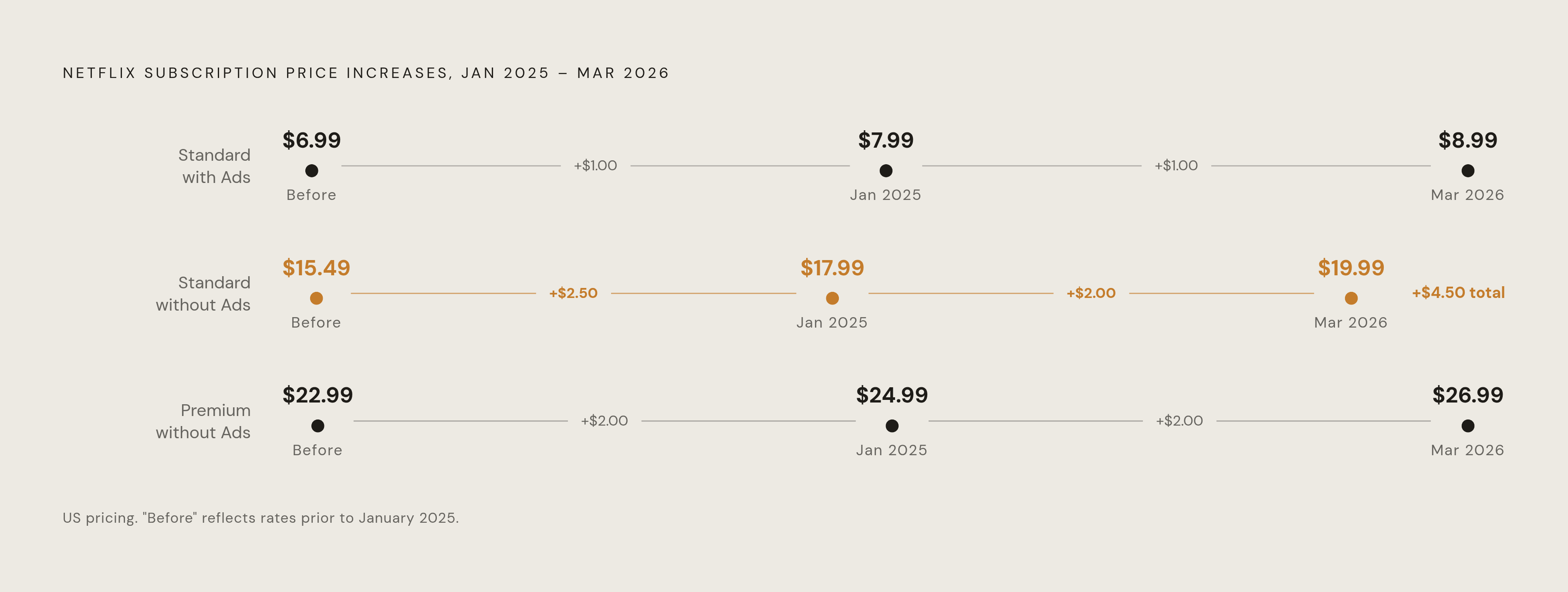
Netflix moves first, and everyone else watches. That's been true since streaming became a real industry, and it held again on January 21, 2025, when Netflix raised prices across every tier. Standard With Ads went from $6.99 to $7.99 a month. Standard Without Ads jumped from $15.49 to $17.99, a substantial increase by any measure. Premium Without Ads rose from $22.99 to $24.99, and the Extra Member add-on climbed from $7.99 to $8.99. Across the board, that's a 14% to 16% increase in one announcement.
Netflix didn't stop there. As of the end of March 2026, Standard With Ads reaches $8.99 a month, Standard climbs to $19.99, and Premium hits $26.99. Three tiers, three more increases, less than fifteen months after the last round.
Price hikes are only half of Netflix's playbook, and treating them as the whole story misses how the company actually grows revenue. In May 2023, Netflix cracked down on password sharing, and the results were immediate: global subscribers grew roughly 27%, from about 238 million to over 301 million by the fourth quarter of 2024. The ad-supported tier grew 70% sequentially in Q4 2023 alone and accounted for 40% of new sign-ups in the regions where it was available. Revenue growth, which had stalled, rebounded to 15.6% in 2024.
Netflix's churn stayed around 2%, among the lowest in the streaming industry, even through repeated price increases, which should worry every competitor watching from behind. Content depth buys Netflix a kind of insulation nobody else on this list has earned yet. When Netflix raises prices and loses almost nobody, competitors read that as a green light. Most of the rest of this article is the story of that green light getting used.
Disney+, Hulu, and the bundle: how Disney's pricing strategy compounded across its own services
Disney+ launched at $7 a month with no ads, a price built to win subscribers fast, not to turn a profit. That era is over. As of October 21, 2025, the Premium plan rose from $15.99 to $18.99 a month, and the With Ads tier rose from $9.99 to $11.99, both effective the same day.
Hulu had already raised its standalone monthly price from $17.99 to $18.99 back in October 2024.
Then there's the bundle, and this is where the increases actually compound. The Disney+, Hulu, and HBO Max bundle with ads rose from $16.99 to $19.99 a month on October 21, 2025. The ad-free version of that same bundle rose from $29.99 to $32.99 the same date. A subscriber holding standalone Disney+, standalone Hulu, and the bundle has absorbed several stacked increases since 2020, and Disney's pricing is built so that stacking happens by default, not by accident.
Subscribers noticed immediately. Disney+ churn doubled from 4% to 8% in September 2025 around the announcement, and Hulu's churn doubled too, from 5% to 10% in the same window. The Jimmy Kimmel Live! removal from ABC, a Disney subsidiary, happened in that same stretch, so untangling how much of that churn was price and how much was the controversy isn't clean, and it shouldn't be treated as clean.
Hulu's future adds another wrinkle. Disney completed full ownership of Hulu in July 2025, and under an internal plan called "Project Gemini," Hulu's content is set to fully integrate into Disney+ by the end of 2026. The standalone Hulu app is slated for decommissioning once that transition finishes, though Disney has stated there are "no current plans to sunset the Hulu app." Read that carefully: integration is already planned, even if the shutdown date isn't official yet. Anyone holding onto Hulu as a separate product should expect that to change on Disney's timeline, not their own.
HBO Max: three price increases in three years, and an executive who said the service was underpriced
HBO Max's ad-free plan launched in May 2020 at $14.99 a month. The first increase brought that to $15.99, and by October 21, 2025, the service had raised prices a third time in three years. Basic With Ads went up a dollar, to $10.99 monthly or $109.99 annually. Standard rose $1.50, to $18.49 monthly ($184.99 annually). Premium climbed $2, now $22.99 monthly, $229.99 a year.
The rationale wasn't subtle. In September 2025, a major media and entertainment company. Discovery CEO David Zaslav told the public that HBO Max was "way underpriced," and that subscribers would tolerate a hike. The increase followed within weeks. As of June 30, 2025, that same media and entertainment company. Discovery reported 125.7 million paying users across its streaming and linear HBO subscriptions combined, a scale that clearly gave Zaslav the confidence to move price without expecting much fallout.
Churn data backs that read. HBO Max held steady at 7% churn between May and June 2025, according to Statista, a far calmer picture than the swings hitting Disney+ and Hulu. Zaslav's bet looks correct so far: he called it, and the numbers agreed with him.
Subscribers have absorbed all this pricing turbulence while the service kept changing its own name. HBO Max became Max, then reverted to HBO Max, all inside the same window as three separate price increases. Paying more for a product that can't settle on what to call itself is its own tax on patience, one Statista's churn numbers suggest subscribers are paying without much complaint.
Peacock, Apple TV, and Discovery+: three smaller services that each raised prices sharply in 2025
Peacock launched in 2020 as the budget option. That positioning is gone now, and it isn't coming back. On July 23, 2025, Peacock made the biggest price move in its history: Premium (with ads) and Premium Plus (limited ads) each rose $3 a month, to $10.99 and $16.99. On the lowest tier, that's north of a 30% increase in one move. Peacock's own explanation was that the hike was "necessary to remain competitive," a phrase that says more about the industry's mood than about Peacock specifically.
It didn't stop there. As of August 2026, Premium Plus climbs again from $16.99 to $19.99, and Premium rises from $10.99 to $12.99, both double-digit percentage jumps. Two increases within about a year, both double-digit percentages, on a service that was marketed as the cheap option four years ago.
Apple TV, which dropped the "+" from its name in October 2025, tells a similar story stretched over a longer timeline. It launched November 1, 2019, at $4.99 a month. By October 2023, that had risen to $9.99. By August 2025, it reached $12.99, a substantial jump and the service's latest in a series of price increases since launch. The price has roughly doubled since 2019, while the Apple One bundle, which packages multiple Apple services together, also saw its own price adjustments over this period. The standalone product got more expensive faster than the bundle did, which tells you where Apple wants subscribers to land. Even the free channel is closing: T-Mobile's "Apple TV On Us" promotion, previously free, starts charging $3 a month on January 1, 2026. Apple TV's churn remained relatively mild compared to the sharp swings that hit Disney's properties.
Discovery+ rounds out the group. On January 7, 2025, its ad-supported tier rose from $4.99 to $5.99, the first increase for that tier since it launched in 2021. The ad-free tier had already gone from $6.99 to $8.99 back in October 2023, and the January move pushed it further. Net result: the ad-free tier is up $3 a month in roughly two years. Given that much of Discovery+'s library is also available through HBO Max, subscribers paying for both are facing a real question about whether they need to, and most of them probably don't.
YouTube TV and Amazon Prime Video: price increases that came packaged as something other than price increases
YouTube TV raised its basic subscription from $72.99 to $82.99 a month, effective December 12, 2024, for new subscribers and January 13, 2025, for existing ones. The company cited rising content costs. That explanation sits awkwardly next to the numbers: YouTube TV's revenues hit a record high that same year, with ad revenue up 12% year over year. Content costs may well be rising, but a service posting record revenue while blaming content costs for a price hike is telling on itself.
Amazon Prime Video didn't raise its listed subscription price at all, and that's exactly the point worth catching. In January 2024, Amazon introduced a separate $2.99 monthly charge to remove ads from a service that had previously come ad-free by default. The math: a Prime member now pays $14.99 for Prime plus $2.99 to remove ads, for $17.98 a month total. A standalone Prime Video subscriber pays $8.99 plus $2.99, for $11.98. Amazon's next Prime Video price change has been reported for April 2026, though details beyond that date aren't confirmed yet.
The mechanism matters more than the dollar figure here. Amazon didn't raise a price, it changed what the price included: ads became the default, and an ad-free experience became a paid upgrade sitting on top of a subscription fee that never moved on paper. That's a quieter kind of increase, and it's exactly the sort of move other services are studying right now, because it lets a company report a flat headline price while collecting more per subscriber.
Why increases keep coming: the industry's financial logic and what executives have said openly
For years, streaming companies chased subscriber growth above everything else, and profitability sat somewhere on the someday list. Wall Street ran out of patience with that approach, and the calculus flipped: sustainable margins now matter more than raw subscriber counts, and price is the fastest lever available to move a margin.
Executives aren't hiding any of this. Wiedenfels said streaming is "priced way too low." Zaslav said HBO Max is "way underpriced" and predicted subscribers would eat the increase, then watched churn hold at 7% while he did. Purdy called it "streamflation" and said the era isn't over. Peacock's team called its own 30%-plus hike "necessary to remain competitive." None of that reads as apology. It reads as strategy stated in plain terms, by people who have no reason to hide it because the churn numbers keep proving them right.
Ad-tier expansion runs alongside price increases as a second lever, not a substitute for one. Services are restructuring their tiers so the cheapest option comes bundled with advertising, which means even the lowest price point generates extra revenue per subscriber beyond the subscription fee itself. Password-sharing crackdowns work as a third lever: Netflix's 2023 crackdown added tens of millions of paying subscribers in the same stretch that prices kept climbing, proof that these three mechanisms aren't competing with each other. They're stacking, on top of each other, at the same time.
Content costs get cited constantly as the reason behind all this. But when a service posting record revenue, like YouTube TV, reaches for the same "content costs" language as a service that's genuinely struggling, the phrase stops working as an explanation. It starts working as cover for a decision to raise margins that executives have already admitted to making out loud. Nobody quoted here has suggested a ceiling is coming. The framing, consistently, from Wiedenfels to Zaslav to Purdy, is that this keeps going.
How subscribers are responding: churn rates, cancellation behavior, and subscription cycling
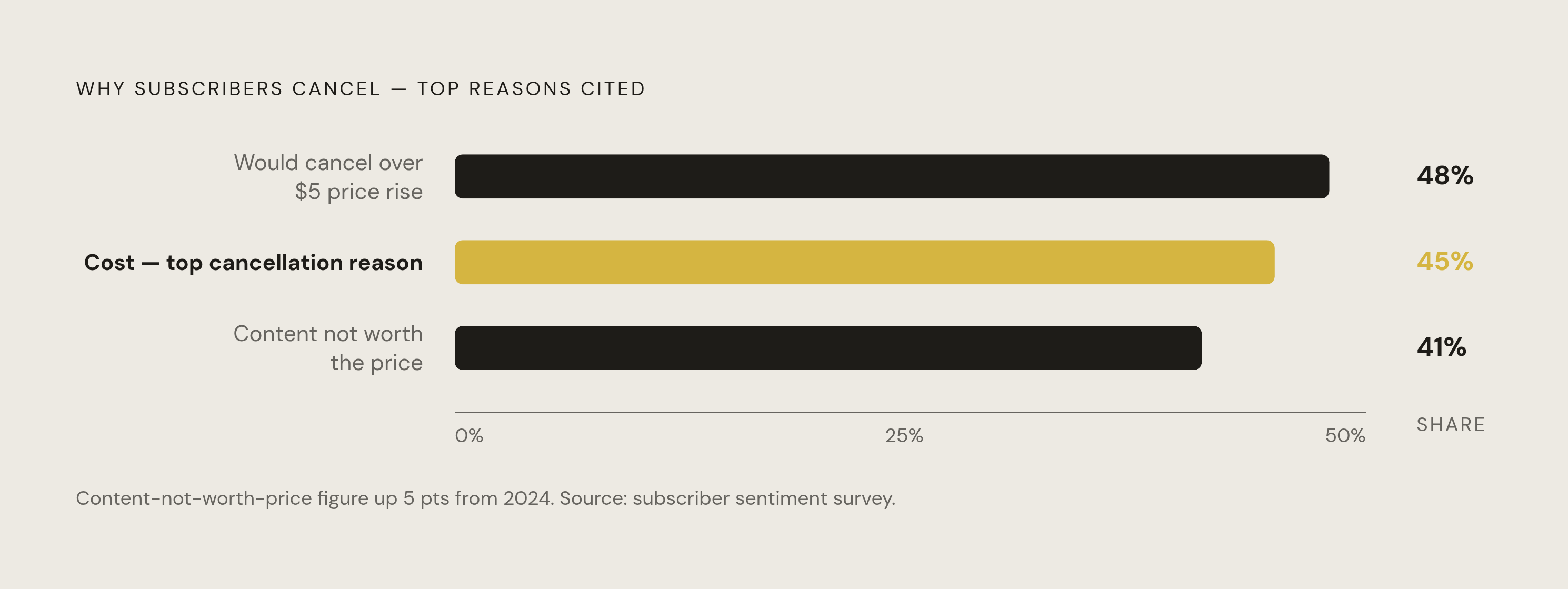
Streaming churn has climbed substantially since 2019, reaching roughly 5.5% by early 2025, according to Churnkey. Cost sits at the top of the list of reasons subscribers give for canceling: 45% cite it directly, more than any other factor.
A research firm's 2025 Digital Media Trends Survey, which polled 3,595 consumers in one country. consumers, found 41% believe streaming content isn't worth what they're paying for it, a five-point jump from 2024. The year before that, Deloitte's 2024 survey of 3,517 consumers found 48% would cancel their favorite streaming service outright if the price rose by just $5. Nearly half the audience has a breaking point that low, and every price increase detailed above tests it.
A research firm's late-2025 research, a census-representative survey of 3,575 consumers in one country. consumers, fills in the rest of the picture. 90% of consumers in that country. households carry at least one paid streaming subscription, and the average subscriber juggles four services at once. 41% canceled at least one paid service in the past six months, and millennials churn the hardest, with 52% dropping at least one subscription in that same window.
None of this reads as passive frustration anymore. It reads as a strategy subscribers built on their own: sign up, watch the one show that pulled you in, cancel before the next billing cycle, then resubscribe months later when something new drops. The industry logs this as churn. It's better described as subscribers doing the math the services forced on them, and beating it. Disney+ and Hulu's September 2025 churn spikes, doubling in both cases inside a single month, show how fast that math moves when a price increase and a content controversy land at the same time. Subscribers now put their loyalty elsewhere, not with a platform. They're loyal to whatever they're watching right now, and they'll log in and out as many times as it takes to prove it.