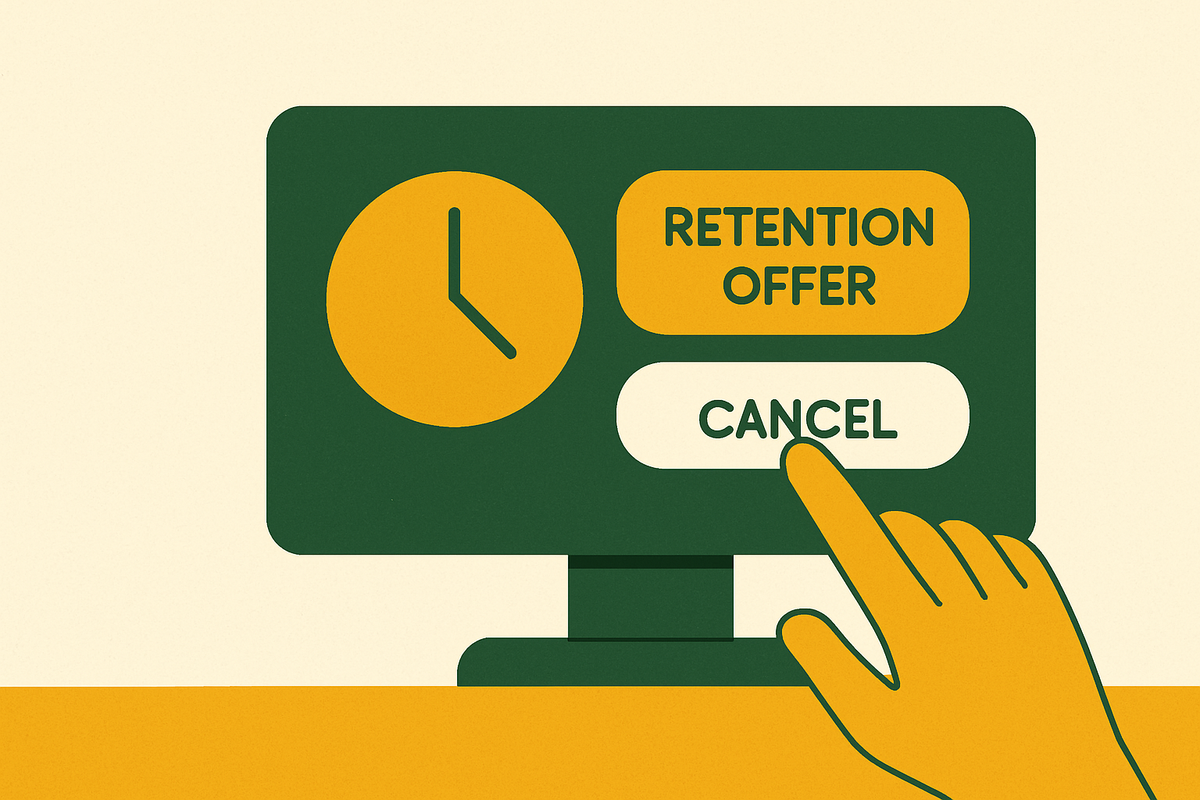
Pause Instead of Cancel as a Retention Mechanism
Pausing lets subscribers keep their price lock and account history while stepping away temporarily.
Canceling a subscription and pausing one are not the same decision, though most people treat them like they are. Pausing keeps the account alive, locks in the price, and lets someone come back without starting over. Canceling ends all of it, and getting back in almost always costs more than staying paused would have. The default move for most people is to cancel anyway, and that default is wrong more often than it's right.
The reason comes down to how people think in the moment they hit cancel. That moment almost never comes from a real verdict on the product. It comes from a logistics problem, such as a trip, a tight month, a backlog of unwatched episodes, or a schedule with no room for a gym class right now. Canceling feels final, like shutting a door. Pausing feels like propping it open. That gap is psychological, and it pushes people toward the option that costs more.
The mechanism itself has gone mainstream. Recurly's State of Subscriptions report found pause usage grew 66% year-over-year in 2024, which makes it a standard part of how subscription businesses expect customers to behave now, not some fringe feature. Yet the same report found only 37% of subscribers say they've actually had a pause option available to them. So most people end up choosing between staying subscribed and quitting outright, when a third option would serve them better. That gap, between what subscribers want and what actually gets offered, is where money quietly disappears. Someone who would've paused ends up canceling instead, loses their price, and often never comes back at all.
Pausing deserves to be treated as a right worth knowing about, not a courtesy some companies happen to extend.
What a subscription pause actually does to your billing and account
Pausing is its own billing state, with its own mechanics. Worth knowing exactly what changes and what doesn't before using it, since the details differ from what most people assume.
The subscription stays fully active until the current billing cycle ends, since whatever's already been paid covers access through that period. Once the cycle closes, the account shifts into a paused state: no new charge goes out, no box ships, no renewal fires. Behind the scenes, the account's data usually stays intact, meaning saved preferences, history, and the subscriber's existing pricing tier don't reset.
The last point, which people underweight, is the real payoff. A paused subscriber typically keeps:
- The price locked in before the pause, often a significant financial benefit of the arrangement
- Account history, saved content, progress, and, depending on the service, other account-level benefits
- A simpler path back in, without having to start the sign-up process from scratch
What they give up is simpler: active access to the paid tier for as long as the pause lasts. Some services soften that with a limited or freemium version during the pause window, so it's worth checking what, if anything, stays usable before locking in a full stop.
Pauses aren't indefinite. Most businesses cap them, commonly at one month, three months, or a set number of times per year, though seasonal products sometimes allow longer windows. When the pause runs out, the subscription auto-resumes and billing restarts on its own. A well-run service sends a reminder before that happens and states the upcoming charge clearly. A poorly run one doesn't, and that silence is exactly where the trouble starts.
Compare that to the alternative: canceling, then coming back later. Re-enrolling often means signing up under different terms than before, and potentially losing saved data and progress along the way. The math rarely favors starting over, and yet starting over is what most people default to.
The specific situations where pausing saves more money than canceling
Pausing works when the reason for stepping away is temporary. Canceling works when it isn't. Confusing the two is where subscribers lose money without realizing it, and the confusion runs in one direction far more than the other: people cancel things that were only ever a scheduling problem, not a verdict on the product.
Pause makes sense in cases like these:
- Travel or a move. Physical subscription boxes, meal kits, fitness studios: none of these are worth paying for if nobody's home to receive the delivery or make the class.
- "Life got busy." This kind of subscriber fully intends to return, the obstacle is time, not dissatisfaction with the product. A pause fixes the actual problem.
- Seasonal use. Software tied to a specific project, a hobby that only runs part of the year, tools mapped to a school calendar.
- Temporary budget pressure. A month or two of breathing room without sacrificing the price lock or the history built up over months or years of use.
Canceling is the right call in a narrower set of cases, and those cases should be named instead of treating every reason as equally valid. The service no longer fits how someone actually lives. A competitor has taken its place for good. Or the subscriber's paying for features they know, honestly, they'll never touch again. That's a much smaller set of cases than the volume of actual cancellations suggests, which is the whole point: the gap between "should cancel" and "does cancel" is where the money leaks out.
The math is simple once it's laid out. Pausing through a two-month gap and returning at the old price beats canceling, waiting two months, and resubscribing at whatever the current, likely higher, rate happens to be. That difference is often the entire discount a subscriber earned by staying loyal in the first place, gone in one bad click. Not a rounding error. A real loss.
Cinemark's Movie Club shows what it looks like when a company adjusts to this pattern instead of ignoring it. Member feedback indicated many people wanted to step back temporarily rather than quit for good, and Cinemark responded by making pausing a prominent option in its cancellation flow. That generosity is not a retention gimmick dressed up as something else. It's a company designing around how its members actually behave, and it's a good sign for anyone using the service.
Before hitting cancel on anything, run the check first. Is the reason temporary? Is there a price lock at stake? Does the cost of re-enrolling, in fees, in time, in lost data, outweigh the cost of just pausing for a bit? Most of the time, it does.
How to find and use the pause option, and what to do when it isn't offered
Finding the pause option usually takes less effort than people expect. It just helps to know where to look first instead of guessing.
Start with account settings or the billing section. Labels like "Pause Subscription" or "Manage Plan" are common. If that's not visible, try starting the cancellation process anyway, since a business following good practice will surface pausing as the first alternative the moment someone signals they want out. If neither shows up, contact support directly and just ask. Plenty of companies offer pausing without ever putting it in the interface at all.
Before accepting a pause, confirm a few things:
- The exact duration, and the date billing resumes
- Whether the current price is locked in for when the subscriber returns
- Any limit on how many times per year the account can be paused
- What level of access, if any, continues during the pause
- Whether a reminder goes out before the charge posts again
Get all of that in writing, both in the app and by email, so there's a record if something doesn't match what was promised later.
No pause option? There are still moves worth making before defaulting to a full cancellation. Ask about downgrading to a cheaper tier instead, which keeps the account alive at a lower cost. Ask for a temporary discount tied to the specific reason for leaving, travel, a tight budget, whatever it actually is. Recurly's data backs this up: 70% of subscribers say they'd reconsider canceling if offered a loyalty incentive. Failing that, canceling and tracking the re-enrollment window becomes the fallback, but expect to pay current pricing on the way back in, not the rate that got quietly left behind.
Pausing tends to show up on streaming services, fitness and wellness apps, SaaS tools, subscription boxes, and learning platforms. It's rarer, sometimes nonexistent, on annual contracts, services without real account-level billing, and some legacy telecom or insurance products.
What to watch for when the pause period ends, the billing moment most subscribers miss
The pause expiring is itself a billing event. Most subscribers don't see it coming, and that blind spot is where pausing quietly stops paying off.
On the resume date, the subscription restarts and a charge posts, often without the subscriber ever actively deciding to come back. The failure pattern plays out the same way almost every time: someone pauses, hears nothing meaningful during the pause window, mentally checks out, then gets charged on resume without ever reconsidering whether they want back in at all. The cancellation they were originally weighing never got resolved. It got postponed, quietly, until the moment it costs money again.
One media publisher running lifecycle experiments on subscribers with declining engagement saw a 6.3% lift in retention by reaching those subscribers before their intent to cancel became explicit. That's a lesson from the business side of the table, but it applies just as directly to the subscriber sitting on the other end of it: re-evaluating before the resume date, not after the charge lands, is the sequence that actually protects money.
A subscriber should be doing a few things proactively, and none of them are complicated:
- Put the resume date on a calendar the moment the pause is confirmed
- Decide, ahead of that date, whether to resume, extend the pause, or cancel outright
- Check whether anything's changed while the account sat idle: price, features, terms
There's a real irony buried in here. A subscriber who uses pausing correctly reduces the risk of paying for a service during a period they aren't using it. A subscriber who sets a pause and then forgets about it just creates a new unnoticed charge down the road, on a delay. The pause duration limits companies build in exist partly to guard against this exact outcome, an indefinite pause quietly converting back into a live subscription months after anyone was still paying attention.
Why subscription billing in general is hard to monitor without help
This pattern extends past any one subscription. It's really about how many of them the average household runs at once, and how few of those ever get looked at with any regularity.
Most people can't name every subscription on their credit card statement from memory. Plenty are auto-renewing quietly in the background, on cards nobody checks line by line each month. Recurly's research found that around 10% of subscribers who cancel an auto-renewal subscription say they'd actually rather have paused. That means a real share of all cancellations, not a rounding error, represent money walking out the door simply because nobody told the subscriber pausing was on the table.
Subscription sprawl doesn't get fixed with a single audit. It needs ongoing attention: free trials quietly converting into paid plans, prices creeping upward a dollar or two at a time, paused accounts resuming without warning, duplicate charges showing up after someone cancels and re-enrolls without realizing they'd been billed twice in the same month. Keeping track of pause dates, renewal dates, price-lock windows, and trial expirations across a dozen services adds up to real mental load. It only gets heavier as the subscription count grows, and for most households, it's growing.
The cost of that inattention shows up in hard numbers, not just annoyance. Per the National Financial Educators Council's survey of 1,200 Americans in December 2025, the average cost of financial inattention came to $948 in 2025, and subscription charges are among the routine expenses that contribute to that kind of loss.
Knowing pausing exists isn't enough on its own. Subscribers need some system for catching pauses before they expire, trials before they convert, and bills the moment they quietly go up, because memory alone won't do it.
How automated monitoring closes the gap that manual attention can't
Most subscribers already know pausing is possible. The real gap isn't knowledge, it's attention at the exact moment that matters, whether that's the pause about to expire, the price about to jump, or the trial converting on some ordinary Tuesday with no warning at all.
A standard budgeting dashboard shows what already got charged. It won't tell a subscriber that a paused account is three days from resuming. That gap, between a dashboard that reports the past and a tool that watches for the event before it happens, is the whole problem, shrunk down to one sentence.
Compass+ works this way. It monitors connected bank accounts, email, and subscription services in read-only mode, meaning it can't move money on anyone's behalf, only surface what it finds. That covers exactly the situations laid out above: subscriptions about to resume, free trials about to convert, bills that crept up without notice, pauses that didn't actually apply the way they were supposed to.
The read-only setup is what makes this work without handing over control to anyone. The tool can see a pause expiration coming and flag it, with no ability to act on the account itself. The subscriber still makes every decision. Getting an alert before a paused subscription resumes turns the resume-or-cancel choice back into something deliberate, made ahead of time, instead of something discovered after the money's already gone. That's the exact sequence the earlier section pointed to as the right one, just automated instead of left to memory.
Other tools cover pieces of this: personal finance apps, bank alert settings, calendar reminders. Each one works, technically, but each one also requires the subscriber to set it up correctly, service by service, then actually remember to check it. An agent running continuously in the background removes that second step entirely, which is usually the step that fails first.
Pausing a subscription is a legitimate financial tool, and one of the more underused ones available to consumers right now. It only works in someone's favor if there's a clock being watched. Watching it consistently, month after month, across every service, is exactly the part manual attention tends to fail at.