Retention Offer Timing in Cancellation Flows
Retention offers reveal how much profit margin companies hid in your price.
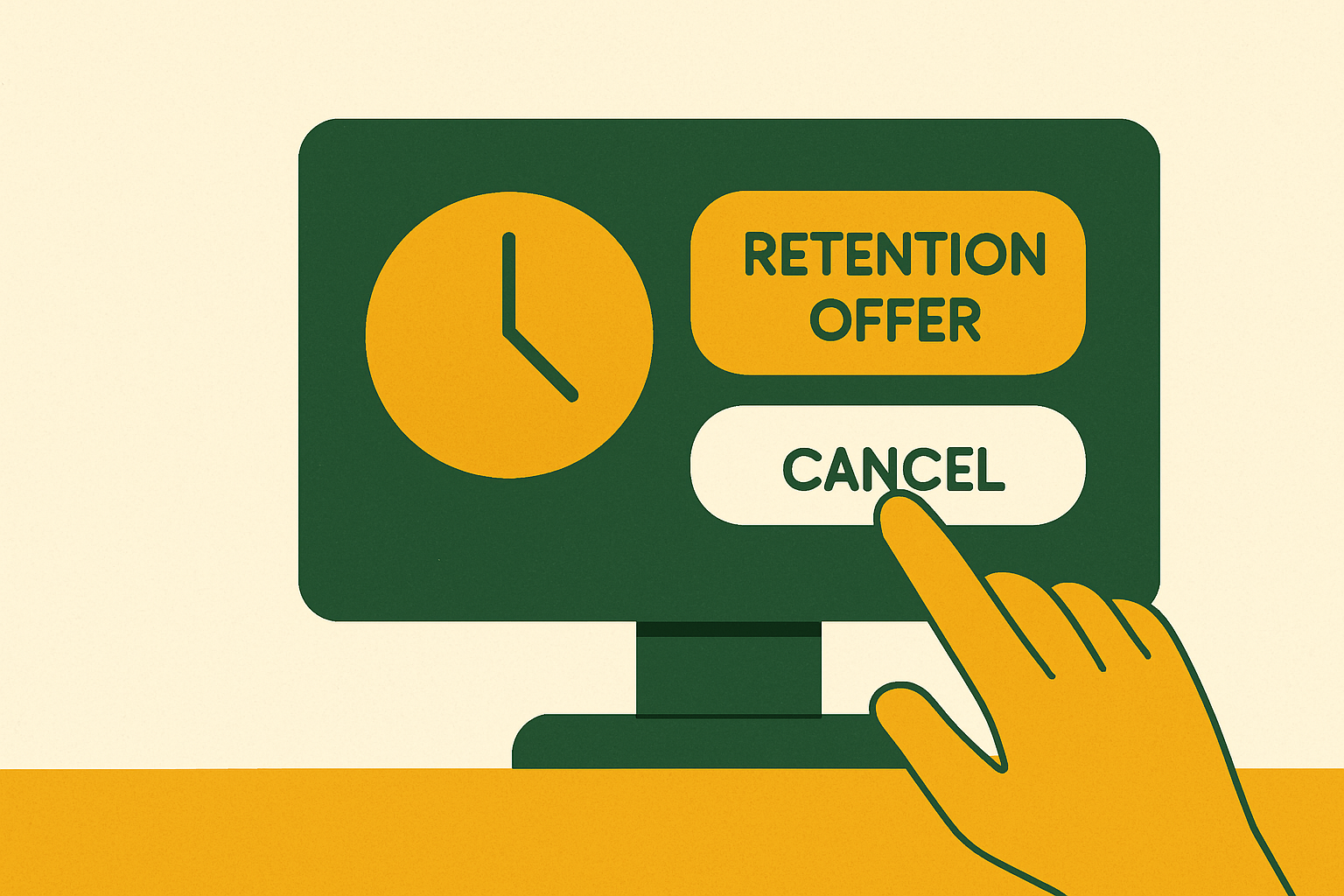
Every cancellation flow you hit is a diagnostic tool, not a wall. It fires the moment you say you want out, and what it offers you in that moment tells you something the company would never volunteer otherwise: how much room was baked into the price all along. Click cancel and you get a survey asking why, then an offer matched to your answer. Most subscribers read that sequence backwards, treating the discount as a favor. It's not. It's a cost of doing business the company absorbs to keep you from leaving.
What save rates tell you about how much margin companies are willing to give up to keep you
Retention platforms report save rates in a tight band, and the number matters more than it looks. Churnkey puts its platform average at 34% of subscribers saved once they hit the cancel flow. Stay AI reports brands using its Cancellation Flows tool seeing 30 to 35% save rates.
A company willing to hand a discount to a third of everyone who tries to leave has already priced that giveaway into the business. It is a line item, budgeted the same way payroll or hosting costs get budgeted, rather than a surprise expense.
The reason it's affordable comes down to simple math: retaining an existing customer costs somewhere between 5 and 25 times less than acquiring a new one, according to Recurly. That gap funds the discount sitting behind the cancel button. Don't mistake it for a gesture of goodwill. It's real money the company already decided to spend, just not until you asked for it.
Why the survey step is the mechanism that makes the offer land
Skip the survey and jump straight to a discount, and the save rate drops. The stronger flow asks why first, then routes you to an offer built for that specific reason. Price sensitivity gets a discount or a downgrade. "Not the right time" gets a pause. A missing feature routes you to a customer success call instead of a coupon. Too much product arriving too often gets a delayed shipment or a change in cadence.
Offer someone 50% off when they're leaving because they're too busy to use the product, and you've solved nothing. Time was the problem, not price. The survey step exists to catch that mismatch before it happens, and skipping it is the mistake a lot of companies still make.
There's a quieter number buried in this: 19% of cancellations happen because subscribers simply don't know they can adjust timing, contents, or frequency, per Ordergroove's research. Those people aren't dissatisfied. They never saw the setting. Surfacing that option at the cancel moment recovers a chunk of churn that never needed a discount, it needed a different button.
The survey is really asking you to self-diagnose. Answer honestly, and the company routes you toward the offer built for your actual objection. But answer honestly, and you're also handing over free product intelligence the company will use going forward, with no visibility into how many other people gave the same answer or what offers exist behind doors you never opened.
The pause option: the retention lever most subscribers never know exists
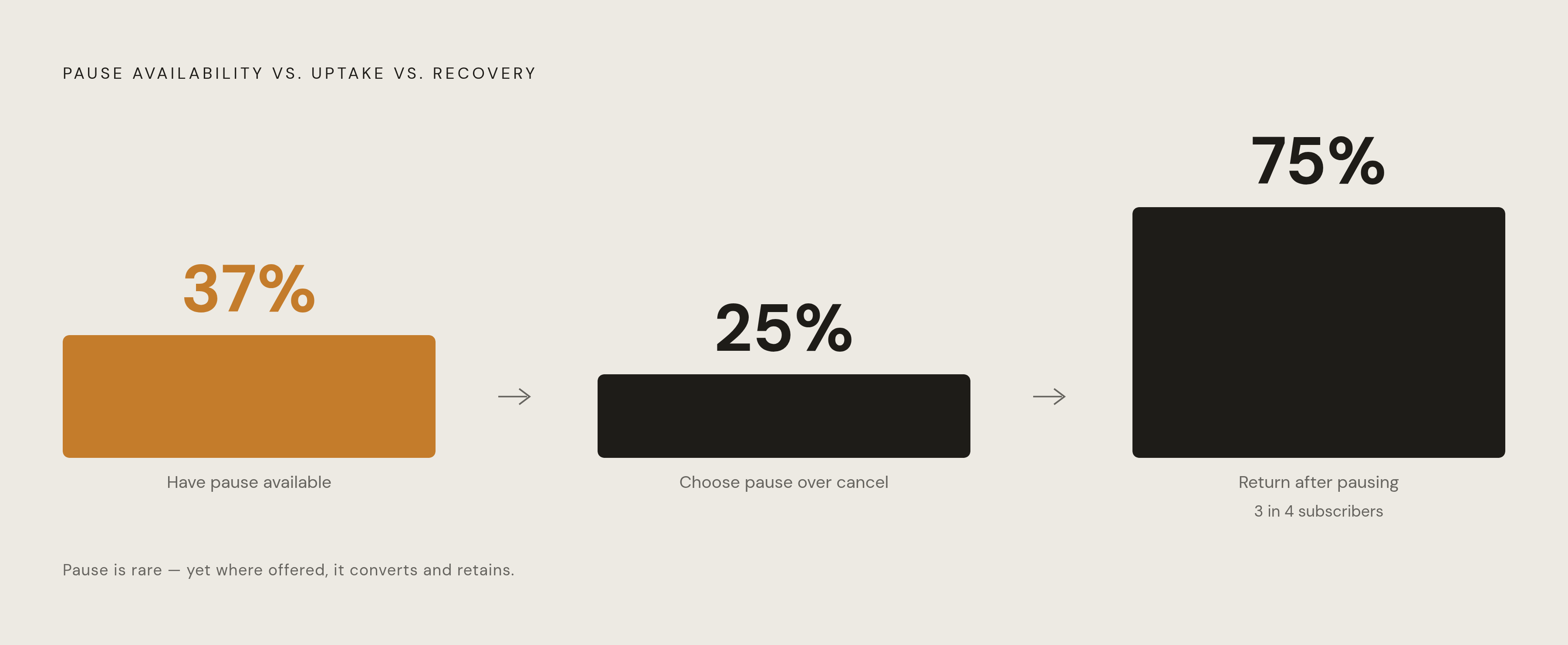
Pausing a subscription costs nothing and keeps everything intact, yet most people never see it as an option. Only 37% of subscribers report having a pause option available to them at all, according to Recurly, even though businesses that do offer pausing see 25% of would-be cancellers choose it over quitting outright. That gap, between how rarely pause gets offered and how well it works when it is, is the single most underused lever in this entire system.
The effect compounds from there. Brands that introduce a "pause before cancel" step saw pause usage jump 337%, and three out of four of those pausers came back within a few months, per Recurly. Across the industry, enabling pause has generated more than $200 million in re-subscription revenue.
None of that value reaches the subscriber who just stops logging in and lets the charge run. Pause only shows up inside the cancellation flow itself, so anyone who quietly ghosts a product instead of formally canceling never sees the option at all. Silence costs you money that a five-second click would have saved.
Stay AI's research describes a stacked logic behind these offers. If a subscriber doesn't take a delay, offer a swap. If not a swap, offer a discount. Pause leads because it protects the company's margin while still solving the subscriber's actual problem, which is usually timing, not money. Almost too simply, reaching the cancellation flow, even with zero intention of canceling, surfaces options tucked away outside the normal account settings page.
How companies read your behavior weeks before you reach the cancel button
By the time you click cancel, the company has usually been watching for weeks. Userpilot describes a three-layer system. More than a month out, behavioral signals accumulate quietly: billing page visits, feature abandonment, logins that produce zero outcomes. Two to four weeks out, customer success teams reach out proactively, while there's still enough motivation left in the subscriber to fix whatever's wrong. Only at the actual cancel click does the formal flow kick in, and by design, it only works on whoever makes it that far.
Here's the gap that matters: 96% of unhappy customers leave without ever saying why. They don't complain, they just stop engaging, and eventually either notice the charge and quietly cancel or keep paying for something they've already abandoned in practice. The cancellation flow only reaches the 4% who cared enough to say something out loud. The behavioral monitoring that happens weeks earlier exists to catch the other 96% before they go silent for good, a piece most subscribers never think about, since the company was already reacting to you before you ever touched the cancel button.
A visit to the billing page carries weight of its own. It's a signal, scored as one. If a company reaches out to you proactively after a stretch of low usage, that offer is drawn from the same retention budget as the one waiting behind the cancel button. Call it a pre-emptive save attempt, not a reward for loyalty, because that's exactly what it is on the company's side of the ledger.
Heading into 2026, this whole system is about to get less reliable. As AI agents start completing tasks through APIs instead of humans clicking through a dashboard, those accounts stop generating the session data companies rely on for engagement scoring. Userpilot notes this creates false positives, low-usage flags on accounts that are actually being used constantly, just not by a person sitting at a screen. The signals companies lean on are already imperfect, and that gap is only going to widen.
What the regulatory boundaries on these flows actually protect
The scale of manipulation here isn't subtle. Research into subscription platforms has found that dark patterns in cancellation flows are widespread, with the majority of services studied using at least one. Signing up for a subscription is typically far faster and simpler than canceling one.
Federal protection against this has been unstable, and that instability matters more than any single rule. The FTC's Click-to-Cancel rule was finalized in October 2024, then vacated by the Eighth Circuit in July 2025 in a case brought by a business communications company against the FTC. That leaves federal enforcement sitting back at the pre-2024 baseline, weaker than it was for a brief window last year.
States are the ones actually worth watching now. California's amended Automatic Renewal Law, effective July 1, 2025, allows companies to make a retention offer during cancellation, but only if a click-to-cancel option is shown at the same time, just as prominently. The offer can accompany the exit. It cannot replace it. California, New York, and Colorado all require that if you signed up online, you have to be able to cancel online too.
Amazon's case sets the practical benchmark for where the line actually sits. The company agreed to a $2.5 billion settlement in 2025, requiring refund distribution monitored by an independent third-party supervisor. That's what "manipulative" means when regulators define it in practice, not in theory.
The line, in plain terms: a retention offer sitting next to a working cancel button is fine. A flow that buries the cancel option, stacks extra screens in your way, or treats the offer as a toll you have to pay before you're allowed to leave is not. California's standard, one offer alongside a visible, simultaneous cancel option, works as a benchmark no matter which state you live in.
What the offer structure reveals about the subscription's actual price floor
TouchNote ran a test worth knowing about, reported in industry research: a 40% discount performed almost identically to a 50% discount in terms of save rate. The company had been giving away 10 extra points of margin for nothing, which is exactly the tell. These discounts aren't generous gestures pulled out of thin air, they're calibrated numbers, tested against real save-rate data until the company finds the smallest offer that still works.
Powtoon's experience points the same direction. Replacing a generic cancel survey with reason-specific offers took its save rate from 8% to 13%, and the improvement came entirely from better matching, not from offering a bigger discount. Precision beat generosity here, not budget, the part most companies get backwards when they assume a deeper discount is always the stronger lever.
The discount sitting at the cancel screen sits above the floor of what the company would accept to keep you. It's the number they've tested and confirmed retains a meaningful chunk of people trying to leave. Above that floor there's slack that was never going to reach you unprompted, and the only way to find it is to get to the screen where it lives.
Price sensitivity dominates the stated reasons for churn. Per Userpilot, 34% of churned customers said a simple discount would have kept them, and another 34% said a lower price generally would have changed their decision. That's two-thirds of voluntary churn tied to price in one form or another. If the company can afford to discount meaningfully the second you try to leave, the list price was only ever the opening one.
Not everyone sees the same number, either. Flows get segmented by tenure, order value, geography, and where someone sits in the subscription lifecycle, per Stay AI. A subscriber who's stuck around for three years may see a different offer than someone who joined last month. But the structure underneath holds either way: the cancellation flow is the single moment where the company's negotiating position is weakest and yours is strongest, built into the mechanism on purpose.
How to use this knowledge without turning every subscription into a negotiation project
Most people already suspect they're overpaying somewhere. Many subscribers already suspect they're overpaying for at least some of their subscriptions. Suspicion isn't the hard part. Acting on it is, because that takes remembering which service to check, when the moment is right, and what exactly to ask for.
Subscription overspend rarely happens as one bad decision. It happens slowly, one forgotten renewal at a time, which means it takes ongoing attention rather than a single cleanup pass.
A few concrete moves follow from everything above. Reach the actual cancellation flow before assuming the price you're paying is fixed, the offer waiting there is often better than anything a phone call to customer service will get you. Answer the exit survey honestly, since your stated reason decides whether you're routed toward a discount, a pause, or something else entirely. Treat any proactive outreach, an email or in-app nudge after a quiet stretch, as a signal pulled from the same retention budget as the cancel-screen offer, not as a reward for being a loyal customer.
The real obstacle is scale. Streaming, software, a gym app, news, food delivery, cloud storage: most households are running a dozen or more of these at once, and staying on top of every renewal date and price hike takes a kind of persistent attention nobody should have to maintain by hand.
That's the gap Compass+ is built to close. It watches subscriptions continuously, flags quiet price increases, catches free trials before they convert into charges, and surfaces the specific moment worth acting on, without requiring anyone to remember to go check. It stays read-only and passive by design: Compass+ doesn't cancel anything or contact a company on a subscriber's behalf. It identifies the moment and the dollar figure attached to it, then hands over a specific next step instead of a research project.
Retention offers only pay off for the subscriber who shows up at the right moment and asks. Compass+ exists to make sure that moment doesn't slip by unnoticed.
Sources
- AI and personalization in subscription retention: What’s next for 2026 and beyond
- Cancellation Flow Examples in 2026: What They Recover and What They Miss
- From cancel to keep: Best practices that retain subscribers | Ordergroove
- Boost Subscribtion Retention With Smarter Save Experiences
- Cancellation flow examples to reduce subscriber churn