Introductory Pricing and the Post-Promotion Price Jump
Companies use introductory pricing to delay revenue while making cancellation harder than signup.

Introductory pricing is a deliberately low rate offered for a fixed window, built to get you comfortable before the real price kicks in. The low number is the on-ramp; full price was always the destination, and most people who sign up have no real intention of paying it once it arrives.
Three structures show up again and again: the fixed-term promo rate (first month at a fraction of normal cost), the trial that auto-converts to a paid tier, and the extended promotional window that's stretched from one month to six months to a full year in digital subscriptions. Per Mather Economics' Q2 2025 benchmarks, longer intro periods mean a bigger share of the subscriber base sits on discounted pricing at any given time. That's a company choosing to delay the revenue ramp it already promised investors. The longer that window stretches, the harder the landing on both ends: for the business model, and for the person's bank statement.
None of this happens by accident, either. Companies show the "regular" price right next to the intro price on purpose. Research published in journals.sagepub.com found that this kind of reference pricing lifts a consumer's sense of what the product is worth, so the eventual full price feels earned rather than jarring.
Why the price jump catches people even when they knew it was coming
Most people sign up for an introductory rate fully intending to cancel or renegotiate before it ends. Then life happens, and the subscription just sits there, quiet, until the charge shows up.
Sign-up is built to be frictionless: one click, a saved card, done in under a minute. Cancellation almost never gets the same treatment. It asks for a login you've forgotten, a support chat, sometimes a phone call. The asymmetry between those two flows is the whole design, not a byproduct of it.
Timing does the rest of the work. Six or twelve months is long enough that the decision you made at sign-up has gone cold by the time the price changes. The mental accounting from month one, "I'm trying this out, I'll reassess," has evaporated by month nine. Per the journals.sagepub.com research, consumers process the promotional rate as a genuine saving and a reward for having tried the product, rather than as an obligation to keep reassessing. That framing is exactly why it works: it doesn't feel like a countdown, it feels like a win already banked.
Then there's comfort. Once a service gets woven into a routine, a streaming app before bed, a productivity tool at the start of the workday, cancelling starts to feel like more trouble than it's worth. Even when the math clearly favors leaving, habit wins. The post-promotion price jump is a behavioral trap that banks on the gap between what you intended to do and what you're actually paying attention to. That gap is the entire business model, not a side effect of it.
What consumers are actually spending, and what the jump is adding up to
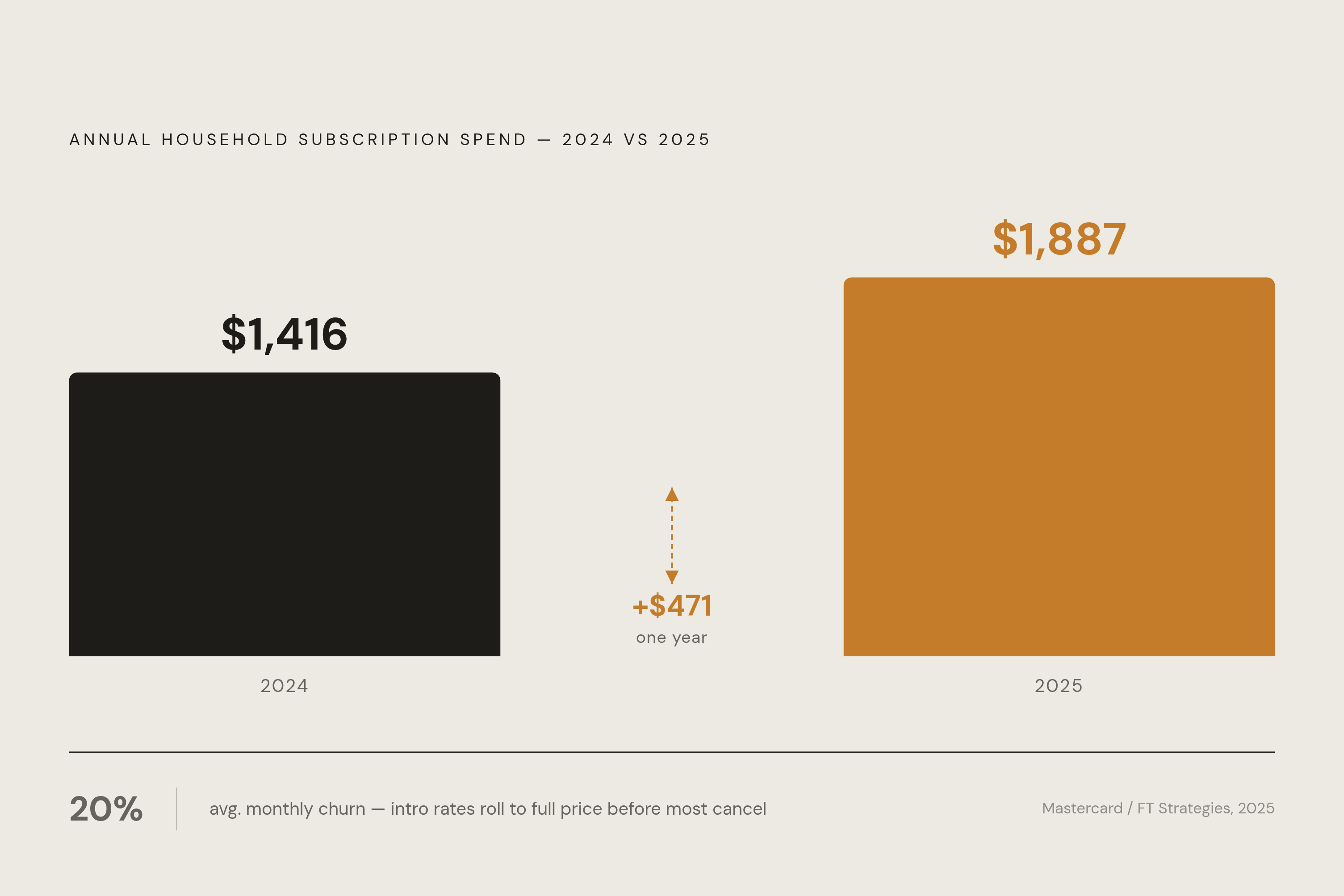
A 2025 Mastercard/FT Strategies report found 44% of U.S. consumers spent more on subscriptions in 2025 than the year before, with average annual spend hitting $1,887, up from $1,416 in 2024. That's $471 more per household in a single year, and not all of it came from choices anyone actually made. A meaningful chunk is intro rates that quietly rolled over to full price without a single decision behind them.
Churn fills in the rest of the picture. Average monthly churn rose to 20% per the same report, meaning a real slice of people pay full price long enough to feel it before finally cancelling. More than half of U.S. businesses report that at least 10% of their subscriber base is inactive, paying for something nobody's using, usually because the price hike wasn't dramatic enough to force a decision. Just annoying enough to create a low hum of dissatisfaction that never turns into action.
The people most exposed are the ones juggling several subscriptions at once, streaming, software, news, fitness, retail, each running its own promotional clock on its own renewal date. Layer in a tighter household budget and the math gets worse fast: unnoticed price creep against a fixed budget does more damage than it ever did against a loose one.
The industries where introductory pricing is most aggressive, and most likely to bite
Streaming leads the pack, mostly on volume. Multiple services, each running its own promo, each with a different end date, stack into a renewal calendar nobody actually tracks.
Software-as-a-service, personal productivity tools, cloud storage, password managers, tends to run annual billing with a year-one discount. The jump there lands as a single lump renewal charge nobody budgeted for. Eleven months is a long time to forget an annual charge exists.
Telecom and broadband promos usually lock to a two-year contract window, and the rate change shows up as a quiet line-item increase on a bill most people don't read closely enough to catch. Financial products carry their own version: introductory APR on credit cards, promotional rates on savings accounts, where carrying a balance through the end of the promo window can mean paying the full rate retroactively, depending on the card's terms. Retail subscription boxes round it out: low or free first boxes that convert to full recurring billing, often paired with a cancellation flow that seems built to be missed.
Here's a detail worth pausing on. Per Pricer24, once a product gets positioned as the budget option — a risk that steep intro discounts can create — consumers resist the later price increase even if they always intended to stay long-term. The discount doesn't just win the sign-up. It builds resistance to ever paying full price, which runs counter to what most people assume a good deal is supposed to do for them.
Regulation is starting to catch up, though not fast enough to matter yet. The FTC's Click-to-Cancel rule, with a compliance deadline of July 14, 2025, requires cancelling a subscription to be just as easy as signing up for one, across consumer and business arrangements alike. Enforcement so far has been uneven, and uneven enforcement is worth exactly as much as no enforcement to the person still stuck on hold with a retention agent.
Reading the fine print before the price changes, what to look for
Three questions matter before hitting "subscribe," not after the charge hits. What's the actual dollar amount after the promo ends, not the percentage off? Exactly when does the intro period end, and will there be a reminder before the new rate kicks in? Can cancellation happen online, or does it require a phone call or a chat window that never quite loads?
Notification practices are all over the map. Some companies send a clear renewal reminder days ahead. Others bury the rate change inside a terms-of-service update email, or say nothing at all. Under the FTC's updated rule, sellers are required to make cancellation as easy as sign-up, and to clearly disclose the terms of any negative option arrangement before the charge hits. That raises the floor, though a gap between knowing and doing still remains.
The simplest defense is still low-tech: a calendar reminder set two to three weeks before the promo period ends, enough runway to evaluate, negotiate, or cancel without scrambling. Chargebee's 2025 survey of 1,454 consumers found 82% consider easy cancellation a prerequisite before they'll even subscribe in the first place. People already know the risk going in. What's missing is follow-through.
One more practical note: subscriptions charged to a credit card are generally easier to dispute or freeze than ones pulled straight from a bank account. That's a choice made once at sign-up that keeps leverage available months later.
Catching the jump after it's already happened, what you can claim and how
Missing the window doesn't mean the fight's over. Plenty of companies, worried about retention, will match a competitor's current intro offer or extend a promotional rate for a loyal customer who simply calls and asks.
Retention offers are common precisely because that 20% average monthly churn rate scares businesses. A cancellation attempt frequently unlocks a discount that was never advertised anywhere on the site. Some retailers and credit card issuers also run price-drop protection programs, refunding the difference if a purchased product's price falls within a set window, typically a week to two months, though some credit providers stretch that to 90 or 120 days.
On the subscription side specifically: if a rate increased mid-term without proper advance notice, a chargeback or billing dispute may be justified, and the FTC's clear-disclosure requirement is the relevant protection to cite.
Pausing is underused, and it shouldn't be. More subscription companies now offer a pause or downgrade option specifically to keep price-sensitive customers from leaving outright. Asking for a pause instead of a full cancellation often produces a discount or a hold period while keeping access intact. Per Chargebee's 2025 data, 78% of consumers say flexibility in their subscription terms is very or extremely important to them, and companies that know this build retention offers around exactly that expectation. That's leverage worth using before defaulting to cancellation.
The single most useful habit for any future dispute: save the original promo terms at sign-up. A screenshot of the sign-up page or the confirmation email establishes what was actually promised, which matters a great deal when a company's story changes later.
Why manual vigilance isn't a realistic long-term solution
Managing a handful of subscriptions across different billing cycles, renewal dates, and promotional windows is a coordination problem more than a discipline problem. No spreadsheet solves that at scale once the count climbs past a handful, and the whole system falls apart quietly once it does.
Subscription sprawl isn't a one-time mess to clean up. It's a permanent condition. New services get added constantly, promo periods stagger unpredictably, and the landscape shifts under you every month. Per Chargebee's 2025 survey, 80% of consumers have no plans to cut back on the number of subscriptions they use, despite churn and cost concerns. The realistic goal is managing the subscriptions already in place without having to think about each one individually, all the time.
Calendar reminders and manual price checks hold up fine for one or two subscriptions. They fall apart at five, ten, fifteen, because the mental load grows faster than the savings from catching any single price hike seem worth. Most personal finance tools, budgeting apps, spending trackers, bank dashboards, only show what already happened. None of them flag that a promo ends in twelve days, or that a subscription nobody's touched in four months is about to renew at a higher rate.
What's missing isn't more data. It's a system that notices the right thing at the right moment and says exactly what to do about it, without requiring anyone to go digging first.
Tools and approaches that monitor promotional periods without ongoing effort from the user
Subscription management platforms connect to bank accounts and cards to surface recurring charges in one place, useful for a snapshot audit of what's currently being paid. Price-protection services scan purchase receipts against retailer policies and can trigger refunds when a one-time purchase drops in price, though that scope is narrow: it covers retail price drops, not subscription rate hikes.
Worth knowing too: subscriptions bought through Apple's App Store have to be managed and cancelled through Apple's own subscription settings, not through the app developer directly. That trips people up more often than it should.
The gap across most of these tools is the same, and it's the whole problem in one sentence: they show what's being charged, but they don't flag that a promo rate is about to expire, that a dormant subscription is renewing at a higher price, or that a bill has quietly crept up since last month. Compass+ is built around closing that specific gap, watching for the exact moments money is about to leave unnoticed: free trials converting to paid, promotional periods ending, bills increasing, duplicate charges piling up. Each finding comes with a dollar figure and a next step.
The read-only setup matters more than it sounds like it should. Compass+ can see what's happening in an account without ever being able to move money out of it, the same principle behind Plaid's infrastructure, where authentication is handled through Plaid's own security standards for connected accounts, without handing over credentials directly.
Here's a distinction that matters, and most tools in this category get it wrong. A tool that reports a subscription cost a set amount last month is doing half the job. A tool that adds that the same subscription jumps to a higher rate next Tuesday, and that the account hasn't logged in for six weeks, is doing the half that saves money before it leaves the account. Whatever tool gets used, the habit underneath stays the same: treat every introductory offer as a commitment that needs an exit plan from day one. The tools just make sure that plan still fires when attention, inevitably, drifts somewhere else.