Subscription Cost Underestimation by Consumers
Most people underestimate their subscription spending by over $1,500 yearly.
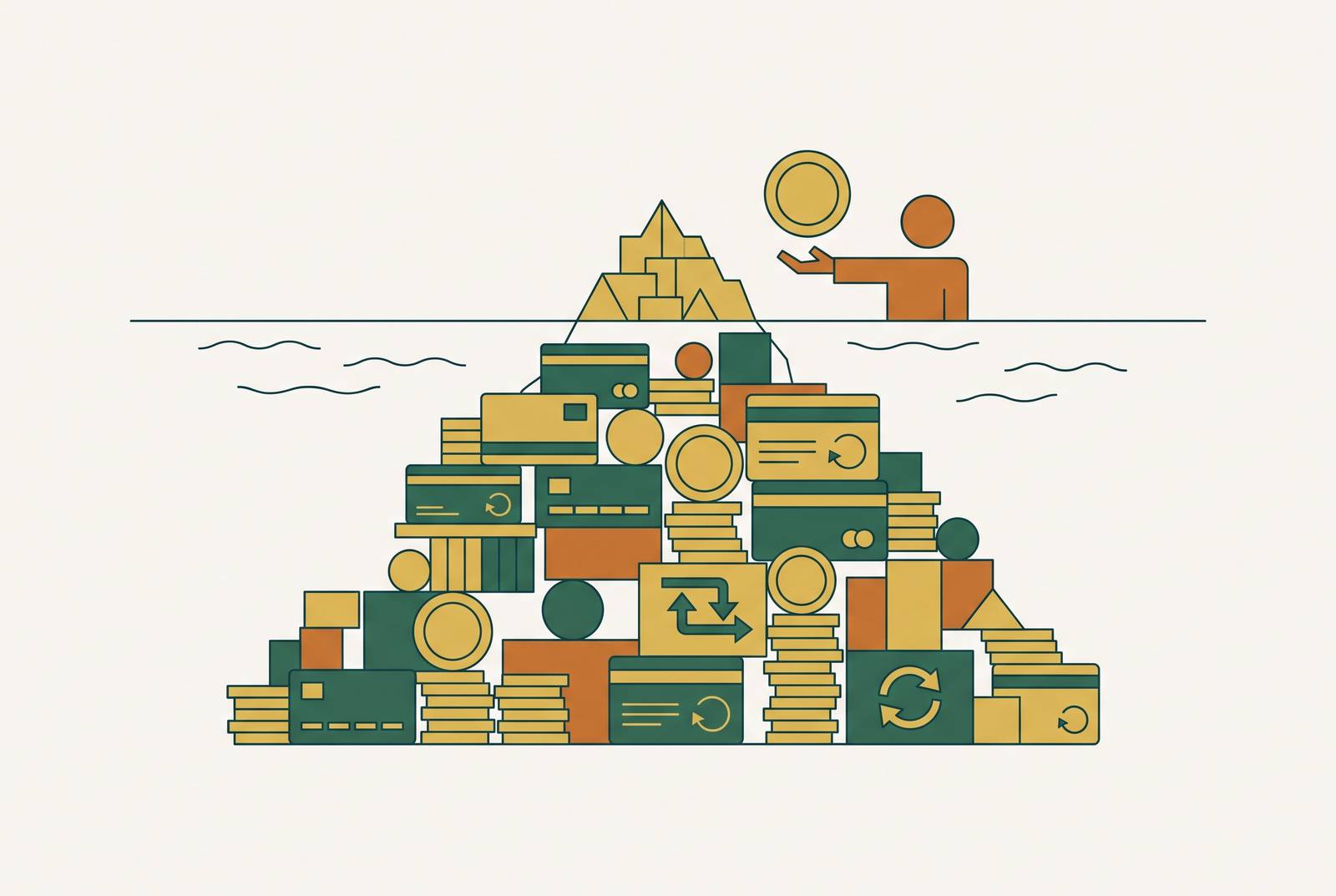
Subscription billing is built so no one ever sees the full number in one place. That's the whole trick, and it's why the gap between what people think they spend and what they actually spend runs into the thousands of dollars a year. This is a design problem engineered into how spending stays hidden. It's a structural one, engineered by the companies collecting the money, and once you see the mechanism, the fix stops looking like "try harder to remember" and starts looking like a system correction.
The size of the gap between what consumers think they spend and what they actually spend
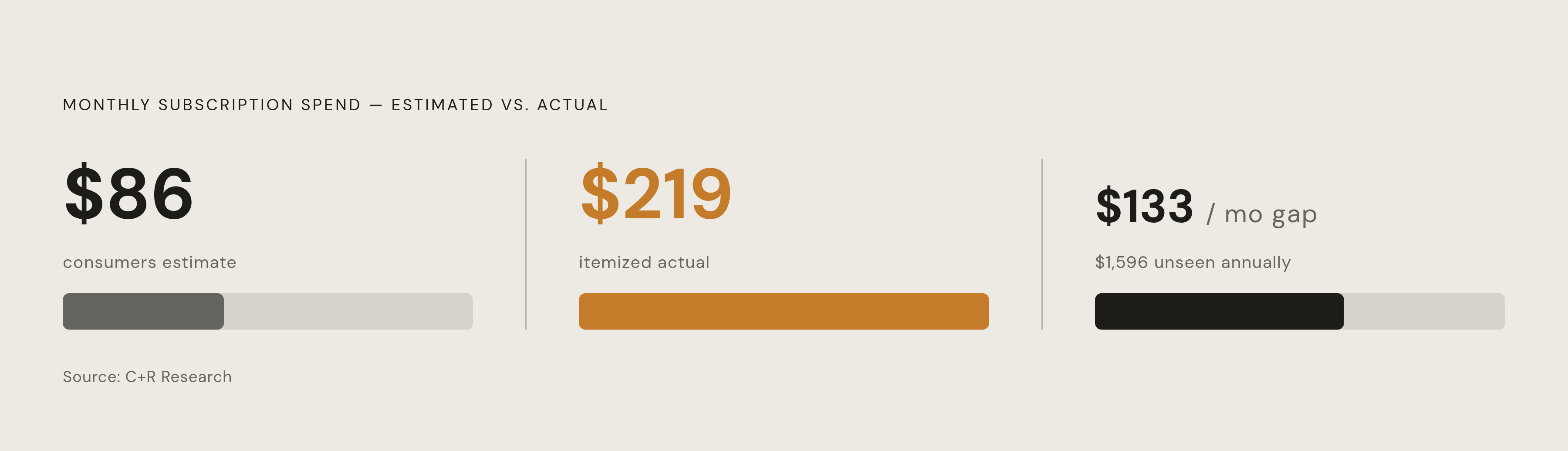
C+R Research put a number on it: consumers estimate $86 a month in subscriptions. The real itemized total comes to $219. That's a $133 gap every month, compounding to $1,596 a year, per person. West Monroe found the same shape of problem from a different angle, finding 89% underestimated their monthly total, with 66% off by more than $200 a month.
Three research groups, three methodologies, and the number lands in the same place every time. That consistency is the actual finding here, more than any single figure. It means the gap is a structural feature that appears regardless of one survey's phrasing. It's a structural feature of how subscription billing interacts with how people track money, which is to say: barely.
The error doesn't cluster among power users running a dozen apps, either. C+R Research found it spread evenly across the population, with almost a third of people underestimating by $100 to $199, and nearly a quarter off by $200 or more. Most consumers simply say recurring charges are easy to forget. Take that admission at face value, because it points straight at the mechanism behind the whole problem.
The stack's continued growth despite consumer efforts to cut back
Autopay is the design choice that matters most. It removes the one moment when handing over money actually feels like handing over money. Once a card sits on file and billing runs automatic, there's no friction left, no decision point, nothing that registers as a transaction in the moment it happens. That's the default setting for how most people manage recurring bills, and it means the psychological signal that normally accompanies spending gets switched off by design.
Layer staggered billing on top of that, and the picture gets worse. One charge hits a card on the 3rd through one payment network. Another hits a different card on the 17th. A third runs through an app marketplace and never becomes visible on a bank statement at all. No single document ever displays the full total, so nobody sits down and sees $219 in one place. They see $6.99 here, $12.99 there, amounts too small to trip the same mental alarm a lump-sum charge of equal size would set off.
Sign-up takes one click. Cancellation, in plenty of cases, takes several screens, an "are you sure" prompt, sometimes a retention offer, sometimes a phone call. That asymmetry is the product of deliberate design choices. It's the business model.
Annual renewals compound the problem, landing once a year on a date nobody's tracking, often long after anyone's stopped thinking about the service at all. Free trials feed the same pipeline: per Self Financial, most consumers say they've forgotten to cancel a trial at some point and gotten converted to paid without meaning to.
Subscription counts are falling, and that should actually surprise you. Self Financial's data shows households went from 4.4 subscriptions in 2023 to 4.1 in 2024 to 2.8 in 2025. People are cutting back, genuinely. Yet total spend barely moves, because the price per subscription keeps climbing to cover the gap. Individual streaming prices have climbed sharply over the past decade, more than doubling in some cases, over the exact stretch when consumers were actively trimming their lists. Deloitte's 2025 Digital Media Trends survey found the average household now pays for four streaming services at a combined $69 a month, up 13% year over year, and that figure doesn't even touch music, gaming, fitness, software, or delivery memberships.
AI tools are the newest front in the same fight. Bango surveyed 2,000 AI subscribers in November 2025 and found the average user pays for roughly four AI tools at about $66 a month combined. More than half said they cancel and restart tools as their budget runs dry. That's cancellation driven by chaos, not discipline. That's chaos with a bill attached.
Among forgotten subscriptions, the most common categories are mobile phone plans (31%), internet service (30%), streaming (22%), and Amazon Prime (16%). These are infrastructure-level products that get mentally filed under "fixed costs" and stop getting questioned. Trimming the subscription count is a one-time act. Prices rising and new categories entering the stack never stops, so the gap reopens the moment the audit ends.
The billing model's dark patterns in practice and the regulatory response
The FTC's amended complaint against Uber alleged enrollment without express informed consent, including through a "Try for free" button, plus charges landing before free trial periods ended, and a cancellation flow requiring as many as 23 screens and 32 separate actions. Twenty-three screens to leave. That number alone tells you the flow wasn't an accident of bad UX.
In December 2025, Instacart agreed to pay $60 million in consumer refunds to settle FTC allegations of false advertising and ROSCA violations, specifically for failing to disclose that a free trial would auto-convert into a paid annual subscription. In January 2026, the FTC sued JustAnswer, alleging consumers believed they were paying a small one-time fee and instead got enrolled in a recurring monthly charge without ever affirmatively agreeing to it.
The federal Click-to-Cancel Rule, which would have required cancellation to be no harder than sign-up, got vacated by the Eighth Circuit on July 8, 2025, on procedural grounds. The FTC restarted its negative-option rulemaking in March 2026, so the fight continues. It's just back at square one. States are moving faster in the meantime: California updated its auto-renewal requirements effective July 1, 2025, with language covering free-to-paid conversions directly, in some respects reaching further than the vacated federal rule ever did.
None of this is speculative. These are documented, adjudicated, or actively litigated patterns, and they confirm something specific: the confusion consumers feel about their own spending is the intended output of the system. It's the intended output of a billing architecture that regulators are now working to dismantle piece by piece.
Consumers have noticed, and they're saying so with their wallets. Chargebee's Global Consumer Insights report, surveying 1,454 consumers, found 82% say easy cancellation is a requirement before they'll even consider subscribing to something new. Demand for transparency is a mainstream expectation now. It's measurable, and it's rising fast enough that regulators and companies both have to answer for it.
How spending breaks down across generations and where the hidden waste concentrates
Gen Z spends more on subscriptions than any other generation, around $377 a month. CNET's survey found Gen Z also wastes the most on subscriptions sitting unused, about $23 a month, or $276 a year, doing nothing. Millennials average roughly $276 a month in total subscription spend, though CNET found that number dropped meaningfully year over year as economic pressure pushed more people to cancel.
Mastercard's report with FT Strategies found average annual subscription spend climbed to $1,887 in 2025, up from $1,416 in 2024. That's a substantial jump per person in a single year, landing at a time when plenty of people believe they're spending less.
Self Financial's survey found almost 60% of consumers have at least one paid subscription sitting unused every month, averaging more than two idle subscriptions per person. The forgotten categories track the same pattern seen everywhere else in this data: mobile phone (31%), internet (30%), streaming (22%), Amazon Prime (16%). Yet the subscriptions persist anyway.
High spend, low perceived value, high forget rate. That's not a coincidence of consumer behavior. That combination is exactly the condition the billing model depends on, and no amount of individual discipline changes the condition itself.
The one-time audit's temporary gap closure and the architecture's reopening of it
The standard advice works, for a moment. Scan the inbox for old receipts, pull several months of credit card statements, list every recurring charge by category. Done properly, this kind of audit tends to trigger a mass cancellation, because seeing the itemized total next to what someone thought they were paying is genuinely jarring. It should be.
But the conditions that created the gap don't go anywhere once the spreadsheet closes. Autopay is still the default. Billing is still fragmented across five cards and three platforms. New services keep entering the market with the same one-click sign-up and the same maze of a cancellation flow. An audit is a snapshot, not a system, and snapshots go stale the day after they're taken.
Mastercard and FT Strategies found average monthly subscriber churn has risen to 20%, and more than half of businesses report at least 10% of their subscriber base sits inactive. Businesses already price in the assumption that people forget. Call it what it is: not cynicism, just economics. The subscription model is profitable in large part because audits don't happen continuously, and every company collecting recurring revenue knows it.
Fatigue is measurable. Marketing LTB found 41% of consumers report subscription fatigue, and many streaming subscribers have canceled at least one service specifically because of it. But fatigue doesn't fix the underlying problem. It produces a burst of cleanup that fades before it becomes sustained vigilance, and then everyone drifts back to autopilot. Meanwhile the free-trial pipeline keeps refilling the stack behind them: RevenueCat's State of Subscription Apps report found a 4.8% average free-trial-to-paid conversion rate across mobile apps. Businesses are, in effect, banking on the gap between the moment someone signs up and the moment they notice they're paying.
Most people say recurring charges are easy to forget, and that's not a character flaw. It's evidence the monitoring task itself doesn't match how people actually live. Closing the gap for good means monitoring that runs at the same frequency as the billing itself: continuously, not annually, not "whenever I remember to check."
Gaps that ongoing, automated monitoring can catch that periodic audits miss
A handful of leakage categories only become visible if something is watching all the time, not once in a while.
- Subscriptions that quietly lapsed into the background after sign-up and never got touched again
- Free trials approaching conversion, where the cancellation window is short and easy to miss
- Price increases on existing subscriptions, the same slow creep that can more than double a subscription's price across a decade of small, unremarked steps
- Duplicate charges for the same service, often split across two payment methods so it never looks duplicate on either statement
Dashboards that show recurring charges after the fact solve maybe half the problem. A person still has to go looking, notice the pattern, and act on it. Something built to surface findings before anyone goes looking flips that dynamic entirely: instead of a person hunting for the leak, the leak appears in front of them, with a dollar figure attached and a next step already specified.
Tools built for continuous monitoring, for instance, can connect to bank accounts, email, and subscription services in read-only mode, and surface findings before anyone goes looking, presenting each as a specific number and a specific action."
Read-only access is what makes this trustworthy instead of risky. A tool that can see an account without being able to move money inside it is a fundamentally different proposition than one that needs write access to function, and that distinction matters more than most people give it credit for. Connecting more accounts is the level of access the job actually requires. These include bank, email, and subscription logins. It's the context required to catch something a single-account view would never find on its own. Apple subscriptions, for one, have to be canceled through Apple directly rather than through the app developer's own website, a platform quirk that trips up more people than it should.
The billing model runs every day: on autopay, across staggered dates, through fragmented statements that never show the whole picture at once. Whatever actually closes the gap has to run on that same schedule. The $133 monthly difference between what people think they're spending and what they're actually spending doesn't shrink on its own, and the companies collecting it are counting on exactly that.
Sources
- Subscription Fatigue: Reasons and How to Prevent It
- Most Americans guess they spend $86 a month on subscriptions, but an itemized tally comes back at $219, and a separate West Monroe survey finds 89 percent of consumers underestimate their monthly total
- The 30 Must-Know Subscription Economy Statistics in 2024
- Subscription Spending Statistics (2026): What the Data Shows
- How Much Does the Average American Spend on Subscriptions?
- readless.app
- self.inc