Why Apps That Find and Cancel Subscriptions Still Run Into Dark Patterns
Subscription trackers find forgotten charges, but services' dark patterns still block the exit.

Subscription-tracking apps help you find forgotten recurring charges in one place, but finding a subscription is not the same as canceling it. Bank-connected tools automate discovery, while manual-entry tools avoid sharing bank data. Finding charges with either tool leaves the dark patterns in the service’s cancellation flow in place. The best way to protect yourself is to keep watching for charges and get proof that cancellation worked.
How subscription businesses are built to resist cancellation
A subscription business has a financial reason to make leaving harder than joining. Even small reductions in churn, the rate at which customers leave, can have an outsized effect on customer lifetime value and recurring revenue. An unfinished cancellation preserves another payment.
Signup is refined through repeated testing and optimization, while cancellation rarely receives the same rigor. The exit may lead to a support inbox or a phone queue. Researchers call this the “roach motel” model. It is easy to enter and difficult to exit, and the imbalance is a revenue mechanism.
The same logic helps explain why actual subscription spending can exceed what people think they spend. The way businesses set prices and renew subscriptions keeps each charge small enough to go unnoticed even as the total grows. Each charge looks easy to set aside. Once a customer sees how much it all costs, the business still controls how they can leave. A tool built to expose spending therefore confronts both an information problem and a business incentive to obstruct the response.
What dark patterns in cancellation flows actually look like
Harry Brignull coined the term “dark pattern” and launched the original site in 2010. The term goes beyond confusing design to name interface techniques that push people toward choices they would not freely make. The distinction is important because the techniques are repeatable. The EU Digital Services Act and the California Privacy Rights Act use these terms, so these practices now face scrutiny under the law.
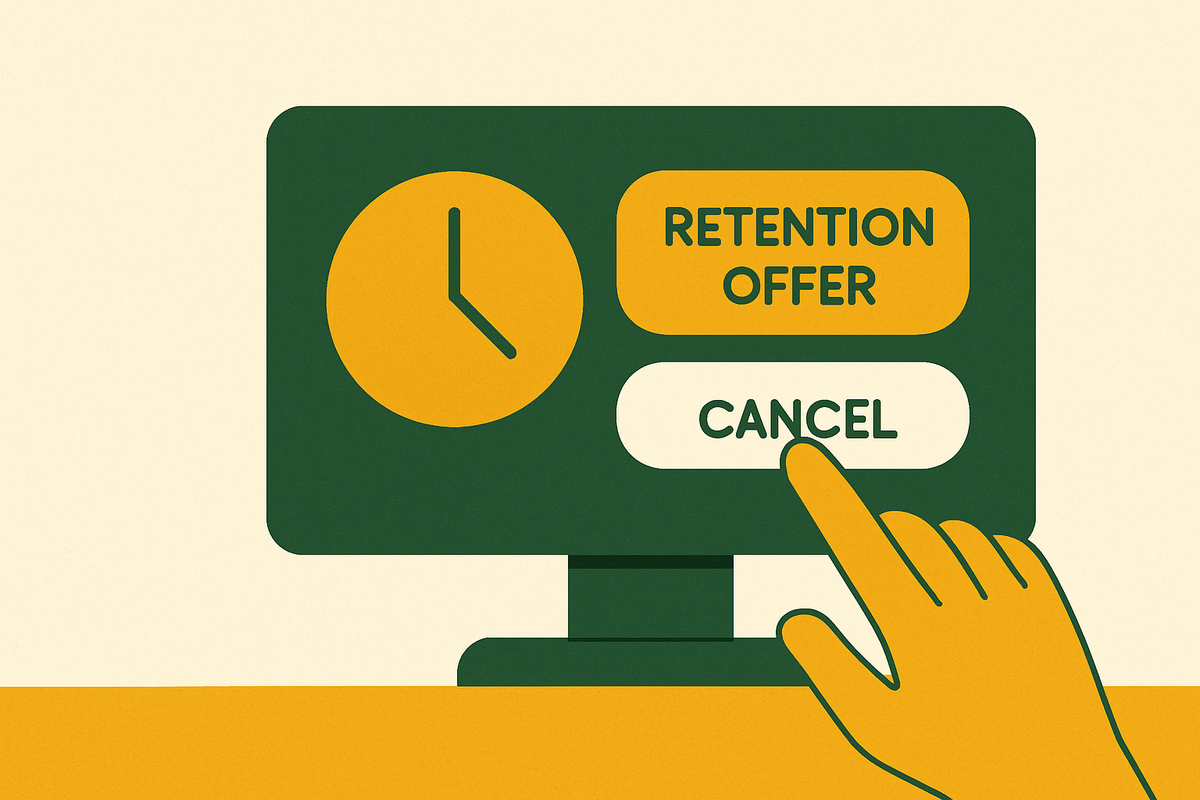
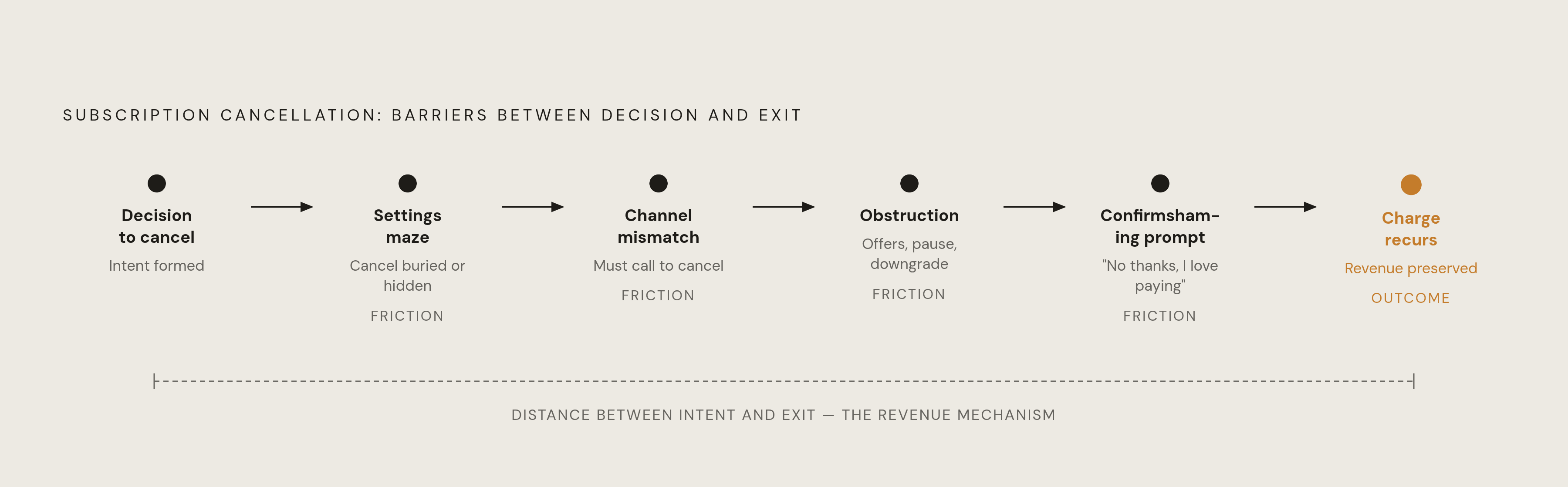
In cancellation, the “hard to cancel” pattern can look like a settings maze in which the exit is buried. Channel mismatch puts another hurdle in the way when customers must call to end something they bought online. The customer must change channels to leave. Obstruction adds steps between the choice to leave and actually leaving, including one retention offer after another, pause options, and downgrade redirects. These patterns impose work after the customer has already decided what to do.
Confirmshaming works on the choice itself through labels that make declining an offer or canceling feel like an unflattering admission, exploiting identity and loss aversion. A customer who only wanted to stop paying must now push past a prompt designed to make that decision feel wrong.
A sweep by 27 authorities across multiple countries found that a large majority of subscription websites and apps used at least one possible dark pattern, and most used more than one. Sneaking and interface interference were the most common techniques. Sneaking hides information or shows it late, while interface interference includes choices already selected to suit the seller. The finding leaves open whether every instance violated the law.
What apps can help you find and cancel forgotten subscriptions?
Bank-connected subscription trackers read transactions to find recurring charges. Their useful output is a list of subscriptions, amounts, and renewal dates. The list shows what the user forgot they were paying for, without making them recall each signup. For someone trying to stop unwanted recurring charges, this is real progress. A cancellation decision cannot begin until the charge is noticed.
Automatic discovery comes with a data tradeoff. A bank-connected app needs access to the complete transaction feed. Reputable apps use read-only, API-based access rather than direct credential sharing, although some bank connections still route credentials through an aggregator when OAuth is unavailable. The app can see account data but cannot move money or change settings, a different risk profile from older screen-scraping methods.
Manual-entry alternatives avoid the bank connection and keep data local to the device. In exchange, the user must populate the record. Neither approach removes the need to act. An identification-only tool ends with a useful inventory, while the decision to cancel and the work of completing cancellation remain with the user.
Tools in this category differ in whether they merely identify a charge or do anything beyond identification. Those are different promises to a buyer. A clear list can reduce the search work substantially without giving the app any power over the service’s exit process.
Where the handoff from tool to user breaks down
A tracking tool operates on the user’s side of the transaction, where it can surface charges and renewal dates. The cancellation flow belongs to the service. Once the user follows through on a finding, the tool’s useful information meets an interface it cannot intercept or bypass.
The resulting failure sequence is straightforward. The tool identifies a subscription, and the user navigates to the service to cancel it. A settings maze, phone queue, retention script, or confirmshaming prompt then stalls or reverses the attempt. The charge recurs despite the earlier decision. Next month, the tracker can surface the same payment again without having changed the condition that kept it alive.
That is why better identification cannot, by itself, solve cancellation. The obstruction is positioned at the moment when a motivated customer tries to leave, exactly when the tracker has completed its part of the job. More accurate discovery does not remove a phone-only exit. Nor does a renewal reminder shorten a sequence of retention offers.
Customer-service bots can make this boundary harder to recognize. A bot may present itself as helping with cancellation while repeatedly routing the customer through alternative offers or retention scripts.
Market design creates this problem. An identification-only product has no authority over another company’s cancellation process. Its output can be correct while the customer keeps paying. The meaningful endpoint is therefore not a subscription marked for cancellation, but a cancellation that succeeds.
Why regulation has not yet closed this gap
Laws against these practices do protect people, but they do not cover everyone in the same way. The FTC’s click-to-cancel rule was vacated on procedural grounds, leaving a gap in the federal framework. The court did not decide the substantive challenges. The FTC retains enforcement authority under existing law, including ROSCA and Section 5 of the FTC Act, so the loss of that rule did not make deceptive subscription practices acceptable.
The FTC’s settlement with Amazon shows that enforcement can have substantial consequences. It does not, however, make every other service’s exit flow easy at the moment a customer needs it. Enforcement works through particular cases after conduct occurs.
California AB 2863 fills part of the gap for contracts entered, amended, or extended on or after July 1, 2025. It requires cancellation in the same medium used to sign up, including online cancellation for online signups. It also requires annual reminders for annual subscription agreements and notice before fee changes. These duties directly address the imbalance between entry and exit. Their scope and application still depend on the contract and the law.
The EU’s Digital Services Act, Article 25, prohibits qualifying online platforms from using interfaces that deceive or manipulate recipients or materially impair free and informed decisions. Its recitals address making cancellation more cumbersome than signup and repeatedly requesting choices already made. These are meaningful constraints on interface design. But enforcement remains retrospective and case-by-case, while cancellation flows are already in use. A compliant-looking redesign can preserve friction through technically permissible steps, leaving the individual handoff unresolved.
What consumers can do to reduce their exposure before and during cancellation
For consumers, the practical response starts before payment details are entered. Check the cancellation terms while the service is still trying to win the signup. An offline exit or an unexplained process is a risk indicator.
For free trials, a virtual card with a low spending limit or a single-charge configuration can provide a separate backstop. If the converted charge exceeds what the card permits, the payment declines. The service must ask for updated payment details before it can take a payment. This shifts conversion toward a deliberate choice. The limit works independently of whether the cancellation interface respects the customer’s intent, although a payment backstop is distinct from completing cancellation.
When canceling, save confirmation emails or screenshots right away. Proof becomes especially useful when the process involves a person and the company later says it has no record of the request. A decision to leave needs a record. Stacked discounts, pauses, and downgrade redirects should also be recognized for what they are in an obstructive flow. They can induce decision fatigue by prolonging a choice the customer has already made.
If a phone call is required, script it in advance. State the intent to cancel at the opening, clearly decline all retention offers once, and request a cancellation confirmation number or email before ending the call. The purpose is to keep the conversation on cancellation. Even with these defenses, the consumer must stay alert at signup, renewal, and exit. That is a heavy demand on the same attention the subscription model is designed to exhaust.
Why ongoing surveillance matters more than a one-time audit — and what that demands of a tool
Subscription sprawl develops on a schedule that does not match a household audit. Promotional prices end, fees creep up, default add-ons appear, and free trials turn into paid subscriptions. A small rise in a monthly bill may go unnoticed, but ten such increases across different services over two years can add up to a real loss each year.
A monthly audit may show those changes later, but it cannot warn of everything in time when so much happens between checks. A trial may already have converted, a price increase may already have taken effect, or a promised refund may still be missing. Detection after the fact leaves work unfinished. This is where a tool’s monitoring schedule and follow-through become more useful than the neatness of its subscription inventory.
The stronger standard is to attach a specific dollar amount and a clear next action to each finding. Monitoring also needs to extend beyond subscriptions to adjacent money leaks, including promised refunds that never arrived, price drops after purchase, late delivery credits, duplicate charges, and free trials about to convert. These are not all cancellation problems. They share the same dependence on someone noticing a financial change and following it through.
This broader monitoring can catch a charge that recurs after a failed cancellation, flag it immediately, and surface the next action. That closes a loop a monthly inventory leaves open. For a buyer seeking an app to cancel subscriptions, the decisive distinction is between finding the payment once and continuing to watch whether the unwanted payment actually stopped.