The Dark Pattern Playbook Keeping Forgotten Subscriptions Active on Your Bank Statement
Services design friction into cancellation while making signup effortless.

Forgotten subscriptions stay active because services make charges easy to miss and cancellation hard to finish. To stop unwanted recurring payments, someone must find the charges, work out how to cancel, and check that the cancellation went through.
How subscription dark patterns are defined and why they matter now
The FTC draws a line between screens that are simply awkward to use and dark patterns designed to trick or manipulate consumers. That distinction separates a bad experience from a potentially deceptive practice. In subscriptions, the design steers people toward continued payment even when they intend to leave. Retention is the goal. Each extra choice a customer must make while trying to cancel gives them another chance to give up.
The vocabulary makes that incentive easier to see. A roach motel makes it easy to join and hard to leave, while obstruction puts barriers in the way of what the customer wants to do. Confirm-shaming uses guilt to push a choice. These terms describe mechanisms. Knowing the name is the beginning of recognizing what is happening to you.
The roach motel: why signing up takes one click and leaving takes twenty minutes
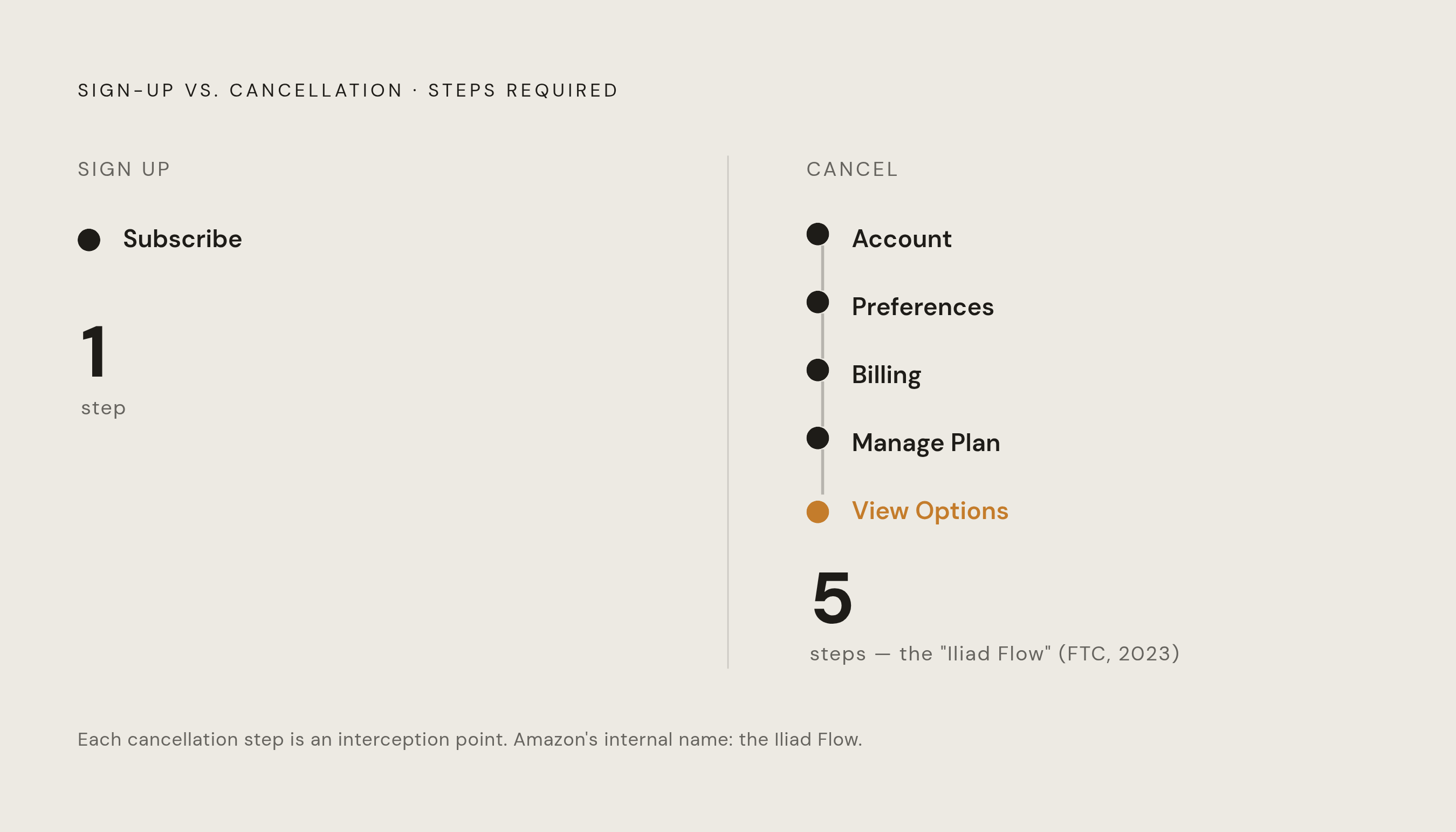
The roach motel starts with unequal paths. Signing up takes one click or one screen, but cancellation disappears beneath Account, Preferences, Billing, Manage Plan and View Options. Each step gives the service another chance to stop someone who wants to leave. The difficulty is concentrated at the exit. That asymmetry is the structure on which other cancellation tricks are built.
The FTC’s 2023 complaint said that cancelling Amazon Prime meant finding a way through several confusing screens. Amazon internally called it the “Iliad Flow,” after Homer’s epic, and the agency referenced that name in its complaint. The example gives the pattern a concrete shape. A consumer who has already decided to cancel must keep navigating to have that decision processed.
The Restore Online Shoppers’ Confidence Act, or ROSCA, requires a simple way to cancel. That requirement gives regulators a way to challenge obstruction without treating every difficult screen as a separate problem. For consumers, the signal is the imbalance itself. If subscribing was obvious but cancelling requires a hunt, the service has made leaving a different kind of task from joining.
Forced human interaction: requiring a phone call to cancel what you signed up for online
Forced human interaction turns that imbalance into a channel switch. A service accepts an online sign-up instantly, then requires a phone call during business hours, a live chat with a retention agent, or an email request with processing delays. The customer must now arrange time around the company. What began as a digital transaction becomes a conversation the customer never needed to join.
The FTC’s amended Uber One complaint, joined by 21 state attorneys general, alleged that consumers faced dozens of screens and many separate actions to cancel. That illustrates how cancellation friction can grow into a whole obstruction structure. Channel-switching is one mechanism within that broader pattern. Its immediate burden is reaching someone who can process the request.
The FTC’s cancellation rule, finalized in October 2024, specifically prohibited requiring consumers to switch channels, but the rule was later vacated. State law can still impose that protection. California AB 2863 requires same-medium cancellation, including online cancellation for online enrollment, for covered contracts entered into, amended, or extended on or after July 1, 2025. The legal position therefore depends on more than the vanished federal rule.
The save-offer loop and confirm-shaming: what happens once you find the cancel button
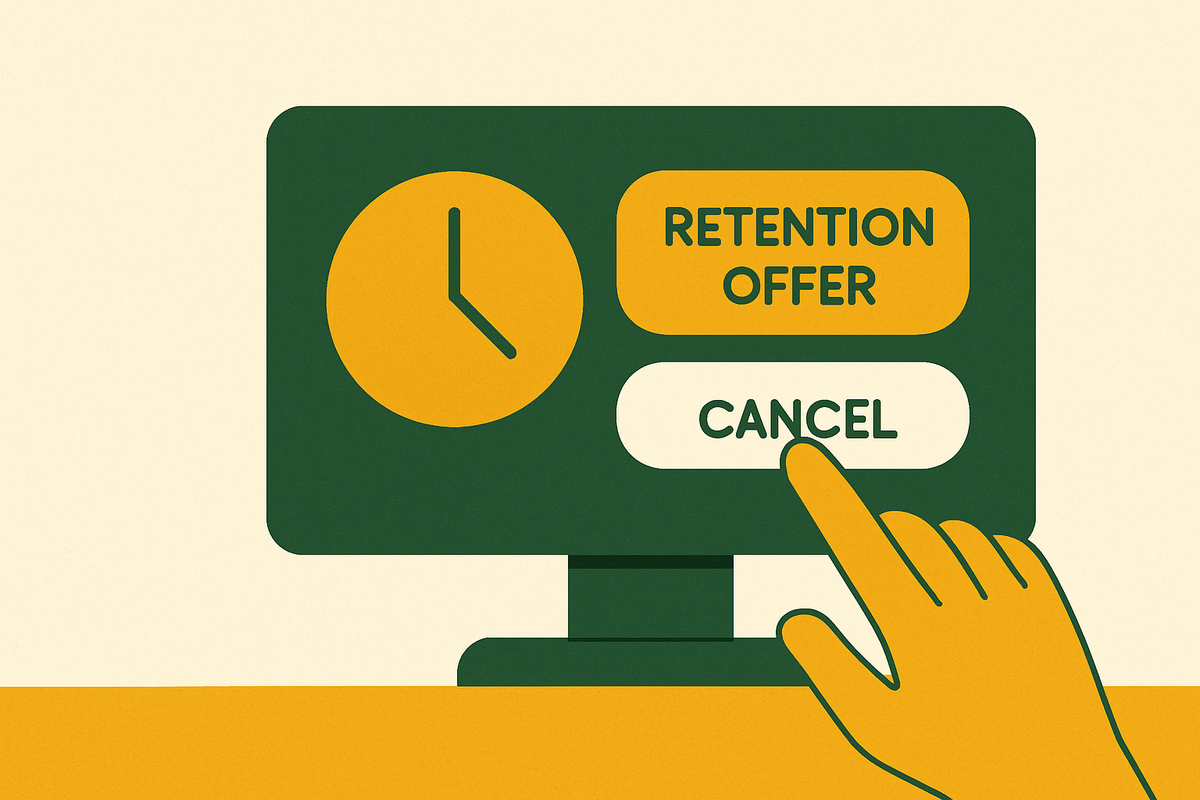
A second layer can replace navigation with repeated decisions, emotional pressure and delay. A discount offer crosses the line when accepting it is the only prominent route and an equally visible “No, just cancel” option is missing. The customer must then find an exit from the offer before reaching the exit from the subscription.
The FTC’s September 2022 staff report, “Bringing Dark Patterns to Light,” documented confirm-shaming. Copy such as “No thanks, I don't want to save money” turns declining into a supposed personal failing. Loss-aversion prompts work through a related pressure, emphasizing lost benefits to create hesitation. A mandatory exit survey adds work at the same moment. Stacked together, these steps drain attention from someone who has already made a decision.
A downgrade redirect goes further than persuasion. When a cancel button leads to a lower-tier paid plan rather than termination, continued payment replaces the requested action. The useful distinction is whether cancellation remains a clear choice throughout. An offer can sit beside that choice without concealing it.
Deliberate billing disaggregation: how spreading charges across amounts, dates, and cards makes the total invisible
Cancellation friction takes effect when someone tries to leave, but billing disaggregation takes effect before they decide to go. Small charges arrive on different dates across several payment methods, rather than appearing as one consolidated subscription bill. Each charge can seem too small to look into. The total is harder to see because there may be no single place that shows every service and billing cycle.
This is a problem of payment architecture. Consumers can remember individual subscriptions while still underestimating what the whole collection costs. The amounts sit apart on the page even though they all come from the same household budget. That gap between individual prices and total spending helps forgotten subscriptions remain unchallenged.
A plan promoted through its savings over monthly billing produces a lump sum that appears only once a year, making its recurring nature easier to forget. AI subscriptions add another layer to the same problem as paid tools accumulate beside streaming and software services. The category is new, but the mechanism is familiar. More separate charges make the full bill harder to hold in mind.
Silent price creep: how subscription prices rise without triggering the cancellation decision they should
Disaggregation hides the total, while silent price creep grows it. A small increase at one service may seem acceptable when considered alone. Similar increases across several services and several years create a different bill from the one the customer remembers choosing. The increment is what softens the decision. Each change asks for less attention than a single announcement of the combined increase would demand.
Notification design can keep that attention low. A price change may sit several paragraphs into an email that looks like a routine newsletter, or inside a terms update whose subject line does not mention the cost. Disclosure and visibility are not the same thing. The information can technically be present without being presented as a reason to reconsider payment.
Annual billing adds distance between the notice and the renewal charge, leaving the customer to confront the new amount when payment lands. California’s law requires notices before fees change and reminders each year for the contracts it covers. For consumers, the comparison is between the current charge and the price they remember choosing. Someone can keep using a service without having thought about its current price.
Free trial conversion traps: the countdown clock consumers never see
A free trial trap exploits a deadline. The service collects payment information at sign-up, while the customer’s attention is on trying the product. By the time the cancellation deadline comes, the customer’s early interest has faded. Conversion then happens without a fresh purchasing decision. Missing the date becomes the event that turns interest into payment.
Buried or pre-checked auto-renewal terms deepen the problem by making consent look like a default setting. The FTC has explicitly said that a pre-checked box does not constitute affirmative consent. Supplying a payment method is therefore not the same as making an informed choice about recurring charges. If the trial converts to annual billing, the first surprise can be much larger than a monthly payment, and a later annual renewal can arrive long after the original enrollment has been forgotten.
The practical warning signs appear before enrollment. When the way to cancel is unclear or the deadline is unstated, the customer has no clear plan for leaving. Some banks and financial apps offer virtual card numbers that can decline after one charge or a chosen date. Where available, that creates a payment checkpoint at conversion and reduces reliance on remembering the deadline.
AI-optimized retention flows: when the tool helping you cancel is working against you
AI can turn a fixed cancellation obstacle course into an adaptive one. Services can use algorithms to test where buttons go, what the words say, which offers come first and when emotional prompts appear, then choose the mixes that lead fewer people to finish cancelling. The friction need not remain the same.
A retention chatbot brings that optimization into conversation. With access to usage data, billing history and behavioral signals, a system can tailor discounts, pauses or feature reminders to the customer’s likely hesitation. The familiar save-offer loop becomes personalized. Instead of presenting the same sequence to everyone, the system can keep selecting reasons for this particular customer to stay.
The consumer signal is lack of progress. A chatbot that keeps coming back to offers instead of getting closer to confirming cancellation may be running a retention loop, even when it sounds helpful. These changing flows also complicate enforcement because the problem may lie in the outcome of a conversation, even when the chatbot sounds polite.
Where the law stands after the Click-to-Cancel Rule was vacated
The U.S. Court of Appeals for the Eighth Circuit vacated the subscription cancellation rule on July 8, 2025. The court found that the FTC had failed to complete a required preliminary regulatory analysis. The decision concerned procedure. Still, it removed the rule that would have required cancellation to be as simple as sign-up, separate express informed consent and documentation of that consent.
Enforcement did not disappear with the rule. Section 5 of the FTC Act still prohibits unfair or deceptive acts, while ROSCA provides authority over online subscription practices. The FTC said it could still use its existing authority to enforce transparency, easy cancellation and express consent. Companies remain subject to scrutiny after the newer rule was vacated, though an unwanted charge alone does not prove a violation.
The FTC’s September 2025 Amazon settlement combined civil penalties and consumer refunds. Adobe’s March 2026 settlement with the DOJ and FTC totaled $150 million over hidden Early Termination Fees and convoluted cancellation processes, with part allocated to consumer relief through free services. The FTC also sued JustAnswer and its CEO in January 2026, alleging that an introductory offer enrolled consumers in recurring monthly subscriptions without affirmative consent.
The FTC announced an Advance Notice of Proposed Rulemaking on March 11, 2026, published in the Federal Register on March 13, to begin rebuilding the rule. As of late 2026, no Notice of Proposed Rulemaking had been published. State protections, including California’s requirements, add another layer. But individual cases do not create the same uniform safeguard as an industry-wide cancellation rule, so enforcement and widespread friction can exist at the same time.
How to recognize when a charge on your statement got there by design, not by accident
Comparing your decision with the payment that followed provides a practical starting point. A charge from a service you tried to cancel suggests an unfinished or obstructed exit, especially when no cancellation confirmation arrived. That absence is a warning. It leaves open whether the service actually processed the request after receiving it.
Other signatures emerge through comparison. Looking at small charges together across dates and payment methods can show disaggregation, including charges billed under names that differ from the brand you know. A recurring charge above the price you remember choosing can be a sign of price creep. A charge from a remembered free trial identifies a conversion that may have happened without renewed attention. A large annual payment can show how the monthly price you remember differs from what was actually taken.
An account review brings together the service, what it costs now, when its trial ends or it comes up for renewal, and any cancellation confirmation. The burden is substantial because each subscription keeps its own clock. That is the playbook’s advantage, and why a forgotten charge should not automatically be dismissed as a failure of memory.