B2B SaaS Seat Expansion as a Revenue Growth Model
How adding users drives revenue growth until AI automation starts replacing them.
Seat expansion has been a reliable engine for B2B SaaS revenue growth because customer adoption can turn directly into larger contracts. But that engine depends on people remaining a useful measure of product value. Understanding its mechanics, its limits, and the pressure from AI is the basis for deciding how much growth to build around it.
How seat-based SaaS revenue actually works before examining its limits
A seat-based contract links the customer’s bill to the number of licensed users. As a customer grows or brings more teams onto the product, it needs more seats. The vendor can then bring in more revenue without selling a different product or winning another customer. Growth has a built-in path through the contract. That made seats a natural default for SaaS products used by people across an organization.
In the revenue model, seat expansion sits between new annual recurring revenue, or ARR, and lower churn. It is cheaper to generate than new-customer ARR because the relationship and trust already exist. The billing unit is also easy to understand. Customers can calculate costs, procurement can approve them, and vendors need no separate consumption meter beyond their authentication system. For collaborative products, the fit goes further because each additional participant makes the product more useful to existing users.
Why Net Revenue Retention is the single number that makes seat expansion matter
Net Revenue Retention, or NRR, measures what happens to revenue from existing customers after expansion, contraction, and churn. It gives seat growth a common test. Adding licenses is not enough if other customers remove them or leave altogether. NRR above breakeven means existing customers bring in more revenue even after those losses, so operators and investors get a clearer view than gross expansion alone gives them.
KeyBanc Capital Markets SaaS Survey 2026 shows median NRR climbing with company scale. Companies in the mid-market ARR band post a median meaningfully above breakeven, while top-quartile performers sit well above that level. The same survey places expansion at more than a third of new ARR for companies above a mid-market ARR threshold, up sharply from earlier years. Expansion is not a side project at scale. However, NRR captures more than seats, including higher prices, increased usage, and additional products, so a strong result does not establish which mechanism produced it.
The land-and-expand motion: four components that have to work together
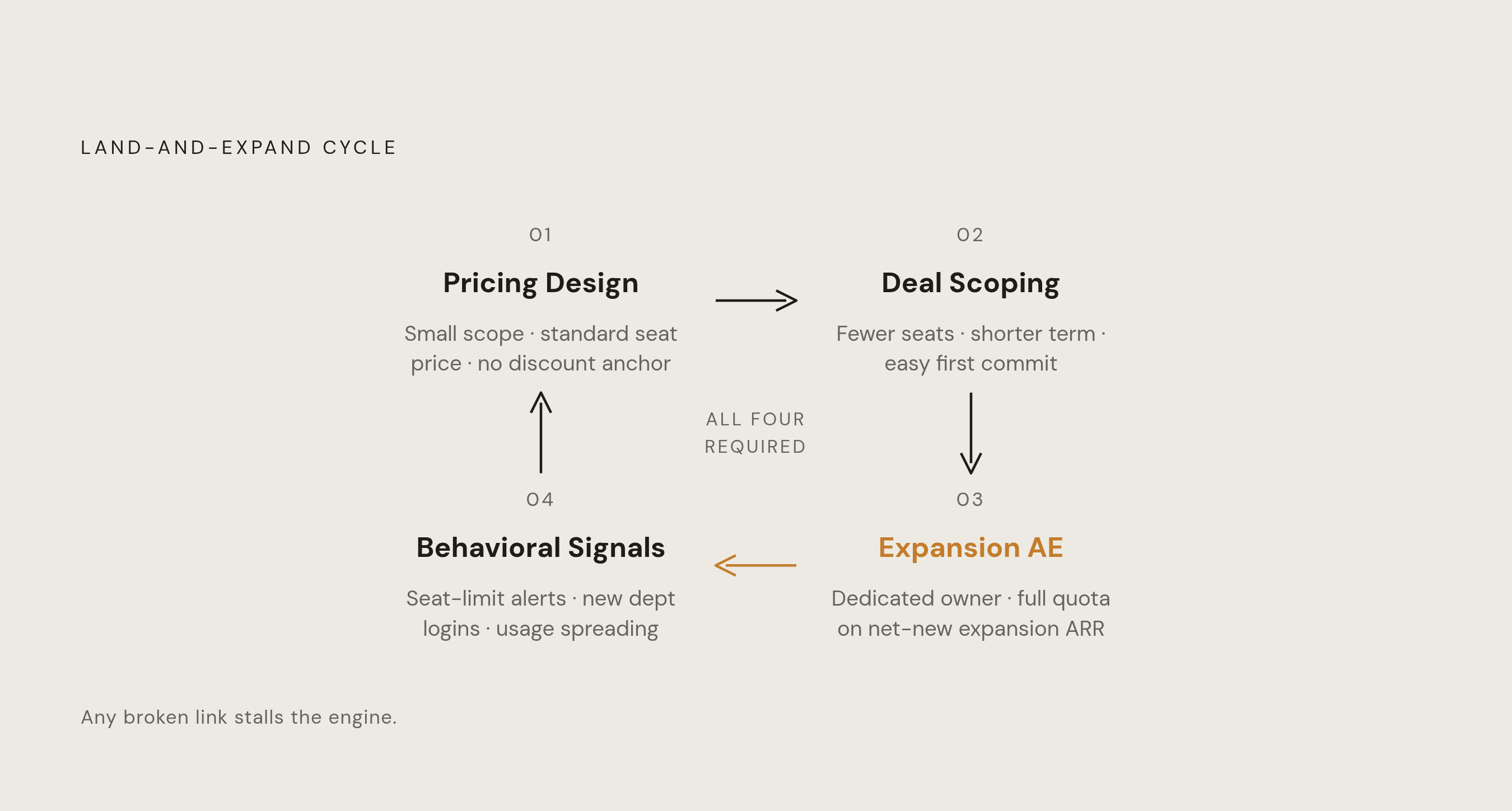
Land-and-expand depends on four components working together, namely pricing design, deal scoping, expansion ownership, and behavioral signals. The initial deal gives those components their starting conditions. It should use fewer seats and a shorter term at the standard seat price, rather than a discounted price for a larger footprint. Small scope limits the customer’s initial commitment. A low price anchor makes later talks about expansion start from the wrong number.
After the sale, time-to-first-value becomes the upstream variable. Accounts that reach first value within the first few months expand at materially higher rates than those that take longer. Readiness is then visible in account behavior. An account approaching its seat limit, another department logging in organically, or usage spreading across teams gives the expansion owner a reason to act. When a customer buys another company, the acquired team may also need access.
A cliff-effect discount can lower the price across the contract when the customer crosses a volume boundary, allowing more seats to produce a smaller bill. Marginal pricing avoids that reversal. Discounts apply only to seats within each band, so each added seat brings in more revenue.
Compensation and signal systems: the operational levers most expansion programs get wrong
Someone must own expansion and have a reason to pursue it. The practical compensation shift is to give expansion account executives a full quota on net-new expansion ARR, with the same on-target earnings as a new-business account executive. This makes expansion part of the job of bringing in revenue, rather than more work added to looking after accounts.
To make that responsibility actionable, signal systems need defined thresholds for monitoring adoption. An account approaching its seat limit should route to an expansion owner. The same applies when it nears an API quota or its included usage tier. Connecting the threshold, the responsible person, and the compensation plan allows growing demand to be recognized before a scheduled conversation.
What Atlassian and Commvault show about seat expansion at scale
Atlassian’s Q2 FY2026 shareholder letter reported its first-ever billion-dollar Cloud revenue quarter and a record number of large deals by ACV. Growth came from paid seat expansion, higher average revenue per user, and cross-sell of more products. Seats were part of a broader expansion engine. The company’s annual filing describes how customers typically begin with free editions or a single app or product for a limited number of users. Small-footprint entry is therefore an explicit strategy.
Commvault’s September 2025 filing reported SaaS NRR well above breakeven as of September 30, 2025. It identified increased utilization and adoption of additional offerings within existing accounts as drivers. That is a broader claim than seat growth alone. Together, the filings show why mature expansion programs link product adoption to account growth and layer additional offerings onto the initial relationship. Their results support an active expansion model.
Where seat expansion hits a structural ceiling
Within a customer, seat growth can spread through existing departments before it reaches the organization’s full headcount. After that, its upper bound is people. Once the relevant users are licensed, further growth depends on more people needing access. Better execution cannot remove that limit. Any force that lets the customer do more work without adding people therefore weakens the link between product success and seat revenue.
Seats measure presence. They approximate value well when every workflow requires a licensed human, but less well when software can perform the work. The active-seat ratio exposes the gap before renewal. When fewer than roughly 60% of licensed seats are actively used, churn becomes likely. Unused licenses are missed chances for expansion and also show that the customer may already be paying for more seats than it needs.
For payments infrastructure, API-first products, transaction processing, and AI-assisted workflows, that mismatch goes beyond temporary underuse. Their output need not rise in proportion to users. The pricing architecture can impose a second constraint through the discount cliffs described earlier. One limit comes from the number of people available to license, while the other comes from how additional licenses change the bill.
How AI agents are actively shrinking seat counts at existing customers
When agents execute workflows that previously required licensed people, an existing customer can need fewer seats while getting more value from the software. This is not merely slower account growth. It reverses the relationship on which seat expansion depends, making successful automation a possible source of contract contraction.
Atlassian reported its first-ever decline in enterprise seat counts, and its stock fell 35% in response. The market reaction shows investor repricing around seat compression. It is not a verdict on the company’s overall prospects, nor does it erase the adoption and cross-sell performance described earlier. Instead, the two signals expose the tension inside the model. A vendor can have valuable products and a functioning expansion program while investors question whether human licenses will capture future growth.
Where seat pricing still holds and where it is already being replaced
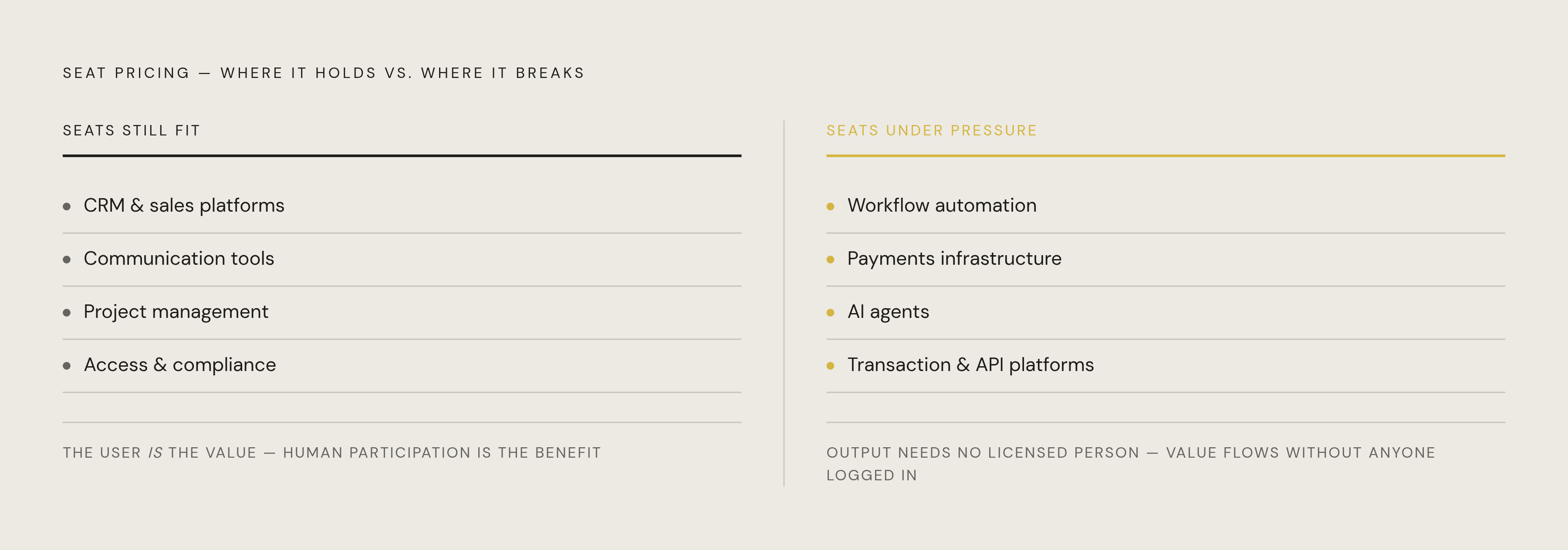
Seat pricing remains structurally sound where human participation is itself part of the benefit, including CRMs used by sales teams, communication platforms, and collaborative project management tools. Access-management and compliance tooling also remain largely intact. In these settings, the user is not simply an intermediary between the product and its output. Giving another person access can be a meaningful unit of additional value.
Workflow automation and task completion face a different test. Payments infrastructure, AI agents, transaction-processing platforms, and API-first products produce value through outputs or throughput independently of the number of people logged in. Familiarity does not make seats a good fit. A vendor in these categories cannot establish the model’s durability simply by pointing to buyers who understand per-user bills.
Microsoft’s Satya Nadella described seats as “just entitlement to some consumption” on the company’s FY2026 Q3 earnings call. That framing preserves a role for seats as one layer of a consumption model.
The three pricing structures replacing or augmenting seat-based models
A platform fee plus consumption separates access from variable use. The customer pays a flat fee for the platform, then pays separately for token usage, transaction volume, or agent actions. Clay introduced this structure on March 11, 2026, with a clear split between the value of the platform and the cost of consumption. Anthropic cut enterprise seat prices while moving more aggressively toward consumption billing. The fit depends on whether the vendor can distinguish the value of access from the cost and value of actual consumption.
A subscription floor with a usage overlay retains a predictable base commitment while letting the contract grow with consumption. Salesforce reported that a majority of Q4 FY26 Agentforce and Data 360 bookings came from existing customers expanding usage. This shows how existing customers can spend more without buying more human licenses.
Outcome-based components make results part of what the customer pays for alongside access or consumption. They suit a different value question. A customer paying for completed work is buying an outcome, while one paying for transactions or tokens is buying a measured amount of activity. These structures are not a ranking, and a pure usage-only model is not automatically the destination. The appropriate combination depends on the product’s value metric, the buyer’s budget process, and the consumption data the vendor has available.
What SaaS operators should take from this when deciding how far to lean on seat expansion
Whether value scales with users or usage is the first diagnostic question. The second is how the active-seat ratio changes between signing and renewal. The third is whether a customer that automated away a quarter of its seats would have a legitimate case that it was receiving less value.
Where the answers point beyond seats, an additive migration avoids treating the change as an immediate replacement of every contract. The path is to add a usage meter or API tier for new signups, preserve existing seat-based contracts through their current terms, and migrate at renewal. Expansion ownership, compensation, and signal systems still have a role. Their purpose shifts toward capturing growth in the unit that reflects customer value, whether that is users, consumption, or outcomes.
The final test is whether a more productive customer should reasonably need a larger contract under the current pricing model. If productivity rises while active seats fall, the diagnostic question is whether seats still measure value or now measure only access.