Usage-Based vs Flat-Rate Subscription Psychology
Flat-rate pricing exploits sunk-cost thinking while usage-based creates bill anxiety.
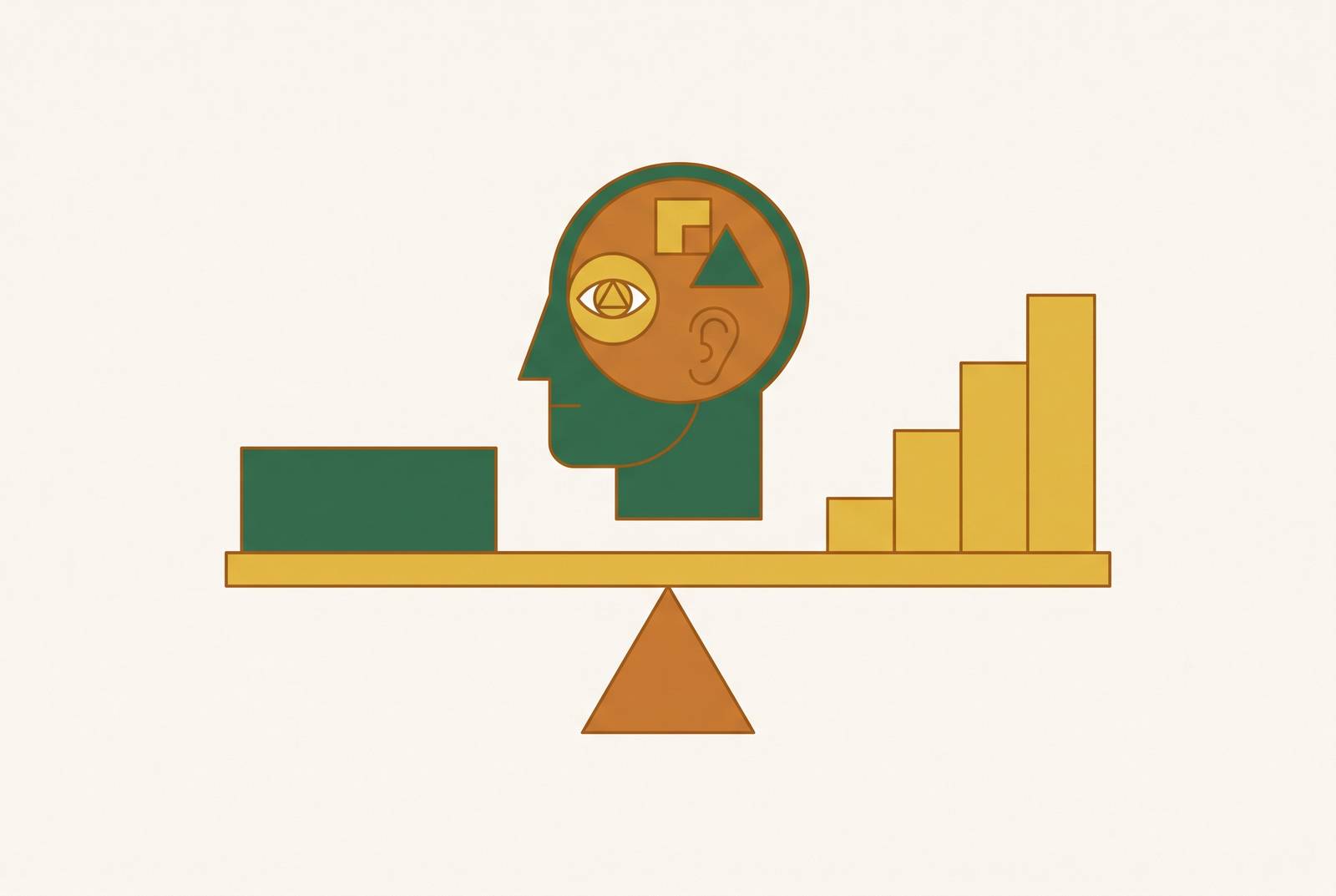
The subscription economy hit $492 billion globally in 2024 and analysts project it'll cross $1.5 trillion by 2033. At that size, the pricing structure behind every subscription you own is a psychological mechanism, built to shape how you think about cost. Two models dominate: flat-rate, where you pay the same no matter what you use, and usage-based, where you pay for exactly what you consume. Product teams pick between them knowing full well what each one does to your brain. You, the person swiping the card, usually never get told.
How flat-rate pricing creates the illusion that you've already gotten your money's worth
Back in 2006, researchers Lambrecht and Skiera identified something they called the insurance effect: people will pay a premium just to avoid the anxiety of an unpredictable bill. Certainty has a price tag of its own, separate from whatever the product actually costs to deliver.
Here's the catch. The moment that flat fee hits your account, your brain reclassifies it as a sunk cost. Gone, already spent, no longer relevant to how you think about using the service. Every individual use afterward feels free as a result. Watching one more episode, opening the app one more time, none of it registers as costing anything, because in your head, the transaction already happened.
That illusion starts even earlier than the first bill, though. At sign-up, people consistently overestimate how much they'll actually use a flat-rate service. That inflated forecast is part of what makes the deal feel smart in the moment. Usage then drops back to reality over the following weeks and months, but the justification for paying doesn't drop with it. The gap between what you thought you'd use and what you actually use is where the money quietly disappears.
None of this is accidental. Flat-rate pricing removes the mental friction of tracking use, and that removal is a deliberate feature of the design. Decoupling payment from consumption awareness is exactly what keeps you subscribed. Loss aversion locks it in further: once you've had access to something, the thought of losing it feels worse than the cost of keeping it, even if you haven't opened the app in two months. Add the endowment effect, the tendency to value things more just because you already have them, and you get subscribers paying for services they've functionally abandoned, still convinced on some low level that they could use it whenever they want.
How usage-based pricing keeps spending visible but introduces its own distortions
Ask people what they'd prefer, and 67% say usage-based pricing. Fairness, flexibility, paying for what you actually consume. It sounds like the obvious fix for everything wrong with flat-rate.
In one real sense, it is. Usage-based pricing keeps the relationship between cost and consumption visible. Every session, every unit, carries a mental price tag, so you're never fully disconnected from what you're spending. That's a genuine advantage over flat-rate's sleepwalking.
Visibility cuts both ways, though. Metered pricing can trigger what's sometimes called the taxi meter effect: users become reluctant to fully engage, watching the clock instead of the content, stressed during the exact moments they're supposed to be enjoying the product. The service runs more efficiently on paper, but it's less enjoyable to actually use. People start avoiding features, skipping sessions, managing their behavior around the bill instead of around what they actually want, which defeats the entire point of subscribing in the first place.
There's also a quieter shift happening underneath all this: close to eight out of ten SaaS companies are planning to use usage data to enhance customer experience and pricing strategies. That can genuinely help some customers get better deals. It also means your price is increasingly optimized against your own specific behavior patterns, in real time, based on data you generated by using the product normally.
Usage-based billing has its own version of flat-rate waste, just flipped. Instead of quietly paying for nothing, users occasionally get hit with a bill far larger than expected, a heavy-use month that blows past the mental budget. Preferring usage-based pricing doesn't mean people are good at managing it. Awareness of cost and control over cost are two completely different skills, and most people only have one of them.
What subscription fatigue reveals about how these models compound over time
A Deloitte study found 42% of users feel overwhelmed by the sheer number of recurring charges hitting their accounts. That number is what happens when the insurance illusion and usage-based anxiety run simultaneously, across a dozen different services, all at once.
Flat-rate subscriptions pile up because each one, individually, feels low-risk to keep. Canceling takes more effort than staying does, so staying wins by default, over and over, across every service you've ever signed up for. Usage-based subscriptions multiply for the opposite reason: people add them believing they'll only pay for what they use, then never actually check whether that's true.
Adapty analyzed $1.9 billion in revenue across more than 11,000 apps and found a clear behavioral shift underway. Users worn down by subscription fatigue are gravitating toward things that feel less risky and easier to exit: weekly plans, free trials, premium tiers. They're prioritizing the feeling of psychological safety over actual financial savings. Which sounds like consumers finally adapting.
The market isn't responding to fatigue on the consumer's terms, though. It's responding on the provider's terms. Flexibility that feels like an easy exit can become its own retention mechanism; easy to start, easy to forget, structurally identical to the flat-rate trap it was supposed to fix.
The number that actually matters here is the cumulative one, and research on mental accounting shows people underestimate it consistently, across every spending category studied. The $27.7 billion attributed to forgotten subscriptions across U.S. households is the aggregate result of both pricing psychologies operating at full strength, at the same time, across millions of households that never sat down to add it all up.
How companies design cancellation friction to protect the flat-rate base
If loss aversion and inertia won't keep users subscribed on their own, the next move is adding friction to the exit. That's a documented design pattern.
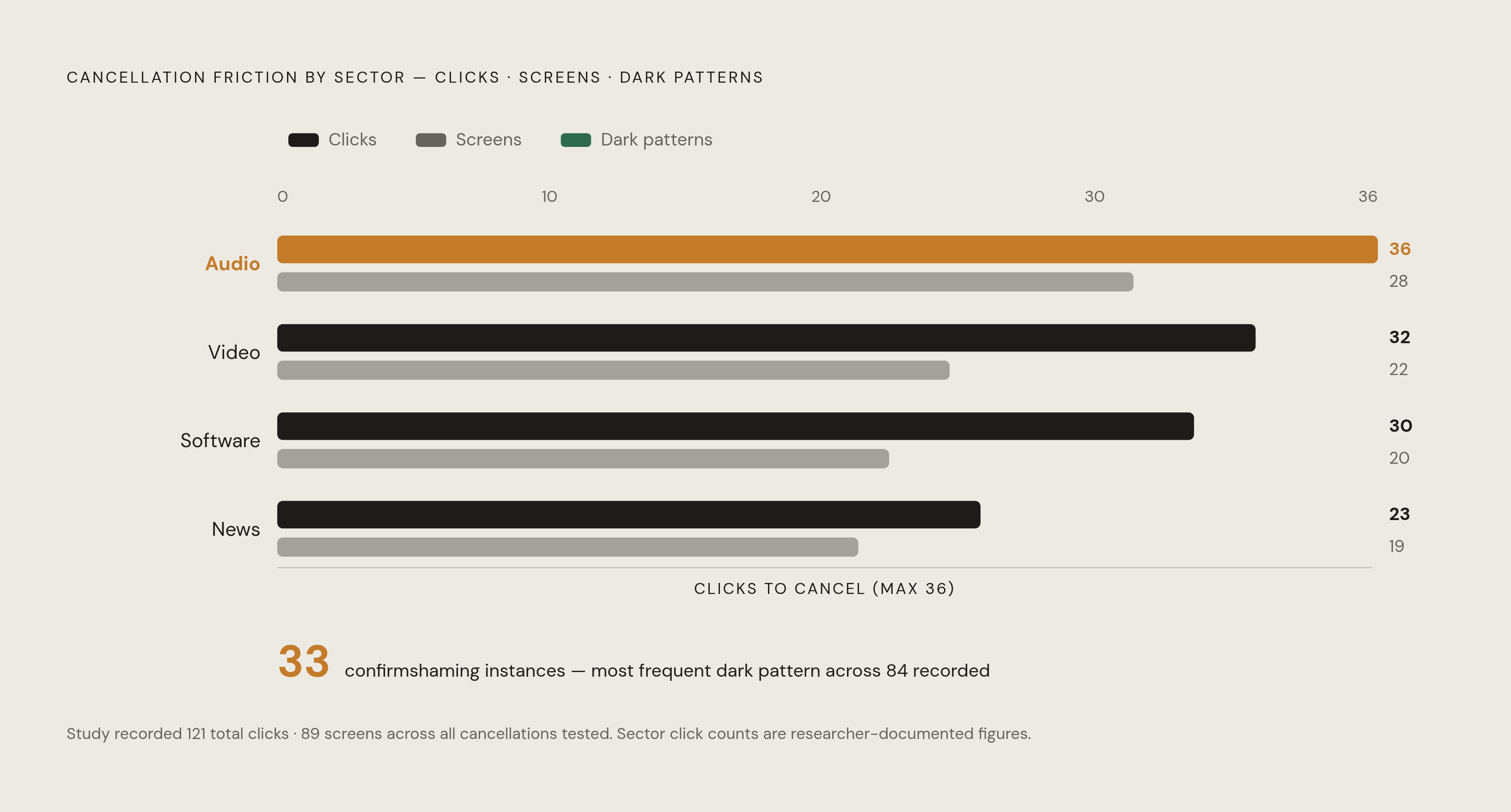
Researchers studying cancellation flows across four sectors recorded 84 dark patterns, requiring 121 clicks and 89 screens to cancel every subscription tested. Confirmshaming, the guilt-trip pop-up asking if you're sure you want to abandon your progress, showed up 33 times, more than any other tactic. Audio services were the worst offenders: 36 clicks and 28 screens just to end one subscription. These numbers don't happen by accident. Somebody built that flow on purpose, and the cost of it lands entirely on the user's time and patience.
Regulators noticed. The FTC pursued a Click-to-Cancel rule that would have required cancellation to be exactly as easy as sign-up, but the rule faced legal challenges and did not take full effect. The backstop consumers expected simply isn't there right now, then.
Amazon's $2.5 billion settlement, roughly $1 billion in civil penalties plus $1.5 billion in refunds over its Prime enrollment and cancellation design, the so-called Iliad Flow case, stands as the clearest example of what these patterns cost once they end up in court. Meanwhile, European regulators have moved to restrict dark patterns on covered platforms. U.S. consumers are working with meaningfully weaker protection by comparison.
The upshot is simple and a little grim: the path out of a subscription is often built to be harder than the path in. Flat-rate inertia is reinforced by deliberate interface design, and plenty of users who fully intend to cancel simply never make it through the screens.
The self-audit question: are you paying for value or paying for access you've mentally filed away
Here's a decent test for a flat-rate subscription: can you remember the last time you used it? If not, and you're still reluctant to cancel, loss aversion is running the show, not genuine value. That reluctance isn't really about the product anymore.
Usage-based subscriptions need a different question. Is the bill arriving close to what you expected, or has your actual spend drifted away from the mental model you built at sign-up? That gap, between expected and actual, is exactly where usage-based waste hides.
Flat-rate waste tends to cluster in familiar places: a streaming service kept alive for one show that ended two seasons ago, a software suite where you touch a single feature and ignore the rest, a gym membership, a cloud storage tier bought bigger than you'll ever need. Usage-based drift shows up somewhere else entirely: cloud compute bills, data plans, API tools, premium tiers billed per seat or per action that quietly scale with behavior nobody's tracking anymore.
Try the cancellation friction test too. If you've thought about canceling something more than once and still haven't, figure out why. Is it because the thing delivers real value, or because you don't want to deal with a multi-screen cancellation flow?
Free trials deserve their own mention here, because they're a hybrid built to confuse both instincts at once. Structurally, they're usage-based: free until the trial period runs out. But they convert automatically into flat-rate billing, stacking the anxiety-reduction of a trial on top of the inertia of a recurring charge. That conversion moment is designed to pass without you noticing.
An honest audit means separating what you actually use from what you're paying to have available. Those two things feel identical in the moment you glance at your bank statement. Over a year, they produce wildly different outcomes.
Why personal surveillance of your own subscriptions fails and what the alternative looks like
Here's the mismatch at the center of all this: subscription pricing runs continuously and automatically, every single day, without pause. Human attention works differently: it's intermittent, it gets tired, and it forgets things, especially small recurring charges that never demand attention all at once.
A once-a-year audit treats the symptom, not the structure. A subscription that looks fine in a January cleanup can quietly turn into dead weight by March, once the novelty of some New Year's resolution wears off and the gym visits stop. Subscription sprawl is a slow leak that needs ongoing attention, which happens to be exactly the kind of vigilance that flat-rate psychology and cancellation friction are engineered to wear down over time.
Without continuous monitoring, a handful of things reliably slip through unnoticed: free trials that convert to paid with no clear alert, flat-rate bills that crept upward since sign-up in increments too small to trigger alarm, duplicate charges from a service you moved to a new account but never actually canceled on the old one, and usage-based bills that have drifted well past the number you originally budgeted for.
This is where automated, ongoing monitoring earns its place, tools like Compass+ that connect to bank accounts, email, and subscription services to catch these patterns as they happen, surfacing each one with a specific dollar figure and a clear next step instead of handing you a research project. Read-only account access is the right architecture for this: the tool needs enough visibility to spot what's going on, without ever touching the money itself. The value scales with how much it can see, too; catching a duplicate charge or an unconverted trial credit requires a full picture across every account, not a partial glance at one.
Consumers aren't careless or inattentive. The systems collecting these payments are built to outlast anyone's attention span. The only response that works on the same timescale as the problem is one that keeps watching even when you've stopped thinking about it.