Annual vs Monthly Subscription Framing Tactics
Companies exploit payment psychology to hide the real cost of annual subscriptions.
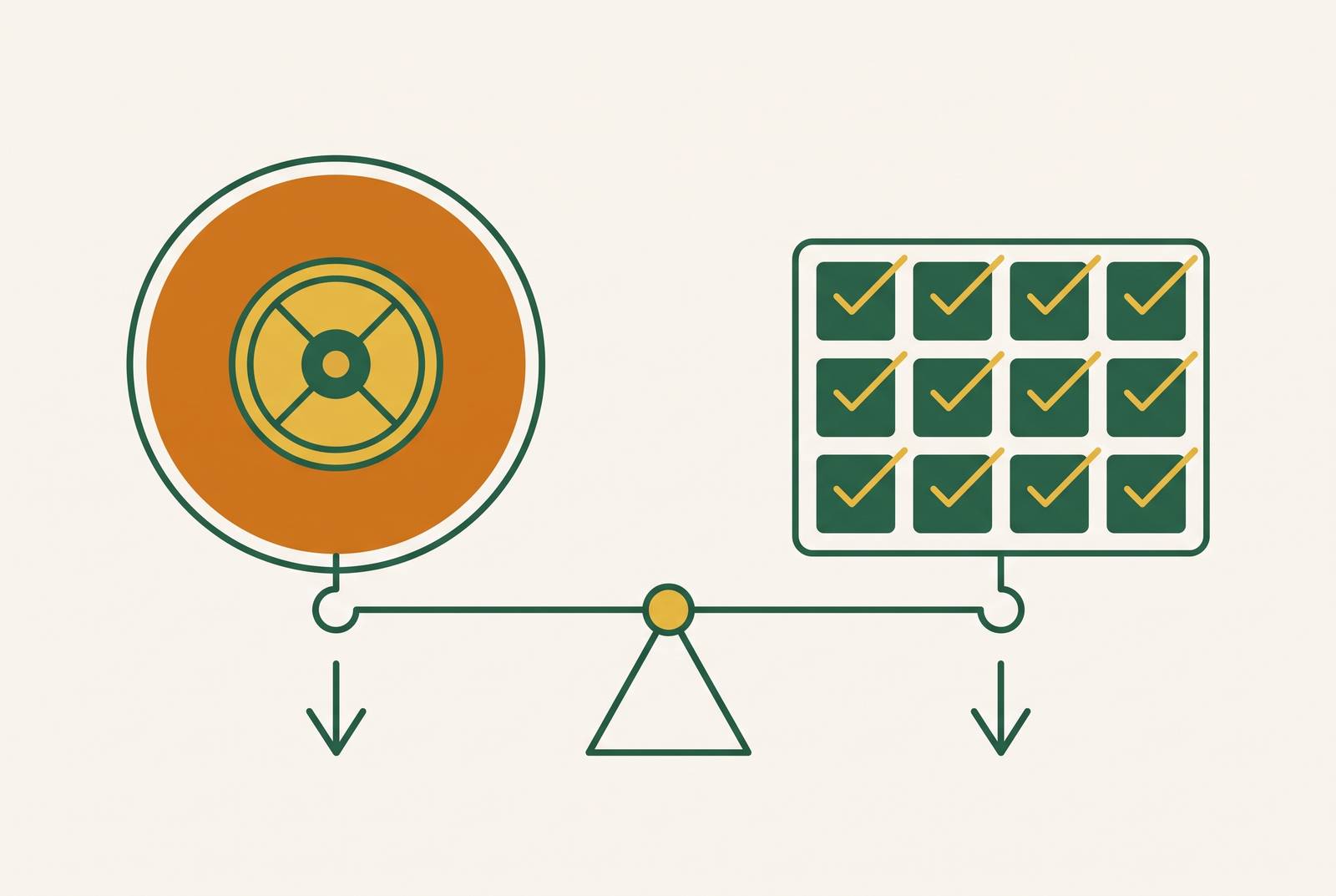
The displayed price on a subscription page is almost never what gets charged. It's the monthly equivalent of an annual bill, dressed up to look like a monthly bill, and that gap is the entire game. Research on the psychology of paying has found that handing over money activates brain regions tied to physical pain; spreading that cost across twelve smaller charges dulls the response. Companies know this, which is why the question worth asking on any pricing page is less "what's the discount" and more "which number are they showing me, and why that one."
Take Headspace: annual billing shows up as a monthly-equivalent figure, with no discount percentage anywhere near it. The framing implies a deal without proving one. Nobody is meant to do the math, and that's not an accident. It's the design brief.
Why "two months free" is the most carefully engineered number in subscription pricing
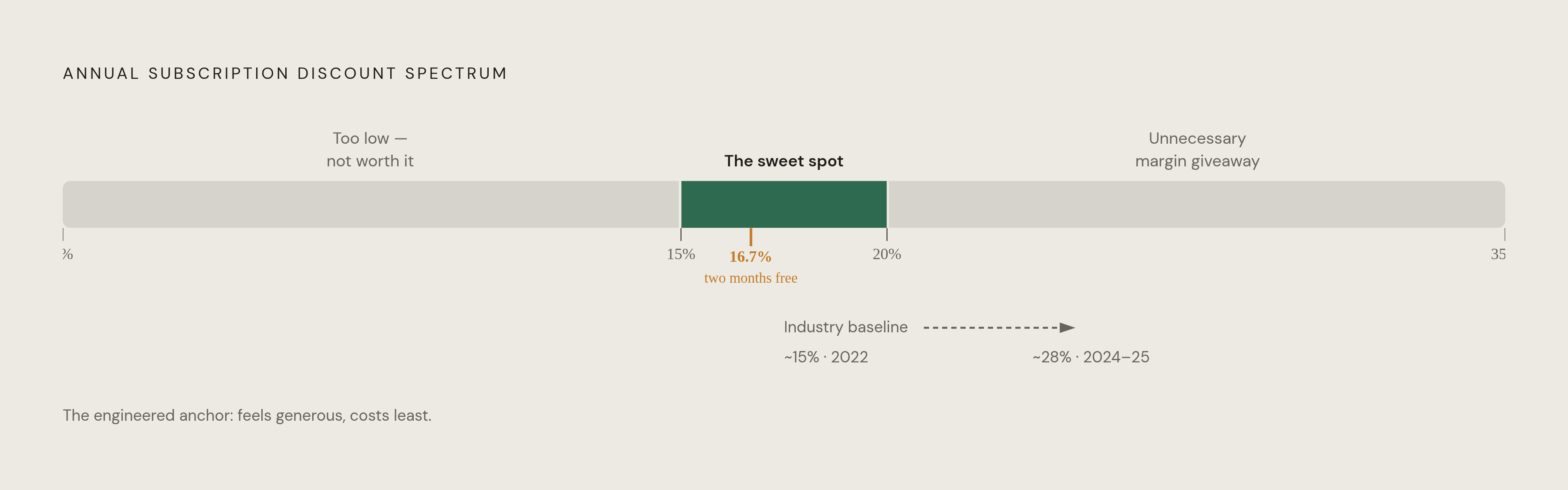
Discount percentages aren't chosen at random. Per pricing guidance from Digital Applied, the sweet spot for an annual discount sits between 15% and 20%. Below that range, the upfront commitment doesn't feel worth it. Above it, the company hands away margin it never needed to give up.
"Two months free" lands at exactly 16.7% off. That's a number picked to sit right in the pocket where the discount feels generous but costs the company as little as possible. Framing it as free months instead of a percentage does more work than it should, too: loss aversion runs roughly twice as strong as the pull of an equivalent gain, so "save $240 a year" beats "16.7% off" almost every time, even though they're the identical offer. One version frames money leaving your pocket. The other frames money you never quite had.
The baseline is drifting as well. According to Digital Applied, average annual discounts have climbed from around 15% in 2022 toward 28% in the 2024–2025 window. Treat that as directional rather than settled fact, but the direction still matters: what used to feel generous is sliding toward the floor.
Here's the one move that actually protects you, and it's mechanical rather than clever. Convert every "X months free" offer back into a percentage. Compare it against that 15-20% range. Then ask whether the margin the company is protecting justifies locking you in for twelve months. The size of the discount is rarely the interesting question. Whether you commit at all is.
What the decoy tier on the pricing page is actually doing
Add a third, expensive tier to a pricing page, and something predictable happens: more people choose the middle option, even though almost nobody buys the expensive one. That's the decoy effect. In 2024, a language learning app added a "Plus" tier to its pricing page and watched uptake of its standard annual plan climb, while the Plus tier itself barely attracted anyone.
The expensive tier was never built to sell. It exists to make the annual plan look like the obviously sensible choice by comparison, full stop.
The monthly option, meanwhile, gets the worst seat at the table on purpose: higher per-unit cost, no "free months" language attached, tucked at the bottom or shrunk down visually. This layout works as an anchor (the premium tier), a target (the annual plan), and a foil (the monthly plan), arranged to walk you toward one outcome. Strip the layout away and the fix is blunt: total up the real annual cost of each option, then ask honestly whether the features in that middle tier are ones you'll actually use, not ones you might get around to.
The real reason companies want you on an annual plan, and it has nothing to do with rewarding loyalty
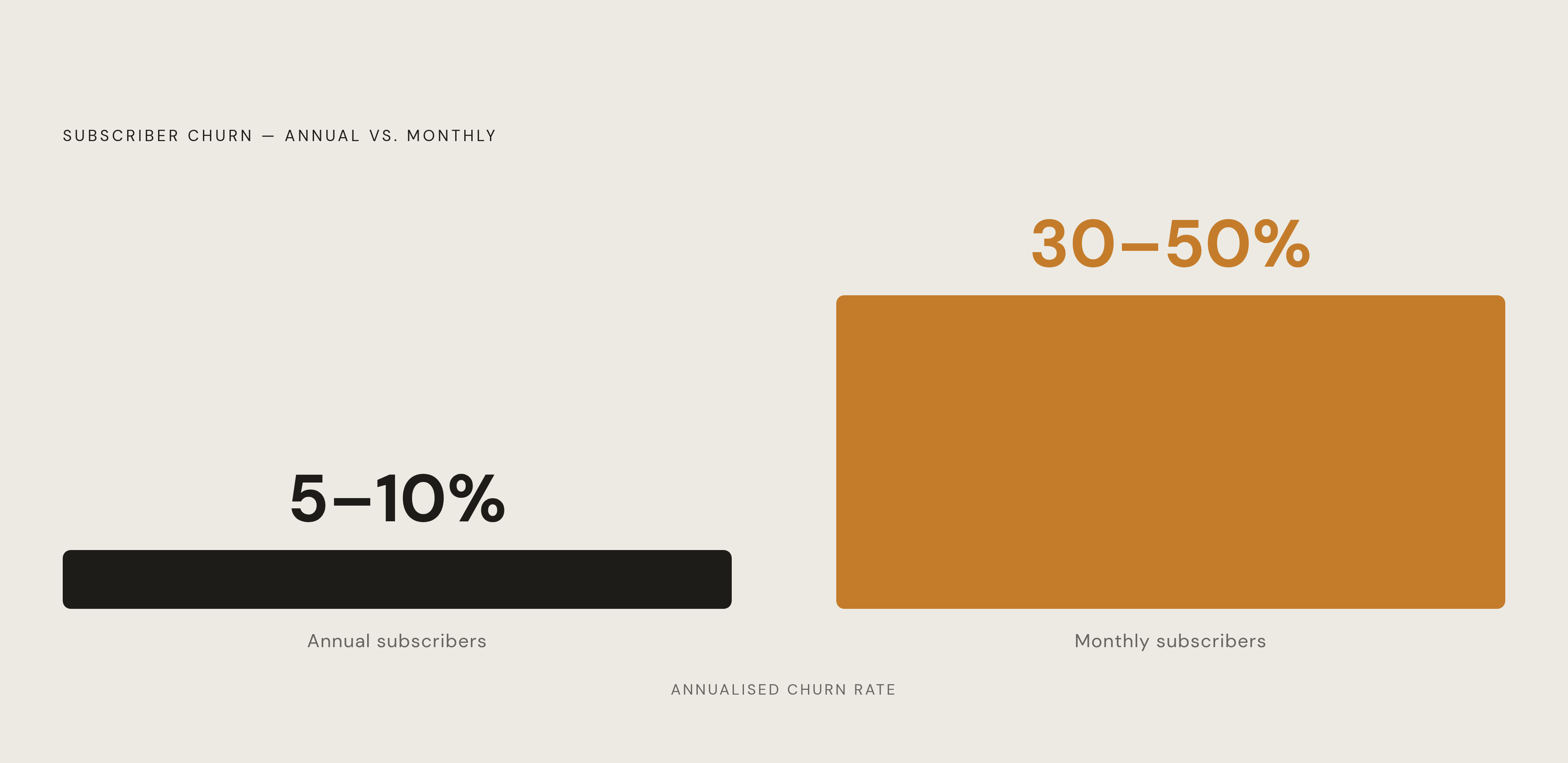
Annual subscribers churn at something like 5-10% a year. Monthly subscribers churn at 30-50%. That gap is the entire business case for the annual discount, more than any gratitude for customer loyalty. Anyone who tells you the discount is a thank-you gift is selling something.
Once money's already paid, canceling starts to feel like throwing it away, even when the product stopped earning its keep months ago. That's sunk cost doing exactly what it does. There's a quieter, more mechanical reason behind the retention numbers too: involuntary churn (meaning failed payments and expired cards) accounts for something like 20–40% of all subscription cancellations, according to Subscription Index. Annual billing drops the number of payment events from twelve a year to one, and most of that exposure just disappears.
There's an engagement angle worth naming plainly, and companies read it wrong on purpose. Annual subscribers use the product more and poke around more of its features, largely because they now need to justify what they paid. That gets reported internally as satisfaction, when it's closer to self-justification wearing satisfaction's clothes, and the confusion is convenient for whoever's writing the retention report.
Some products have a natural shelf life, and this is where the annual model gets almost cynical. Weight loss programs, dating apps, skill-building courses tend to run their course for a typical user in three to five months. Noom prices its annual plan at roughly three months' worth of its monthly rate, close to a 2.99x multiplier, on a product charging near $70 a month. Subscribers who don't see results by month four rarely bother canceling mid-year anyway. The discount functions less as a reward for sticking around than as the price the company pays to lock in retention before the customer's own motivation runs out first.
How the pain-of-paying suppression works across billing cycles
Monthly billing means monthly re-evaluation. Every charge is a small moment where you ask, "is this still worth it?" Annual billing collapses twelve of those moments into one, then buries that single moment eleven months in the past by the time it would actually matter again.
Mojo, a social media app, reportedly saw a 45% increase in new revenue per paywall impression just by switching its annual plan display to monthly-equivalent pricing. No new discount, no change to the underlying offer, just a different number on the screen. That's how much of the conversion work framing alone can do, and it's worth sitting with how little the actual product had to change.
After the initial charge clears, the product tends to vanish from monthly budgeting entirely: no line item, no mental tally, nothing to trigger reconsideration. Some platforms lean into that disappearance on purpose, discounting year one and quietly renewing at a higher rate in year two. Anyone who remembers "saving money" on the original purchase rarely redoes the math when the renewal notice lands. The suppression doesn't stop at the sales moment; it's built to flatten every future moment where reconsideration might happen. The fix is unglamorous but it works: calendar the renewal date the day you buy, and treat the renewal notice, whenever it shows up, as a fresh purchase decision rather than a formality to click past.
What annual commitment actually costs when a consumer's needs change mid-year
The marketed trade-off sounds simple: pay less per month, commit for twelve. Straightforward math, on the surface.
What never gets marketed is the cost of leaving early. Canceling an annual plan mid-year usually means forfeiting whatever months remain, or wrestling with a prorated credit that only works inside that same service, which reads more like a consolation prize than a refund.
Cancellation flows make the exit worse on purpose, and the numbers back that up rather than just implying it. Research examining subscriptions across audio, entertainment, health, and publishing found 84 separate dark patterns, requiring a total of 121 clicks and 89 screens to cancel across the services studied. Confirmshaming (the guilt-loaded language planted right at the cancel button) was the single most common pattern, showing up 33 times across those sectors.
The clearest example in the wild is Amazon's Prime cancellation flow, internally nicknamed the "Iliad Flow" after the length of the Greek epic, reportedly built to wear users down until they gave up and stayed subscribed. In September 2025, that flow led to a $2.5 billion settlement: $1 billion in penalties, $1.5 billion returned to consumers. That number alone should settle any argument that these frictions are accidental. Annual commitment is a flexibility trade at least as much as it's a pricing choice, and the exit cost is asymmetric in a way no pricing page will ever show you upfront.
Reading a subscription offer against the grain: the questions the pricing page never answers
Every pricing page is built to make one comparison loud (monthly versus annual) while keeping several other questions quiet. The job is to go dig those quiet questions out yourself, because nobody else is going to hand them to you.
Start with the actual annual total, in dollars, today, instead of the monthly-equivalent figure they'd rather you anchor on. Then look at what actually separates the tiers, and ask honestly whether those extra features match how you'll use the product; the decoy tier only works if you accept its feature list at face value instead of testing it against your own habits.
Usage window matters more than most people give it credit for. If the product has a natural endpoint (a course, a fitness program, something seasonal), the annual math changes completely, because you might be paying for eight months you'll never touch. Before committing, find out what cancellation actually requires; test the flow or look it up, since the exit cost is part of the real price, not a footnote. And ask what the renewal price will be in year two, because year-one discounts that quietly renew at full rate aren't the exception. They're the default you should expect.
The honest reframe here treats savings as almost beside the point. An annual offer is a question of how much flexibility you're selling back to the company, and whether the discount on the table is worth that sale.
Why catching these tactics after the fact is harder than it looks, and what makes it easier
According to Medium, the subscription economy hit roughly $492 billion globally in 2024 and is projected to clear $1.5 trillion by 2033. Some of that growth is products people genuinely love. A meaningful chunk of it is commitments people simply forgot they made, and that second category is the one worth worrying about.
Across an estimated 130 million U.S. households, according to Medium, forgotten or underused subscriptions add up to something like $27.7 billion a year in spend. Each individual charge feels trivial ($9.99 here, $14.99 there), and that triviality is exactly why the model holds up at scale. Nobody cancels over nine dollars. Everybody forgets about nine dollars, and the business model depends on that exact asymmetry.
Annual plans are the hardest of all to catch. They don't show up on a monthly statement scan, the renewal arrives once a year with almost no friction attached, and the year-two price hike rarely triggers anyone to stop and reevaluate. Manually auditing twelve months of statements works, but it's slow, and most people don't do it until the charge is already gone. Bank dashboards that flag recurring charges close part of the gap, but they still depend on someone acting once the flag appears. A virtual card with a spending cap, used specifically for trials that plan to auto-convert into annual billing, forces the renewal moment to become an active decision again instead of something that just happens to you.
The tactic that makes annual framing so durable has less to do with the discount itself than with the way the whole structure turns an active choice into a passive one, something that happens rather than something decided. Reversing that takes monitoring that's just as passive, running in the background without waiting for anyone to remember to check. That's the specific gap tools like Compass+ are built to close, connecting to bank accounts and subscription services in read-only mode to surface upcoming renewals, price increases, and charges that no longer match how the product actually gets used.