How Subscription Tracking Apps Expose the Dark Patterns That Keep Unwanted Charges Alive
Subscription apps reveal how companies deliberately obscure cancellation to keep charging you.

A subscription tracking app checks connected accounts for recurring charges the customer has forgotten, and reminders flag trials and renewals before they turn into bills. Finding a charge is not the same as canceling it, and no tool can find every subscription without enough data. These apps expose dark patterns by drawing attention to unwanted charges that would otherwise go unnoticed, showing which services are billing, how much they charge, and when the deadlines fall.
The attention gap that makes dark patterns profitable
Recurring billing separates the decision to subscribe from the decision to keep paying. At sign-up, the user is present and choosing. Days, months, or billing cycles later, the charge happens without another decision. That separation is useful for a service the customer wants, but it also creates room for deliberate design choices that exploit inertia and reduce cancellations. The interface does not need to fool an attentive customer every month.
Instead, it needs attention to lapse at the right moment. A promotional price expires quietly, a fee creeps upward, or a free trial becomes a paid subscription without a reminder. Each change can seem too small to look into, but the costs add up across several services. With Six trials on different schedules, a brief lapse in attention can keep costing money.
UX designer Harry Brignull coined “dark pattern” in 2010 to describe interfaces that trick users into unintended actions. In subscriptions, the trick often stretches across time. What looked simple when the user joined becomes expensive or difficult when the user wants out.
The specific design patterns that depend on that gap to survive
At checkout, sneak-into-basket and pre-checked default consent take advantage of the moment before billing starts. A checkbox for a free trial comes with auto-renew terms, or a premium add-on is already checked. Paid service becomes the default unless the user notices and intervenes. Hidden or delayed pricing shifts the same problem to renewal, making the introductory price prominent and the later price easy to miss. Confusing billing cycles obscure a different term by describing an annual commitment paid in installments as “monthly billing.”
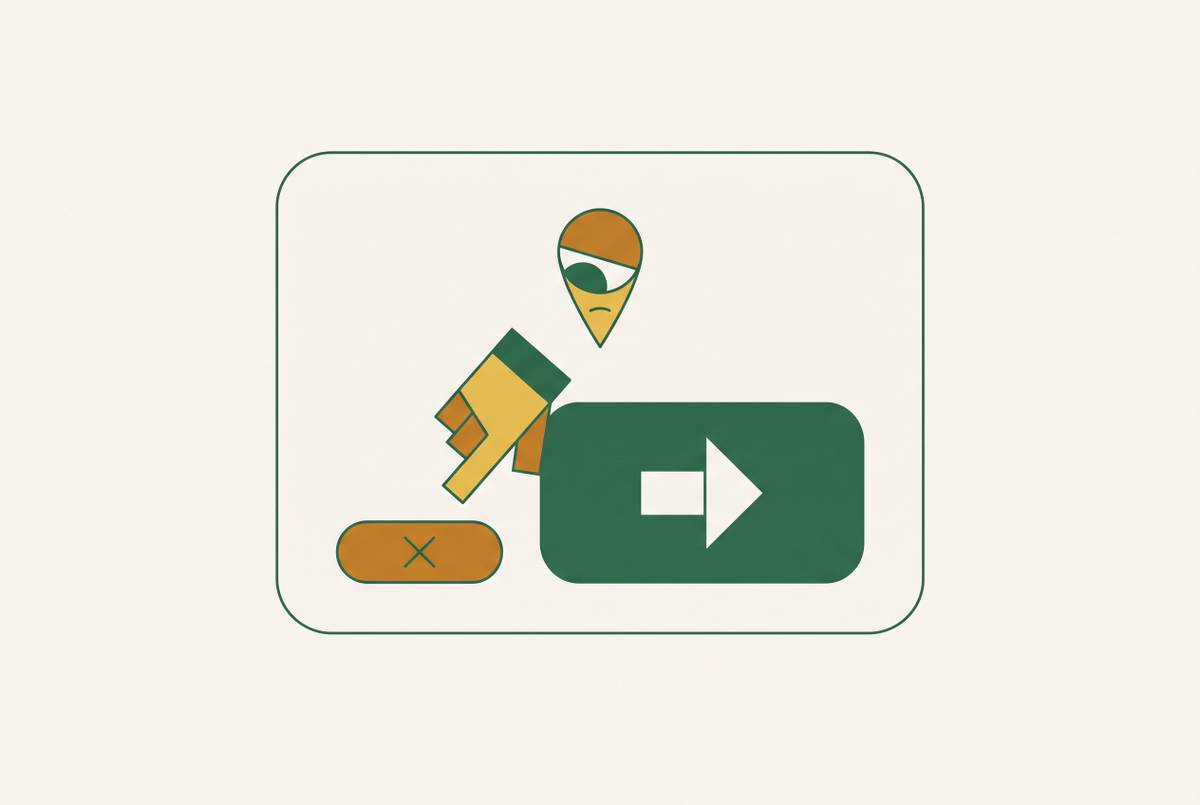
At cancellation, the roach motel reverses the ease of entry. One-click sign-up becomes a buried settings page, repeated confirmations, a retention video, or a phone call available only during business hours. The mechanism is abandonment through effort. Asymmetric button design and interface interference then steer the eye away from the intended choice, with a large blue “I changed my mind” button competing against small gray cancellation text.
Confirmshaming forces a user to select loaded cancellation wording such as “No thanks, I want to pay more” or “I'll miss out on savings”. The save offer trap makes a discount the only prominent choice while hiding or removing the cancel path. A discount alone is not the problem. The obstruction is what turns an offer into a trap.
Subscription resurrection comes after the apparent exit. Some services reactivate a canceled subscription when the user logs back in or updates a payment method, treating that action as implicit consent to resume billing. The customer believes the decision is settled, so there is little reason to watch for another charge. Unlike checkout defaults, this pattern exploits attention that has already moved elsewhere.
How regulators confirmed these are deliberate strategies, not design accidents
The Amazon case gives that architecture a name. A federal court entered an order on September 25, 2025, requiring Amazon to pay $1.5 billion in consumer refunds and a civil penalty over its cancellation process. The FTC called the flow “Iliad,” the name Amazon's own teams used internally. The reference was to Homer's epic poem about the long, arduous Trojan War. A cancellation process named for an ordeal is difficult to dismiss as accidental complexity.
Other cases target different points in the lifecycle. Instacart agreed in December 2025 to pay tens of millions of dollars in consumer refunds to settle allegations that its Instacart+ trial enrollment failed to adequately disclose automatic enrollment in a paid annual subscription. Chegg agreed in September 2025 to pay millions of dollars to settle allegations of difficult cancellation and continued charges after consumers believed they had canceled.
The FTC's lawsuits describe further forms of obstruction. In August 2025, it sued LA Fitness, alleging that cancellation required an in-person visit or mailed notice, that consumers were told to use certified or registered mail, and that important details were not clearly explained. On January 13, 2026, it sued JustAnswer over allegations of enrollment without consent in a recurring monthly subscription. The alleged monthly fee was charged immediately, in addition to the advertised low one-time join fee.
The legal duties predate those cases. The Restore Online Shopper’s Confidence Act requires clear disclosure of material terms before billing information is collected, express informed consent, and simple cancellation. The CFPB's January 2023 circular also warned against terms that are unclear, billing without consent, and ways of misleading customers who try to cancel. California's Automatic Renewal Law and its 2024 amendment AB 2863 require cancellation in the same medium used to sign up and prohibit tactics that undermine consent or obstruct cancellation.
The broader federal rule remains unsettled. The Eighth Circuit vacated the FTC's Click-to-Cancel Rule in July 2025 for procedural reasons. The FTC submitted a draft Advance Notice of Proposed Rulemaking to OIRA on January 30, 2026, and formally announced and published it in March 2026 to restart the process. Enforcing the law can deal with what happened in the past, but it does not stop the next unwanted charge from hitting someone's account tonight.
Why individual vigilance fails as a defense against patterns built to outlast it
That immediate gap is where “just pay attention” falls short. A customer can read and understand the terms and still miss a change to a promotional price 12 months later. A monthly statement review may reveal an annual renewal only after the chance to prevent it has passed, with little room left under the refund policy. Knowledge at sign-up is not attention at renewal.
Manual tracking can work for a motivated person with a small number of subscriptions. It gets harder when six or more trials run on different clocks, fees change, and the customer has to keep trying to cancel. Calendar reminders preserve dates that someone remembers to enter, but they do not discover a forgotten service or an unexpected increase. Friction, guilt, and inconvenience also wear down the drive to keep tracking everything by hand.
The structural mismatch is that a provider's automated billing runs all the time, but the customer checks only now and then. AI tool subscriptions add another layer of recurring charges, often clustered in the same monthly billing window. Automatic monitoring addresses that mismatch by making detection an ongoing process.
How do you find and cancel unwanted recurring charges on your bank account?
Automatic monitoring begins with identifying the service, the amount, and the relevant date. That makes it useful for finding subscriptions in one place, but detection and cancellation remain separate capabilities. A tracker does not remove a merchant's cancellation screens simply by exposing its charges. The useful comparison is therefore between what a tool can discover before billing, what it can flag afterward, and what remains for the customer to resolve.
For trial conversions and pre-checked enrollment, email confirmations can show the terms and dates, and streams of transactions from connected accounts show what is being billed. When the necessary information is available, a tracker can surface the service name, conversion date, and dollar amount before payment. Annual renewal reminders serve the same purpose over a longer interval. Timing is the crucial difference here. A warning before renewal gives the customer time to decide, but finding a charge afterward shows that the problem has already started.
For hidden pricing, bill creep detection checks a recurring charge against what it used to be. An increase that blends into a long statement becomes a finding tied to the same merchant. Renewal information can also make an annual commitment more visible when “monthly billing” has obscured it, although transactions alone do not necessarily reveal the contract terms. Monitoring needs the relevant notice or subscription information to expose the distinction.
For the roach motel, button interference, confirmshaming, and save offer traps, monitoring lets the user see which service is charging, how much it costs, and when action is due. Continued monitoring can then identify charges in connected accounts when billing persists after an attempted cancellation or resumes through subscription resurrection. It does not guarantee that the cancellation succeeds.
Duplicate detection adds another check by flagging the same merchant and amount appearing twice in one cycle, or two charges that appear to cover the same service category. Such a finding needs examination rather than an automatic assumption that both charges are wrong. Promised-refund tracking addresses a related gap after a dispute or cancellation. When a refund agreement and expected window are available, a connected-account monitor can flag that the money has not arrived.
Target and Best Buy offer price adjustments for most products within roughly two weeks, while Home Depot and Costco usually allow 30 days. A tool that sees purchase confirmations and price changes can surface a possible claim before that window closes. Across these uses, completeness depends on access. A manual-entry tracker knows only the subscriptions the user has already remembered to add.
The data access trade-off and why read-only architecture changes the security calculation
Connecting accounts introduces a real privacy cost. A tool cannot find a forgotten subscription in a transaction stream without also seeing other payments, including paychecks, mortgage payments, and pharmacy visits. That history passes through additional parties. A breach or a change in data policy can therefore expose information well beyond the charges the user wanted help finding.
Read-only architecture limits a different kind of risk. A tool linked to a bank through a read-only access token does not store the bank password and cannot move money or start transactions. A breach of that monitoring tool can expose transaction history without granting the ability to transfer funds.
Bobby on iOS and Subby on Android and iOS store subscription data locally on the device without requiring a bank connection. They avoid exposing a bank transaction stream to a monitoring service. In exchange, they cannot find subscriptions the customer has forgotten to enter or spot changes in those bank charges on their own.
For a reader choosing between these approaches, the useful criteria are detection coverage, advance reminders, price-change monitoring, and the breadth of account access. The decision depends on the number of subscriptions and accounts, the potential savings, and trust in the tool's security architecture. Less access means less visibility into private activity.
How AI is changing which side of this fight has the automation advantage
Companies are using conversational AI to make retention flows respond to the person trying to cancel. Instead of presenting the same screens to everyone, a retention agent can answer objections with personalized offers, emotional appeals, and further friction. The obstacle adapts as the conversation continues. That makes occasional consumer attention a weaker counterweight to an increasingly automated effort to preserve billing.
The AI-assisted “refund loop” extends the problem beyond cancellation. A customer service chatbot agrees to process a refund for a lost package, defective item, or canceled service, but the refund does not follow. The conversation appears to settle the issue. Unless someone checks the promise against what later shows up in the account, the missing payment can go unnoticed.
Consumer-side AI applies automation to that missing comparison. Agents that can read an inbox, a card statement, and renewal notices can connect a service's terms with its charges and surface findings continuously. Their useful output is a named subscription approaching renewal, a changed bill, or a promised refund that has missed its expected window.
That capability depends on the data available and still leaves some actions unresolved, with cancellation, a refund, and complete coverage of every account remaining uncertain. But it changes which side must rely on memory. A service can keep designing friction, while monitoring keeps the cost and deadline visible long enough for the customer to act.