State Auto-Renewal Laws and Consumer Notification Requirements
Federal subscription cancellation rules collapsed in 2025.

No federal rule now tells a business how a subscriber has to be allowed to cancel. That standard collapsed in the summer of 2025, and the rules that have replaced it live entirely at the state level. The protection a subscriber gets depends on the address on file, not the size of the company charging the card.
Why the federal baseline for subscription cancellation no longer exists
For years, the FTC's Negative Option Rule was set to apply one cancellation standard across the country, giving consumers a uniform national protection for subscription cancellation. On July 8, 2025, that plan ended. The Eighth Circuit vacated the rule in Custom Communications, Inc. v. FTC, and it did so on a procedural technicality rather than a substantive one: the FTC had skipped a required preliminary regulatory analysis before finalizing it. The timing made the ruling sting even more. It landed six days before the rule's compliance date.
The FTC has not let the issue drop entirely. The FTC restarted rulemaking with an advance notice announced March 11, 2026 and published in the Federal Register March 13, 2026, and the comment period closed April 13, 2026. No proposed rule has followed. Until one does, there is no federal floor requiring that canceling a subscription be as easy as starting one. That vacatur left state law carrying the entire weight of subscription cancellation protection, with legislatures, attorneys general, and regulatory bodies each deciding independently how much friction a business can put between a subscriber and the "cancel" button.
How states moved to fill the gap
States accelerated their own auto-renewal legislation in 2025 and 2026, producing a set of laws that share common architecture but differ in ways that matter to consumers and businesses alike. That distinction carries real weight for anyone trying to figure out what protection they actually hold: a common structure across states doesn't mean a common standard.
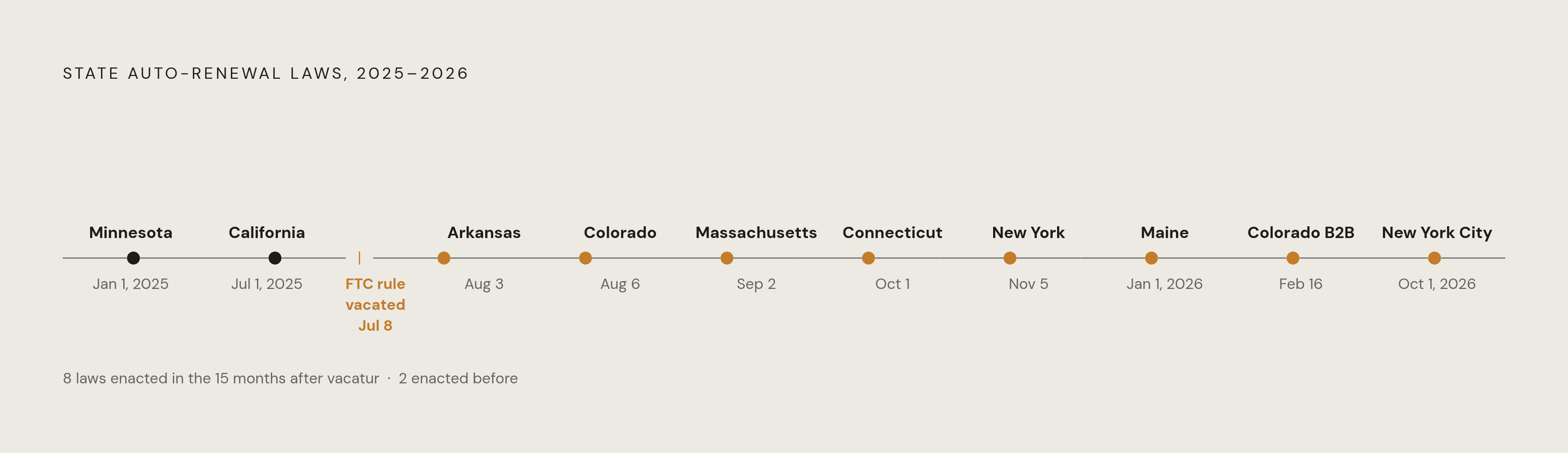
The list of states now active in this space is long, and it's still growing. California's amendments took effect July 1, 2025. Arkansas passed its first-ever auto-renewal law, effective August 3, 2025. Massachusetts issued Attorney General regulations effective September 2, 2025. Connecticut amended its law effective October 1, 2025, with more changes coming via a further bill in July 2026. New York amended its existing statute effective November 5, 2025. Maine's amendments take effect January 1, 2026. Colorado's law split its rollout, with consumer-facing provisions starting August 6, 2025 and a business-to-business extension following February 16, 2026. New York City adds its own layer starting October 1, 2026.
Minnesota's law took effect January 1, 2025, months before the federal rule even got vacated, so state auto-renewal law was already underway rather than a reaction to the federal collapse. State auto-renewal law wasn't a reaction to the federal collapse. It was already underway, and the collapse just removed the one force that might have pulled all these state efforts toward a single standard.
What these laws share is a four-part structure: clear disclosure before a purchase, affirmative consent to renewal terms, reminder notices before a subscription renews, and cancellation that's no harder than signing up was. They diverge in how far in advance a reminder has to arrive, whether a business can make a retention offer during the cancellation flow, whether business-to-business contracts get covered, and how price increases get handled. Rights when a subscription renews at a higher price without warning depend on the state of residence, full stop, and someone in New York holds meaningfully more leverage than someone in a state with no auto-renewal law on the books at all.
What the disclosure requirements say before a consumer agrees to anything
Before any of the consent or cancellation machinery kicks in, state law dictates what a business has to say, and how visibly it has to say it, before a subscriber signs up. That's the first pillar, and it operates entirely upstream of any charge: terms have to be disclosed clearly, conspicuously, and near the moment a consumer agrees to anything, not tucked into a terms-of-service page nobody opens.
California and Colorado both require the same basic package before a contract is executed, including notice that the subscription will auto-renew, how long the renewal term runs, the dollar amount that will be charged, and how to cancel. New York's amended statute adds a spatial requirement to that list. Material terms have to sit in "visual proximity" to the request for consent, or "temporal proximity" for a phone or voice-based offer, and the point-of-sale disclosure has to happen before the business even asks for billing information. That ordering detail closes a common trick: asking for a card number before the subscriber has actually seen what they're agreeing to.
Massachusetts pushes further on trial offers specifically. A business running a free trial in Massachusetts has to disclose, in writing, the actual calendar date by which a subscriber must cancel to avoid getting charged. That standard is stricter than what the now-vacated federal rule ever required. Connecticut, meanwhile, built its definition of "clearly and conspicuously" to closely track California's, and it goes a step further by directing regulators and courts to look at whether a business kept a record of affirmative consent when deciding whether it broke the law. California backs that expectation with a hard number: proof of consent has to be kept for three years, or one year past cancellation, whichever runs longer. Colorado has no matching recordkeeping rule.
None of this works if "clear and conspicuous" gets treated as a throwaway phrase. California additionally requires businesses to retain proof of affirmative consent for the longer of three years or one year after cancellation, while Colorado does not include equivalent recordkeeping requirements.
The affirmative consent requirement
Disclosure tells a subscriber what they're agreeing to. Consent is where the law decides whether they actually agreed to it, and this is where the newest wave of state law breaks most sharply from how subscription businesses have operated for years. A pre-checked box, or a renewal clause folded into a general terms-of-service agreement, no longer counts.
California's law now splits consent into two separate acts. A customer has to check a box or click "I agree" to accept the contract as a whole, and then has to give a second, distinct affirmative consent tied specifically to the auto-renewal terms. Regulators are expected to require something like an unchecked box for that second step, though the statute itself doesn't spell out the exact mechanism. The two consents cannot be collapsed into one click. Colorado, despite having one of the more developed auto-renewal regimes in the country, hasn't caught up to that specific language yet: it requires consent to renewal terms but doesn't demand the same "express affirmative consent" standard California does, which leaves a real compliance gap for any business trying to run one national consent flow.
New York requires affirmative consent to the auto-renewal offer before a business can charge for the initial subscription term. Maine's SP 650 does something similar, amending its existing law to require separate consent to the auto-renewal provision specifically, effective January 1, 2026.
Taken together, these requirements have a direct consumer-facing consequence. A business that enrolled someone through a pre-checked box, or through language buried inside broader terms, is likely operating outside the law now in California, New York, and Maine, among other states, and any charges that followed that enrollment may be recoverable.
The Instacart case shows what this failure looks like in practice. Instacart's free-trial signup flow for Instacart+ didn't adequately tell subscribers they'd be billed once the trial ended, and it didn't disclose the company's refund policy either. The FTC settled with Instacart in December 2025, and the company agreed to pay $60 million back to affected consumers. That number puts a dollar figure on what a disclosure and consent failure at the trial-to-paid conversion point actually costs.
What price-increase rules now require
Disclosure and consent govern how a subscription starts. Price-increase rules govern what happens once it's already running, and this is arguably where the newest state laws matter most to a subscriber's actual wallet. The core shift: a business can no longer just send a notice that the price is going up and then charge the higher amount.
New York's amended law, effective November 5, 2025, gives a business exactly two ways to comply when it wants to raise a price. It can get the subscriber's affirmative consent to the new price before charging it, or it can charge the new price and then let the subscriber cancel penalty-free within a set window afterward, with a pro-rated refund for the rest of that billing term. That second path matters because it builds a safety net directly into the billing cycle instead of relying on a subscriber to catch the change before it happens.
A carve-out applies when a subscriber agreed to a price increase at signup, say a promotional rate that converts to standard pricing after some fixed period: that conversion isn't covered by the new consent requirement. California takes a different angle on the same problem: its amended law requires advance notice before any price increase, even one the subscriber already agreed to at signup, which makes California's notice obligation broader than New York's on this specific point, even though New York's consent-or-refund structure goes further in other ways.
The practical right this creates for a New York subscriber is specific. If a statement shows a higher charge than the last billing cycle, and the business never got advance affirmative consent for that increase, the subscriber has a 14-day window to cancel and claim a pro-rated refund for the rest of that period.
That right matters because of how subscription pricing actually moves. A promotional rate expires, a tier gets renamed and repriced, an add-on feature gets switched on by default on the next invoice, and historically none of those changes required a new consent act from anyone. New York City's rule takes effect October 1, 2026. Netflix Premium illustrates the scale this kind of quiet escalation can reach: the tier launched at a fraction of today's price, and as of March 2026 it had climbed 238% over 15 years. The Netflix Premium example illustrates the general shape of the problem these laws were built to catch: increases that arrive gradually enough, and separately enough, that no single moment ever demanded a subscriber's fresh yes.
Renewal reminder timing windows
A reminder that arrives after the cancellation deadline has already passed is a receipt, not a reminder. That's why the timing window a state mandates matters as much as whether it mandates a reminder at all, and states have landed in genuinely different places on this question.
New York requires a renewal reminder for subscriptions with an initial term of a year or more and a renewal term of six months or more, sent within a set window before the cancellation deadline, delivered through whatever method the subscriber picked, and including instructions for how to cancel. California requires reminders before annual renewals, on its own timeline, and a shorter-window reminder before a free trial longer than a month wraps up. Colorado requires notice before each annual renewal, and for anything billed monthly or shorter, before the specific renewal that would push the subscription past its one-year mark.
Massachusetts splits its approach by plan length. Subscriptions running longer than a month get a written reminder within a set window before the cancellation deadline; shorter plans get either a pre-renewal notice or a receipt sent at least as often as the subscriber gets charged. Utah requires a reminder before renewal for longer subscription terms, plus a separate notice at least three days before a free trial ends.
Minnesota's rule stands apart from all of these. It requires a written annual reminder for any continuous-service subscription with no fixed end date, including ordinary month-to-month plans, but it doesn't apply the same requirement to fixed-term auto-renewals. New York City adds one more layer on top of all of this, effective October 1, 2026: its rule covers auto-renewal and continuous-service subscriptions sold to NYC residents no matter where the business itself is located.
Putting the differences side by side brings the consumer stakes into focus. In a state without any reminder requirement, a subscription can renew quietly for years without a single notice. In Minnesota, a business has to reach out at least annually even for a service that costs almost nothing per month, and that single annual notice does real work: it's the mechanism that makes it possible to stop tracking every subscription manually and still catch the ones worth cutting.
Cancellation mechanics: what "as easy as sign-up" means in specific legal terms
"Cancellation should be as easy as sign-up" sounds like a slogan until it gets written into statute, and once it does, it turns into specific, testable requirements that vary meaningfully by state. This pillar has produced the most enforcement action over the past two years, because subscription flows have been built wide of what the law now demands.
California's version of the standard is medium-matching: however a subscriber signed up is how they have to be able to cancel. Sign up online, cancel online. Sign up by phone, and the business has to provide a toll-free number to cancel by phone. The cancellation process itself has to be no more complicated than enrollment was. Colorado's amendment, effective August 6, 2025, goes further for online subscriptions specifically by requiring a "one-step online cancellation link," and it separately bars businesses from obstructing or delaying the cancellation process once a subscriber starts it. Massachusetts requires that the cancellation option live on the same website or web application used to sign up in the first place.
That last distinction, same platform versus similar platform, sounds like a technicality. Whether "easy to cancel" is a real legal standard, or a phrase a business can satisfy on paper while still routing subscribers through a maze to get out, comes down to exactly this kind of technicality.
Sources
- New York and Colorado Update Auto-Renewing Subscription Requirements | Perkins Coie
- States Press Forward with Automatic Renewal Laws Amidst Vacating of the FTC’s Negative Option Rule | Inside Privacy
- Auto-Renewal Laws: 2025 Round Up | Kelley Drye & Warren LLP
- Automatic Renewal Mid-Year Update: Legal Landscape Imposes Increasingly Complex Obligations on Subscription Businesses
- US Appeals Court Blocks FTC’s “Click-to-Cancel” Subscriptions Rule: What Your Business Must Know, Matthew Richardson
- California Amends Autorenewal Law, with Stricter Consent Requirements and a “One Save” Rule: Fast VAST Update | Insights | Venable LLP
- New York’s New Automatic Renewal Law: How It Compares to California
- Minnesota Automatic Renewal Law: Notice Requirements | Aaron Hall, Attorney