Consumer Refund Rights When Subscription Terms Change
Know your window: most subscription refund claims expire within 14 to 30 days.
Consumer Refund Rights When Subscription Terms Change.
How subscription pricing and terms quietly shift
Subscription terms change all the time, and most of those changes come with a legal obligation to notify the consumer clearly before billing them differently. That obligation gets ignored more often than most people realize, and the money involved is not small. The average U.S. adult spends $1,080 a year on subscriptions, and $205 of that goes toward services that have simply been forgotten moneywise.com consumeraffairs.com ClaimCow. Forgetting is not a personal failing so much as a predictable outcome: 42% of consumers say they've lost track of a recurring charge at least once, and the average person believes they're running 3 active subscriptions when the real number sits a little over 5 C+R Research's Subscription Service Statistics Report.
Nothing about the service changes when this happens. The show still streams, the software still opens, only the number on the statement moves. That's why it goes undetected for so long.
None of this is really carelessness on the consumer's part. It's the designed outcome of a billing model built so that doing nothing equals agreeing to whatever the new terms are. The money keeps leaving the account either way, and the rights to get some of it back already exist. They just require knowing where to look, and when. Late-2025 price hikes of just $1–$3 per service quietly pushed many households $15–$30 higher per month, small enough to pass unnoticed, large enough to matter across a year consumeraffairs.com ClaimCow Refund Policy Clauses in Subscription Service Terms.
What triggers a refund right when subscription terms change
Three kinds of change most commonly open the door to a refund: a price increase, a real cut to features or service scope, and a shift in how cancellation works or how much notice a company has to give before billing continues. The legal concept underneath all three is called negative option billing: a company treats silence, or simple inaction, as consent to be charged under new terms C+R Research's Subscription Service Statistics Report. That's only legal when every material term was spelled out clearly and visibly before the billing information was even collected. When those disclosures are missing, or hidden in dense fine print, or arrive after the charge already hit the card, the charge stops being legally defensible.
Two federal rules do the heavy lifting here. ROSCA, the Restore Online Shoppers' Confidence Act, bars online negative option marketing unless the company laid out all costs and cancellation terms clearly before collecting payment information. Section 5 of the FTC Act works as a broader backstop, banning unfair or deceptive practices in commerce generally. On top of that, most states run their own Automatic Renewal Laws, which require a business to tell consumers about a fee increase before it renews, spelling out the new rate, the date it takes effect, and how to cancel. Skipping any of that gives the consumer grounds to cancel penalty-free or to ask for a refund.
Federal law does not hand consumers a refund just because they're unhappy about a price hike. The trigger is the company's failure to disclose. So the practical test is simple. Got charged a higher rate with no clear notice beforehand? There are grounds. The practical test is whether anyone acts on these grounds before the window closes.
The notice windows and cooling-off periods that determine whether a claim holds
None of these rights sit open indefinitely. Almost every claim comes down to whether the consumer moved within a defined window after the triggering event, and those windows are often shorter than people assume. Refund policies commonly give 14 days for monthly renewals and 30 days for annual ones, though this varies by company, and some allow as little as a week DMH Stallard Refund Policy Clauses in Subscription Service Terms.
The UK's Digital Markets, Competition and Consumers Act, with subscription rules expected to take effect in January 2027, offers a useful picture of what a disclosure-linked window looks like in practice. It sets a 14-day cooling-off period after a free trial ends, and again after any renewal that locks a consumer into another 12 months or more DMH Stallard govfacts.org Refund Policy Clauses in Subscription Service Terms. If a business never told the consumer about that cooling-off right in the first place, the cancellation window doesn't just stay open, it stretches out to as long as 12 months, which is a serious remedy for a company that stayed quiet DMH Stallard govfacts.org. After a renewal happens, consumers get a 14-day cancellation right along with a refund calculated proportionally DMH Stallard Refund Policy Clauses in Subscription Service Terms. Businesses also have to confirm any online cancellation within 24 hours and send renewal reminders ahead of key dates, including the end of a free trial and every six months after that.
There's a U.S. A parallel to moneywise.com consumeraffairs.com ClaimCow. Connecticut's law, effective July 1, 2026, requires renewal notices to go out through whatever channel the consumer used to sign up, or whatever channel they most commonly use to talk to the company dglaw.com. That closes off the old defense of "we emailed you," when the email in question landed in a spam folder nobody checks. Most consumers have no idea a window is open until it has already shut. Watching billing dates and notice emails, even loosely, is really the only thing that makes any of these rights usable. And "proportionate refund" isn't the full subscription price back, it's calculated on unused time, so anyone filing a claim should keep track of usage dates and the exact timestamp of cancellation.
How enforcement actions reveal the specific failures companies make
Regulatory settlements are the clearest map of where companies actually go wrong, because the FTC and state attorneys general don't chase vague complaints, they chase specific, provable failures consumeraffairs.com ClaimCow dontpayfull.com dglaw.com.
Amazon agreed to a $2.5 billion settlement over claims it enrolled millions of people in Prime without real consent between 2019 and 2025 consumeraffairs.com ClaimCow. Of that, $1.5 billion went toward consumer refunds, up to $200 per person after a September 2026 court order raised the amount from an original $51, with the remaining $1 billion landing as civil penalties, making it the largest subscription settlement on record consumeraffairs.com ClaimCow. Adobe settled for $150 million in March 2026, split between a $75 million civil penalty and $75 million in free services, over trapping people in annual plans without clearly disclosing the cost of getting out early consumeraffairs.com ClaimCow dontpayfull.com dglaw.com. A separate, earlier Adobe settlement carried the same $75 million cash plus $75 million free-services structure consumeraffairs.com ClaimCow dontpayfull.com dglaw.com. The lesson from both cases isn't that early termination fees are illegal, it's that burying them is consumeraffairs.com ClaimCow dontpayfull.com dglaw.com.
Chegg paid $7.5 million over a cancellation flow regulators called confusing and hard to navigate, on top of billing customers who had already cancelled claimcow.com. The FTC's complaint made a sharper point here: disclosures can technically exist on the page and still fail, if the overall signup flow was built to prevent anyone from actually absorbing them consumeraffairs.com ClaimCow dglaw.com. Shutterstock paid $35 million after marketing subscription packs as "on-demand" purchases while quietly enrolling buyers in automatic renewals and making cancellation difficult.
Each of those failures lines up directly with a refund right that sat unclaimed until a regulator stepped in. The penalties involved explain why: FTC violations can run past $53,000 each, and the FTC's all-in-pricing rule, in force since May 12, 2025, allows penalties up to $51,744 per violation legalclarity.org ClaimCow DMH Stallard govfacts.org. Multiplying either figure across a few million accounts means a nine-figure settlement stops looking unusual, since FTC violations can exceed $53,000 per violation and the all-in-pricing rule carries penalties up to $51,744 per violation legalclarity.org ClaimCow DMH Stallard govfacts.org. For anyone reading this who got auto-enrolled without clearly saying yes, or kept getting billed after hitting cancel, checking active settlement claim sites for Amazon, Adobe, Chegg, or Shutterstock costs nothing and might already apply.
The patchwork of state laws that may give U.S. consumers stronger local rights than federal law provides
Federal law sets a floor here, not a ceiling. California, Colorado, and Connecticut all require that material subscription terms stand out visually from the rest of the text, larger type, a contrasting color, a set-off symbol, rather than just existing somewhere inside a wall of terms and conditions. California goes a step past that: businesses have to keep proof of each consumer's affirmative consent for at least three years, and for a year after the subscription ends, which leaves an evidence trail a consumer can actually request.
Connecticut's rule, again effective July 1, 2026, requires that renewal notices arrive through the same channel the consumer originally used to sign up, or whichever channel they use most often to deal with the company dglaw.com. That shuts down the old excuse of a notice buried in an inbox nobody opens. New York City moved in April 2026, with Mayor Mamdani and the city's Department of Consumer Protection proposing a municipal "Click to Cancel" rule modeled on the version the federal government lost in court dglaw.com. If it goes through, New York City would be the first city in the country enforcing that standard on its own dglaw.com.
At the federal level, there's a bill in motion but nothing binding yet. The bipartisan Unsubscribe Act, introduced January 13, 2026 by Representatives Takano, Amodei, and Magaziner, would require affirmative consent before a free trial converts to a paid charge, advance notice before payment, and a cancellation method that matches however the consumer signed up dglaw.com gcn.com. As of the most recent reporting, it hasn't reached a floor vote dglaw.com gcn.com. And the federal rulemaking picture has an actual gap in it right now: the FTC's Click-to-Cancel rule got vacated by the Eighth Circuit in July 2025 on procedural grounds, and while the FTC has since opened a new rulemaking process, none of the specific mandates from that rule are enforceable today. That leaves state law doing more of the real protective work than federal law at the moment. Anyone assuming they have no recourse should check their own state's ARL first, since many states with strong ARLs already give consumers direct grounds to dispute a charge without waiting on a federal enforcement action. Federal law provides a floor, not a ceiling: state Automatic Renewal Laws often impose stricter disclosure, consent, and notice requirements than ROSCA or FTC rules alone.
Building a concrete claim when a subscription changed its terms without adequate notice
Start by pinning down the triggering event. Find the exact date the price or terms changed, and figure out whether a clear notice arrived before that date. If nothing appeared in that notice period, that silence is itself part of the evidence.
From there, document everything before making contact. Screenshot the subscription's current terms and price. Pull 12 months of bank and credit card statements to lay out the billing history and pin down exactly when the change happened DMH Stallard govfacts.org. Search email, including the spam folder, for any renewal or price-change notice the company claims to have sent, since whether it exists or not is material to the claim. And compare the cancellation process available at signup to whatever process exists now: if it's gotten harder to cancel over time, that shift matters legally.
Once that's assembled, contact the company with something specific: the date of the undisclosed change, the exact amount overbilled, and a direct request for a refund covering the period billed without adequate notice. Scripts asking a rep for a courtesy credit tend to work more often than people expect, and staying quiet after making the ask, rather than filling the silence, tends to work in the consumer's favor, since reps are frequently authorized to offer a retention credit just to avoid losing the account. If the company says no, a credit card chargeback is the next step. Most issuers accept disputes over unauthorized or undisclosed charges, and the company's refusal should get attached to that chargeback submission as proof.
Filing a regulatory complaint matters too, even when it doesn't produce an instant refund. The FTC takes reports at reportfraud.ftc.gov, and most state attorneys general and consumer protection offices take them directly, particularly valuable in a state with a strong ARL. Speaking of which, it's worth checking whether one of those settlements already covers the situation. Amazon, Adobe, Chegg, and Shutterstock have all run active claim periods, and consumers billed improperly during the relevant stretch may already qualify without having filed anything themselves. After cancelling anything, confirm it in writing by email, screenshot the confirmation screen, delete any saved payment method from the account, and check the following month's statement for a ghost charge, since billing that continues after cancellation is its own separate claim.
Why these claims go unclaimed
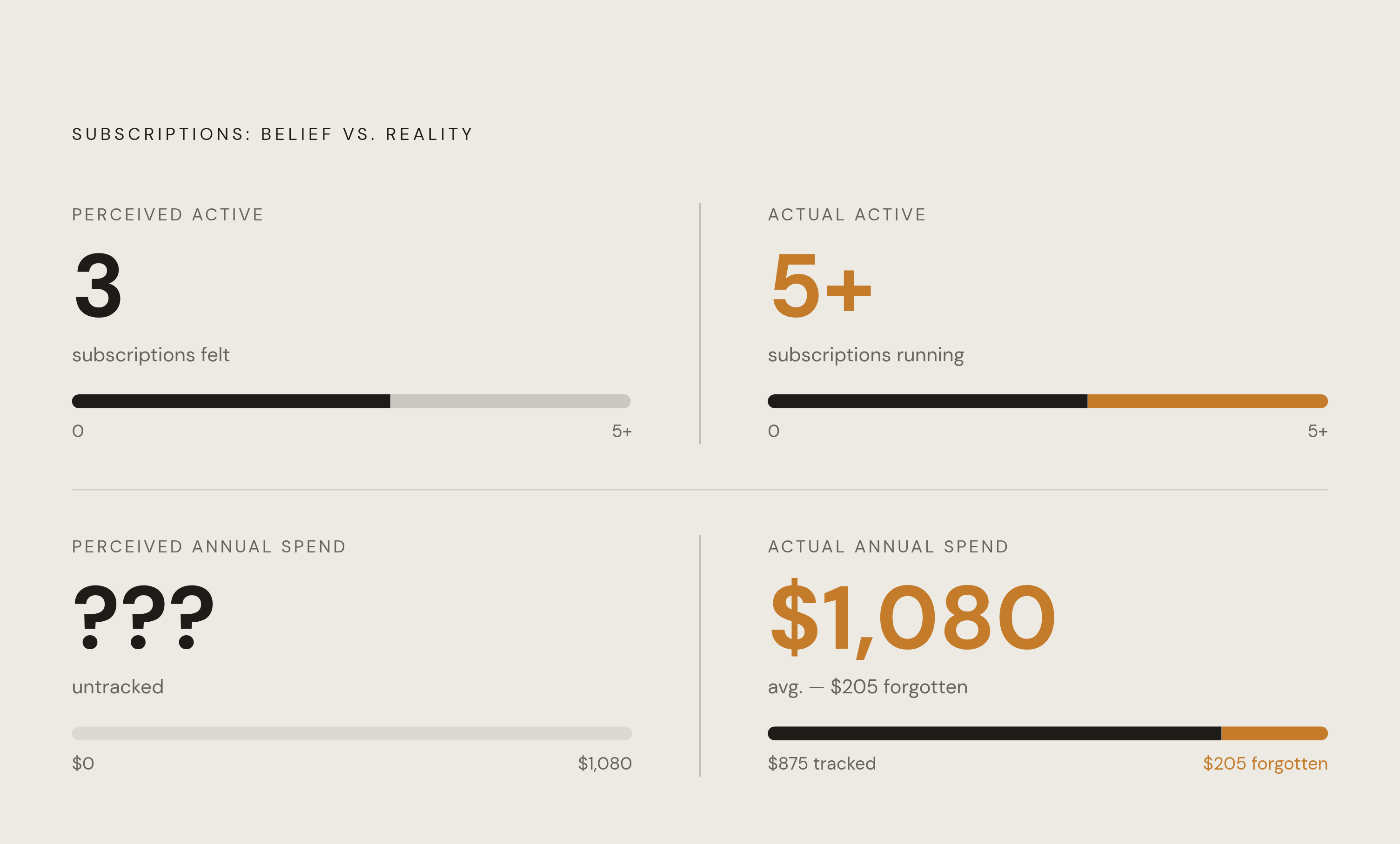
70% of consumers ended up stuck in a paid subscription they didn't want simply because a free trial slipped past them unnoticed gcn.com. That's not really about intent. Nobody sets out to forget a trial converts on the 14th of the month DMH Stallard govfacts.org Refund Policy Clauses in Subscription Service Terms. The difficulty of manually watching several different billing cycles at once, month after month, without ever letting one slip, is visible in the numbers: 42% of consumers say they've forgotten about a recurring payment at least once, and the average person believes they have 3 active subscriptions but actually has a little over 5 C+R Research's Subscription Service Statistics Report. The average household runs a little over 5 active subscriptions while believing the number is 3, and that gap alone explains why most people aren't even tracking what needs tracking in the first place C+R Research's Subscription Service Statistics Report.
Every right laid out in this piece runs on a clock. A 14-day cooling-off period, a renewal notice that should have shown up by a certain date, a price change that took effect on a day that's already passed DMH Stallard Refund Policy Clauses in Subscription Service Terms. A right that expires unused behaves exactly like a right that was never there to begin with. And the asymmetry driving all of this cuts one direction: companies run automated systems tracking every single billing event down to the second, while consumers rely on memory and the occasional glance at a bank statement, most not even checking monthly, let alone catching anything inside a 14-day window DMH Stallard Refund Policy Clauses in Subscription Service Terms.
Subscription creep is ongoing and needs ongoing attention, not one clean audit. It's ongoing, so it needs ongoing attention, not a single pass through the bank statement every January. The legal rights mapped out here are real and specific, tied to exact statutes, exact dollar figures, exact deadlines. What's missing for most people is the habit of watching closely enough, and often enough, to catch the moment those rights actually open. It's the habit of watching closely enough, and often enough, to catch the moment those rights actually open.
Sources
- New subscription rules are coming: is your business ready? - DMH Stallard
- Spring Cleaning Your Subscription Practices: What to Toss Before Regulators Do
- Refund Policy Clauses in Subscription Service Terms
- Can I Refund a Subscription? Your Legal Rights
- Subscription Settlement Guide for 2026 | ClaimCow
- Subscription price creep is real — and it quietly got worse in late 2025