Feature Removal as an Effective Price Increase
When vendors strip features or kill discounts, the price stays the same but what you get costs more.
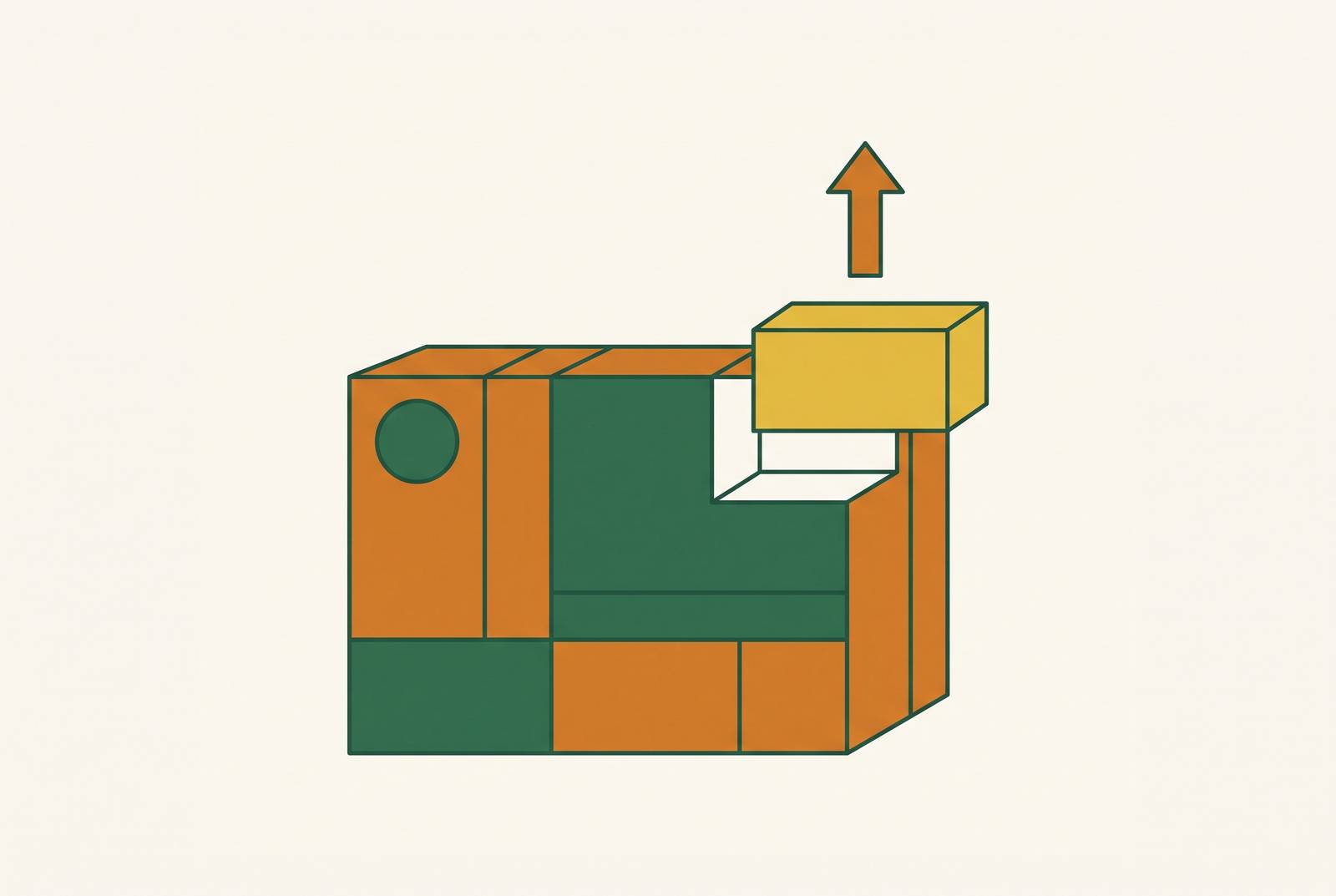
A price increase doesn't need a new number on the invoice. Stripping a feature, killing a discount, or quietly renaming a tier leaves the bill the same while what it buys gets smaller. That's an effective price increase, and it never appears on any price-change notice a vendor sends out.
The distinction matters because of how each type gets tracked. A nominal price increase is easy to catch: the number on the invoice changes, someone notices, done. An effective price increase hides inside the fine print of "what's included." The mechanic takes three forms, and once you can name them, you start seeing them everywhere.
First: a capability that used to come with your tier gets pulled and moved up to a pricier one. Second: a discount or volume break baked into your contract gets eliminated, usually with zero fanfare. Third: the tier itself gets restructured, renamed, rebundled, so that keeping the access you already had now requires an upgrade you didn't ask for.
None of this appears on a "price change notice" because, technically, the vendor isn't lying. The list price for the tier really didn't move. Or new features got bundled in, and the vendor can point to those as justification for the new number. The customer's loss never makes the headline. It's buried inside a paragraph about "enhanced value" or "platform improvements."
The loss is dollar-denominated, and it requires the customer to do the math themselves. The vendor has zero incentive to do that math for you. Nobody sends a follow-up email that says "by the way, you're now paying 19% more for the same access you had in October." That math is your job, and most people never run it.
How vendors justify the mechanic: the AI bundling pattern of 2025–2026
The dominant move over 2025 and 2026 has been bundling AI features into existing tiers, then using that bundle as cover for a list-price increase, regardless of whether the customer ever touches the new feature.
Adobe restructured Creative Cloud into Pro and Standard tiers, effective June 2025, with effective increases running as high as 27%, per licenseware.io. The justification: generative AI tools folded into the plans. Whether a given customer used those tools was beside the point.
ServiceNow did something similar with its Now Assist AI add-on, which produced a 30 to 45% uplift on affected contracts in 2025, according to the same source. Microsoft ran a version of this too: bundling Defender for Office 365 Plan 1 into E3, and Security Copilot capacity into E5, alongside price increases set for July 2026. Per redriver.com, for organizations that were already paying for those capabilities separately as add-ons, the bundle actually changes the math in their favor. For everyone else, it's just a cost increase with a feature most of them won't use.
Now run that mechanic in reverse. Stripping a capability that used to be included while leaving the price untouched means the customer absorbs the loss without a single line of disclosure calling it a loss. That's the quiet half of the software-bundling story, and it's the half that doesn't get press coverage.
This isn't a story about villainy. Plenty of customers get real value from AI features bundled into their existing tier. The point is narrower and more useful: the mechanic works identically whether value is being added or subtracted, and the customer usually can't tell which one happened without running their own audit. More than 200,000 Adobe customers switched away from the platform in Q1 2026, per lowermysubs.com, which is the clearest signal available that people do eventually notice and act. But the lag between the change landing and the customer reacting is exactly where the money leaks out.
The discount-removal case: Microsoft's EA volume discount elimination
Microsoft's enterprise pricing changes for 2026 come in two parts, and the coverage mostly caught one of them.
Part one is the visible piece: list-price increases announced in December 2025, effective July 1, 2026. Per samexpert.com and trustedtechteam.com, the increases break down like this:
- Microsoft 365 E3: up 8.3%, from $36 to $39 per user per month
- Microsoft 365 E5: up 5.3%, from $57 to $60 per user per month
- Microsoft 365 F1 (frontline): up 33%, from $2.25 to $3.00 per user per month
- Microsoft 365 F3 (frontline): up 25%, from $8 to $10 per user per month
- Office 365 E3: up 13%
- Microsoft 365 Business Basic: up from $6 to $7 per user per month
Those are the numbers that made it into the trade press. Part two is the one that mostly didn't: in November 2025, one vendor eliminated automatic volume discounts under its enterprise licensing program for Levels B, C, and D. Per samexpert.com, those discounts used to run roughly 6% at Level B, 9% at Level C, and 12% at Level D. Now, every EA, EA Subscription, and MPSA customer (outside US Government on AOS-G) defaults to Level A, meaning list price, at renewal or whenever they add a new online service not already sitting on their price sheet. Seat count no longer matters.
That's the feature removal hiding in plain sight. The discount wasn't a marketing gimmick, it was a contractual mechanic built into how EA pricing worked. Pulling it out is a real, measurable price increase, and it landed months before the announced July hike, on a change that never appeared on anything labeled a "price change notice."
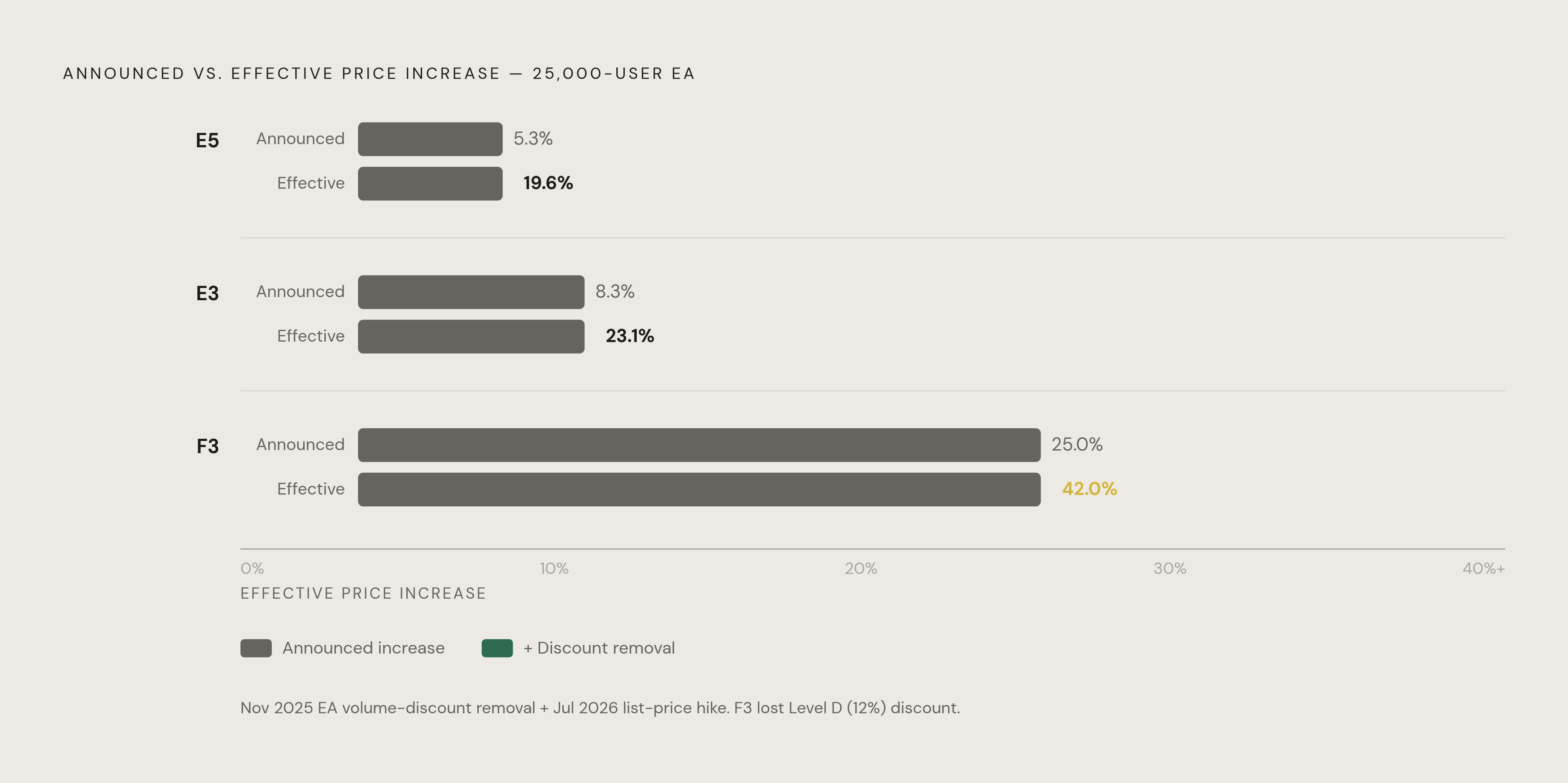
Stacking the two together makes the math ugly fast. Take a 25,000-user organization running Microsoft 365 E5 that previously held Level D pricing. Per samexpert.com, its annual cost before November 2025 was $15,048,000. After the July 2026 increase, that same seat count runs $18,000,000. That's an effective increase of 19.6%, compared with the 5.3% the E5 list-price bump would suggest on its own. The same organization on E3 is looking at a 23.1% effective increase. Frontline F3 customers who held Level D pricing face the worst of it: a 42.0% effective increase, because the 25% list hike stacks directly on top of the lost 12% discount.
Trustedtechteam.com puts it in blunter terms: when EA clients actually model out a renewal that combines both changes, the number that comes back is typically 15 to 20% above last year's rate. Not the 5 to 8% the headline announcement implied.
To be fair, not every product got hit. Two other product tiers held flat, and customers under one government's jurisdiction. Federal, State, and Local agencies on AOS-G were excluded from the EA discount removal entirely, per trustedtechteam.com. This isn't really about making Microsoft the bad actor here. It's about showing how two separate changes, each individually disclosed and each technically accurate on its own terms, combine into a number that no single notice ever communicated in full.
The same mechanic at consumer scale: subscription tier restructuring and promotional expiry
The enterprise version of this problem has a consumer twin, and it runs on the exact same logic, just with smaller numbers and no legal department reading the fine print for you.
Per billcreep.com, the pattern looks like this: a promotional rate expires after 12 months and the account rolls over to the standard rate without anyone signing anything new. A streaming tier gets renamed and repriced. An AI add-on gets switched on by default starting with the next invoice cycle. None of these require a customer's signature, a checkbox, or even an email you're likely to open.
Paramount+ is a clean, named example. In November 2025, effective January 15, 2026, the service confirmed price increases alongside a phase-out of free trials. Both the ad-supported Essential plan and the ad-free Premium plan saw price increases. Removing a free trial is its own quiet version of feature removal: the "feature" being removed is a cost-free evaluation window, and the subscription price on the other side of it didn't drop to compensate.
Zooming out, the scale is harder to ignore. Per lowermysubs.com, Q1 2026 was the most aggressive pricing season in two years: 34 major subscription services raised prices, while only 8 either added real value or lowered costs. Do that math across a typical household and the number stops being abstract. A household running 8 to 10 subscriptions should expect costs to climb somewhere between $12 and $28 a month, or $144 to $336 a year, depending on which services it's carrying.
The mechanic at consumer scale isn't structurally different from the enterprise version. It's just less visible. Enterprise customers at least get contract notices and legal language to parse, however dense. Consumers get fine print they agreed to at signup, half-remembered at best, and a line item on an invoice they probably scanned rather than read.
Why the math stays hidden: how the design of billing and cancellation works against the customer
Recurring billing runs on one core assumption: inaction equals consent. The customer has to actively object to a change; the vendor never needs active reauthorization to keep charging. That default, baked into how auto-renewal works everywhere, is the entire reason this mechanic functions at scale.
Cancellation flows make the asymmetry worse. A peer-reviewed study presented at ECCE 2025 in Tallinn, Estonia looked at six services, The Economist, Bloomberg, Scribd, Adobe Creative, Amazon Prime, and Audible, and found Loss Aversion Manipulation present in 5 of the 6. Hidden Options and Navigation Barriers were present in 4 of the 6, engineered friction at the exact moment a customer tries to stop paying. These aren't accidents of interface design. They're friction, engineered into the exact moment a customer tries to stop paying.
Regulation hasn't caught up yet, and where it tried, it stumbled. The FTC's Click-to-Cancel rule, an expansion of its existing Negative Option Rule, was finalized in 2024 but got vacated by a federal appeals court in 2025 over procedural issues, per pandectes.io. New York is moving on its own: the state's FY2026 budget includes rules requiring cancellation to be as easy as sign-up, plus advance notice of price changes, per budgetandthebees.com. But that's one state. Federal protection on this specific problem doesn't currently exist.
None of this means vendors hide changes outright. Most communicate them, in an email, a terms-of-service update, a renewal quote. The communication is built to be missed, and the burden of reading it, understanding it, and acting on it sits entirely with the customer.
The VMware to Broadcom transition is the extreme version of all this. Perpetual licenses got forcibly converted into subscription bundles, and customers reported net cost increases running from 150% up to 1,200%, per licenseware.io. The "feature" removed there wasn't a checkbox or a discount tier. It was perpetual ownership itself.
Research cited puts the broader recurring-charge economy at $27.7 billion, built structurally on customers not paying close attention, a market that runs on inertia. That's not an accusation against any one company. It's a description of a market where the business model runs on inertia.
What to do when a benefit you were paying for disappears
Start with a baseline. What does the plan you're paying for actually include right now, and what did it include the day you signed up? The gap between those two lists is your effective price increase, in plain terms.
For consumer subscriptions, price-adjustment windows exist, but they're time-bound and they close without a reminder. Target offers up to 14 days for members and 7 days for non-members, per errorempire.com. Crutchfield offers a 60-day window. Missing the window means the price drop you were entitled to simply evaporates.
For software or enterprise contracts, pull the actual Customer Price Sheet before signing any renewal. Per trustedtechteam.com, the published tables show list-price movement, not what a vendor will actually quote a given account, and something like an EA discount removal can be entirely absent from the headline percentage a rep quotes you.
Negotiation still exists, it's just no longer automatic. Per samexpert.com, organizations now have to negotiate for any discount instead of qualifying for one automatically based on seat count. The discount didn't vanish so much as it moved from automatic to opt-in, and opt-in requires someone on your side to ask.
Cancellation remains a legitimate response when a feature removal tips a tier below its price point. Alternatives to Adobe's Creative Cloud, tools like Affinity and Pixelmator, get cited in the research as the kind of competitive option customers turned to in 2026 when the math stopped working for them.
There's a simple tactical defense for free-trial traps too: a virtual card, something like Privacy.com, set to a $1 spend limit after the trial period ends. Configured that way, the renewal charge gets declined automatically, and the customer never has to remember a cancellation date under pressure.
And if a cancellation flow is actively obstructed, that's reportable. The FTC takes complaints at reportfraud.ftc.gov, and regulatory enforcement builds case by case on exactly that kind of individual reporting. New York residents now have additional state-level recourse under the FY2026 rules as well.
Why ongoing monitoring beats periodic auditing for this specific problem
Microsoft's EA discount removal and its list-price increase landed months apart, as two separate events. An audit run after the July 2026 announcement but before a renewal could easily miss the November 2025 discount removal, since the two changes landed months apart as separate events. That timing gap is the whole argument for monitoring over auditing.
Every recurring bill is built to creep continuously, not as a single event. Promotional rates expire on a schedule. Regulatory recovery fees tick up in small increments. AI add-ons get switched on by default with the next invoice cycle. None of this is a one-time change you can catch with a single sweep of your statements.
Subscription sprawl compounds the problem. With 34 major services raising prices in a single quarter, per lowermysubs.com, the sheer pace of change outruns anything a periodic review could realistically track. By the time a quarterly audit rolls around, three or four separate changes have already happened and already cost money.
Effective monitoring means watching renewal dates as they approach, tracking exactly when a promotional rate was set and exactly when it's scheduled to expire, flagging when a tier's description changes between billing cycles, and catching a fee line item that ticks up without a notice attached to it. That's a fundamentally different task than reviewing a stack of statements once a quarter.
The same financial data connections that make this kind of monitoring possible, a large and growing share of consumers have linked financial accounts to third-party services, are read-only by design. A monitoring system can see that a fee changed. It cannot move a dollar. That's the correct scope for something watching your accounts on your behalf.
None of the companies running these changes are announcing them as losses to the customer. They're announcing updates, restructurings, improvements. The only real way to know what actually got taken away is to have something checking the fine print before the renewal posts, not after.
Sources
- Software Price Increases 2025 – 2026
- Microsoft 365 Price Increases for 2026 - How to Save With Discounts
- Microsoft 365 2026 Price Increase Is Nearly 20% | SAMexpert Blog
- Microsoft 365 Price Increase 2026: What’s Changing and When
- Q1 2026 Subscription Price Changes: Every Increase and New Deal Tracked
- nickalive.net
- dl.acm.org
- pandectes.io