Unused Subscription Services and the Cost of Forgotten Memberships
Billing systems are designed to hide the true cost of your subscriptions from you.
Unused subscriptions pile up because the billing system behind them is built to stay below the threshold of conscious attention, not because people are careless. Small recurring charges run on autopilot. They land on different dates, draw from different cards and accounts, and never collect themselves onto one statement a person could glance at and understand in full. The same frictionless design that makes signing up effortless also makes forgetting effortless.
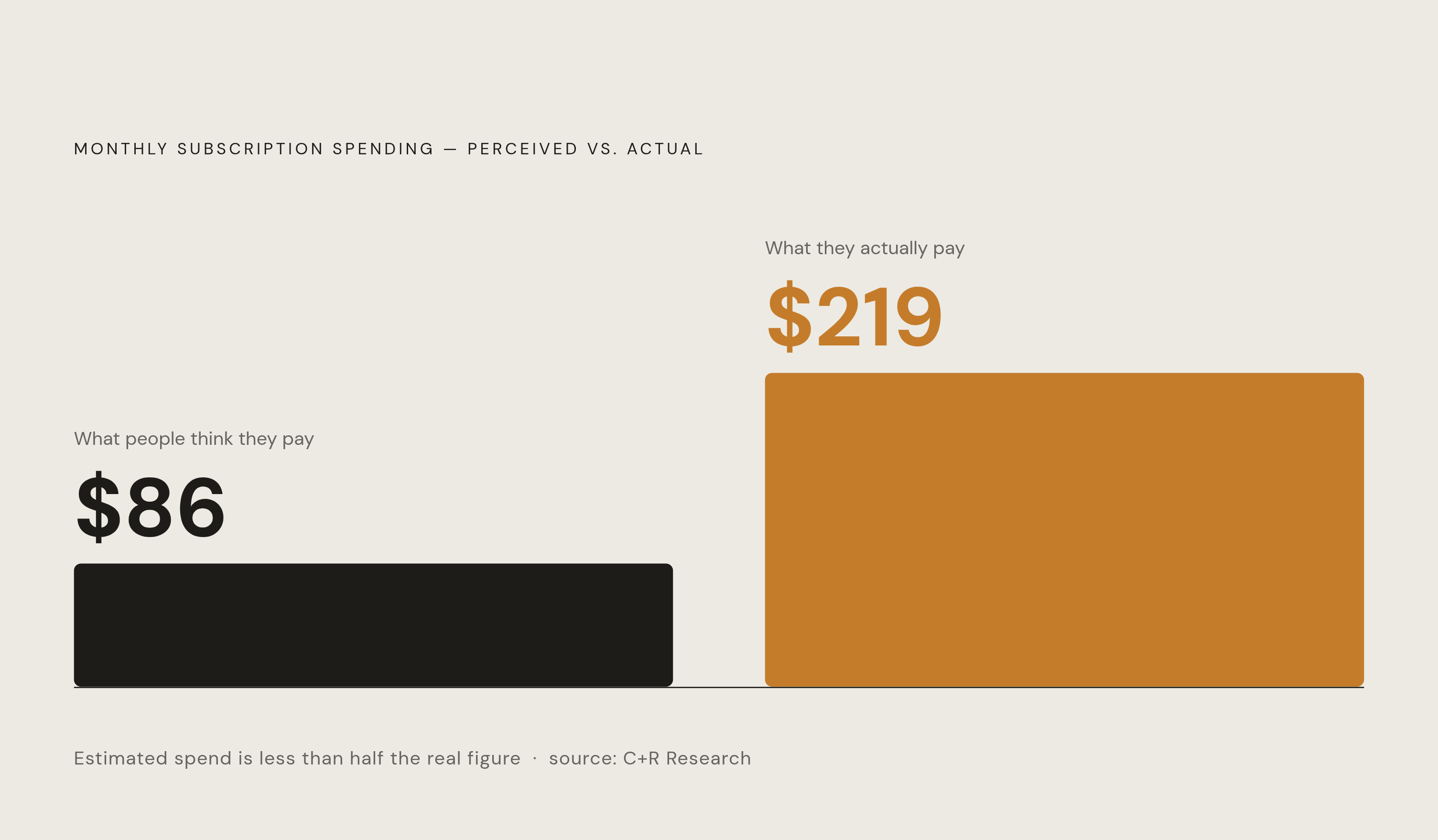
This gap between what people think they pay and what they actually pay is the clearest proof that this works as intended. Research has found the average American estimates a monthly subscription total less than half of the real figure. That gap doesn't come from bad math or sloppy budgeting. It comes from a billing model built so no single moment of review ever forces the full number into view.
Price increases make the gap worse over time. A service raises its price by a dollar or two between the rare moments someone actually checks, and the old number stays lodged in memory while the new, higher charge runs quietly in the background. Nothing about this is accidental. Spreading charges across dates, cards, and billing platforms is a structural choice, and it produces exactly the kind of blindness that keeps unused subscriptions alive month after month.
The average American subscription stack in 2026
Most people carry more subscriptions than they could list from memory, and the categories go far past streaming now. Self Financial's 2026 data found 59.9% of respondents have at least one paid subscription going unused every month, a number that only makes sense once the full range of what people subscribe to comes into view: fitness apps, cloud storage, food delivery, and a fast-growing layer of AI tools.
C+R Research puts the average household at 8.2 active paid subscriptions across all categories, and tallies that count every category, including smaller or less obvious ones, run higher. Streaming alone accounts for a meaningful chunk of that total. Deloitte finds the average paying household carries about four streaming services at a substantial combined monthly cost, and that's before music, gaming, fitness, software, or delivery memberships enter the picture. Younger households carry even more: Gen Z and millennial households average five streaming services, putting them at the front edge of stack creep.
The newest addition to the stack is AI. Tools like ChatGPT Plus and various productivity copilots have stacked on top of entertainment and fitness subscriptions people already had, adding an entire category that barely existed two years ago. Most people are swapping one subscription for another instead, so the total count stays elevated even as individual services come and go.
The breadth of all this is the real problem. When subscriptions span banking apps, app stores, direct billing, and a half-dozen unrelated categories, no single place shows the whole list.
Reasons so many subscriptions go unused every month
A majority of people are paying for something they aren't using, and the reasons are structural before they're personal. Cancellation flows are often built to resist cancellation. An analysis of subscription services found a significant share of companies make canceling deliberately difficult, adding extra steps, hidden menus, and time-consuming processes that stand between a customer and the exit. A hidden cancel button, a "pause" option offered instead of a cancel button, a "keep 30 days free" prompt dropped in at the last second: each of these exists to interrupt a decision that was already made.
Psychology does the rest of the work. The sunk cost fallacy keeps people paying for something just because they've already paid for it, treating past spending as a reason to keep spending. Sensitivity asymmetry plays a role too: people notice one large charge far more readily than several small ones, and subscription pricing keeps individual line items small enough to slide past that scrutiny. Annual billing adds another blind spot, since a charge that hits once a year is much easier to miss than one that hits every month, and plenty of services default new signups to annual billing for exactly that reason.
Trial-to-paid conversion causes more forgotten charges than any other single mechanism. A free trial often converts at a low introductory rate before stepping up to full price later, so the first statement after conversion looks unremarkable even though the price has climbed. 2026 data identifies this pattern as a leading driver of the entire perception gap described earlier.
Even the newest, most talked-about subscriptions aren't exempt. Self Financial's 2026 survey found ChatGPT Plus is now the most commonly unused paid AI subscription, with more than half of its subscribers not having used it in the prior month. If a subscription as prominent and as actively discussed as ChatGPT Plus falls into the same unused pile as a long-forgotten streaming app, the mechanism clearly isn't about any one category or any one company. It's about how billing itself is built.
The real cost of subscription blindness
Money lost to subscriptions nobody's using adds up to a real household expense, and almost all of it leaves accounts without a single conscious decision behind it. Self Financial's 2026 survey found the monthly average value of unused paid subscriptions has risen sharply from the year before, even though the number of subscriptions per person hasn't grown nearly as fast. The drain is getting bigger on its own.
At the national level, the number is staggering: Americans collectively waste more than $15.5 billion a year on forgotten subscriptions, a figure that includes streaming services watched once and free trials that quietly converted into paid plans nobody meant to keep. For individual households, the fallout isn't abstract. Self Financial's survey found that for more than a third of respondents, unexpected charges from forgotten free-trial conversions forced them to cut back on other spending. For roughly one in five, it meant borrowing money from a relative.
Price increases make the drain worse even for people who think they've already handled it. Netflix, Disney+, Hulu, Peacock, and Spotify all raised U.S. prices between 2023 and 2025, so a subscriber who did a careful review a year or two ago is likely paying more today without adding a single new service. Checking bank statements won't necessarily catch this: the perception gap data says otherwise for most people, and the design of spread billing, charges landing on different dates across different cards, defeats a casual glance at any one statement. That compounding effect, prices climbing quietly between audits, raises the next question: who's supposed to be stopping this?
Regulation's limits in stopping the drain
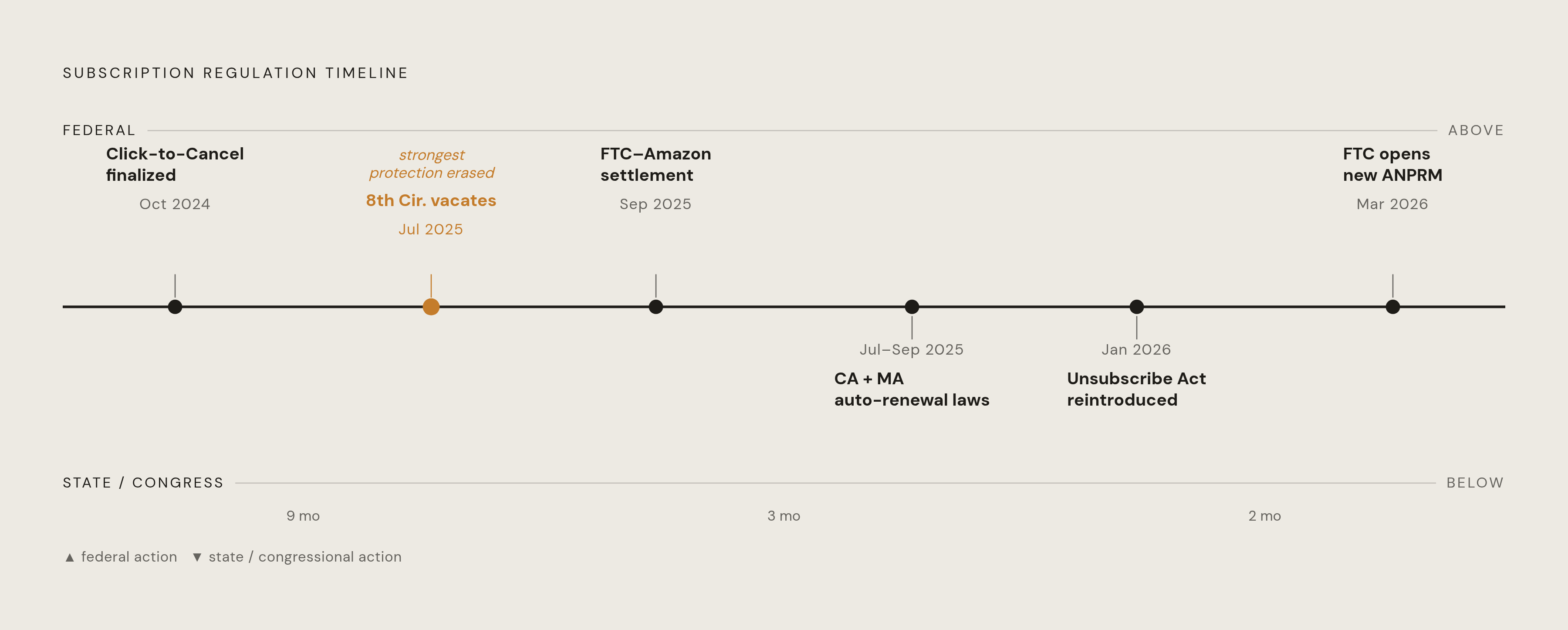
Federal regulators have tried to address subscription dark patterns directly, but the current rules form a patchwork rather than a single clear standard any consumer can count on. The most consequential recent attempt was the FTC's Click-to-Cancel rule, finalized in October 2024, which would have required cancellation to be at least as easy as signing up. In July 2025, the U.S. Court of Appeals for the Eighth Circuit vacated the rule, ruling that the FTC never conducted the preliminary regulatory analysis required once a rule crosses a $100 million cost threshold. New FTC leadership has not re-issued the rule or filed a new appeal, so as of late 2025 it carries no legal force.
Enforcement continues in limited ways. The FTC secured a major settlement with Amazon in September 2025 over dark patterns in Prime enrollment, a deal that included consumer refunds and civil penalties covering tens of millions of affected customers. In March 2026, the FTC opened a new advance notice of proposed rulemaking, signaling it intends to revisit the issue, but rules at that stage typically take years to finalize and enforce.
States have stepped in where federal rules stalled. California's amended auto-renewal law took effect July 1, 2025, and Massachusetts's auto-renewal regulation took effect September 2, 2025, both echoing provisions from the vacated federal rule. Protection now depends heavily on which state a consumer lives in. Congress has a bill in motion too: the Unsubscribe Act, reintroduced January 13, 2026 by Representatives Takano, Amodei, and Magaziner, would require affirmative consent before charging a customer once a trial ends and would require cancellation to be as easy as sign-up. It has bipartisan backing but has not reached a floor vote.
Even strong enforcement arrives after the damage is done. A settlement or fine reaches a company months or years after a customer has already paid for a service they didn't want. Regulation functions as cleanup, not prevention. Nothing here makes government oversight pointless, and real enforcement activity is happening. But no consumer should assume the law is currently catching every dollar before it leaves their account.
What a systematic subscription audit requires
A real subscription audit takes more than scrolling through last month's bank statement. It means checking multiple sources methodically, and most people underestimate how much that actually involves. Start with bank and card statements rather than app dashboards, scanning several months across every card and account for anything recurring, vague, or billed annually. A subscription has to be noticed before it can be canceled.
One detail trips up far more people than it should: the cancellation path has to match the sign-up path. A subscription started through Apple has to be canceled through Apple. One started through Google Play has to be canceled through Google Play. One started on a company's own website has to be canceled there. Cancel in the wrong place, and the charge keeps running no matter how certain someone feels that they handled it.
A few habits make the process faster. Consolidating subscriptions onto a single credit card means every recurring charge turns up on one statement. Annual billing deserves particular attention: a charge that hits once a year won't show up in a short review window, so the lookback needs to stretch back far enough to catch it. For free trials specifically, a calendar reminder set two to three days before renewal, labeled with the service name directly, works well. A more aggressive option is to cancel the moment the trial starts and let access run out naturally, removing the risk of forgetting. That risk is larger than it sounds: per Self Financial, 70% of respondents have been locked into a paid subscription because they forgot to cancel a free trial in time.
When a company makes cancellation difficult, consumers have a few points of leverage. Banks can block ACH and direct debit charges. Some card issuers offer virtual card numbers with spending limits attached, a proactive way to cap what a subscription can ever charge, since a company can't raise a price past a ceiling that isn't there to raise.
A careful audit like this genuinely works, for the day it's done. Its limitation is timing: it's a point-in-time fix, not ongoing surveillance. New charges accumulate. Prices rise. Trials convert. All of it starts again the moment attention moves on to something else.
Why catching the drain requires permanent surveillance
Subscription creep is a permanent condition built into how billing works, and the only response that matches it is monitoring that runs just as permanently. The moment a manual audit ends, the same architecture that made the problem invisible in the first place starts right back up: trials convert, prices tick upward, new services get added.
The scale of that resumption shows up directly in the numbers. Self Financial's 2026 data found the monthly value of unused subscriptions rose sharply year over year even as the average subscription count also rose, from 2.8 to 3.4. Price increases alone are driving part of that growth, with no new services required to make the total climb. Billing stays spread across cards, payment dates, Apple, Google Play, and direct billing, so no single account or statement ever shows the complete picture. Catching all of it manually means checking every one of those sources on a recurring basis, a level of ongoing vigilance most people don't sustain for long. The architecture that makes subscriptions easy to forget the first time makes them just as easy to forget again after an audit. The system is the obstacle, not a person's memory.
Ongoing monitoring needs to catch several things at once: subscriptions that have gone dormant, prices that have quietly climbed, trials approaching conversion, duplicate charges for the same service across different accounts, and refunds that were promised but never arrived. None of that is visible from a single card or a single bank login. Connecting more accounts is what turns monitoring into something real, since a tool that only sees one card will always miss whatever gets billed to another, and seeing the full picture is what turns generic advice into something specific and accurate.
The shift that matters most is where the effort sits. Instead of a person hunting down every charge across every account, the opportunity comes to the user. That's the real difference between a dashboard that only shows what already happened and a system built to catch the drain while it's still happening.