Recurring Charges Banks Won't Block and the Subscription Layer That Can
Banks can block payments, but only subscription services can cancel the underlying agreement.
Stopping unwanted recurring charges means cancelling the subscription agreement as well as blocking the payment. A subscription management app such as Compass+ can help find forgotten subscriptions across billing channels and show what they cost each month and how to cancel them. The bank supplies the payment backstop, but the agreement must be ended with the party that bills you.
Why subscription billing is structurally different from a one-time purchase
A one-time purchase produces a transaction, while a subscription creates an agreement that keeps producing transactions on a schedule. That agreement has a payment method attached to it, but the two are separate. The payment method tells the merchant where to collect money. The agreement is the basis for continuing to collect it. So reversing the latest transaction still leaves open what happens at the next renewal.
Deleting an app removes the software and leaves the billing agreement intact. Removing a saved card or stopping use of a service also leaves the agreement intact. Its home is the place where the subscription began, which may be different from the account where the charge appears. A clean exit has to reach that home.
What bank tools can and cannot do when a recurring charge appears
Wells Fargo’s Control Tower shows recurring payments, mobile wallets, and third-party data connections in one place, with controls for card access. Capital One offers a subscription view and free virtual card numbers that can be shut off for a single merchant without replacing the real card. Bank of America shows recurring charges through Erica and transaction search. Chime shows transaction history and has a way to disable a card.
These tools help answer useful questions about where money went and which payment method remains available. Banks can also lock a card, issue a new number, place a stop payment, and dispute unauthorized charges. Those are meaningful protections when the problem is a payment that should not go through. These protections control the account while leaving the obligations paid from it intact.
Some banks offer a separate cancellation service where available, including Capital One. The service can address cancellation, while the block controls whether a payment is approved. Treating them as interchangeable is where an otherwise useful bank tool becomes an incomplete answer.
The account updater problem: why a new card number does not break the billing loop
Replacing a card sounds like a clean break, but account updater services can keep the connection in place. Certain merchants, including gyms and streaming services, can request updated card details when a bank issues a new number. The bank gives them those details, so an existing subscription can charge the new card. The agreement has not followed the old card into retirement. It has simply acquired a working payment method again.
A “security close” addresses this card-level problem by requesting that the new number not be enrolled in account updater services. It requires a phone call and brings a practical cost. Payments that should go through must be set up by hand with the new number too. This makes it a real control, but not a selective cancellation tool.
Account updater shows why monitoring the agreement can be more useful than repeatedly replacing its payment method. A monitor that surfaces a hidden subscription before renewal gives the consumer a chance to cancel at its source. With tools such as Compass, it helps to see the subscription and what to do next along with notice that another card charge appeared.
How subscription billing hides across channels, making the payment layer an unreliable map
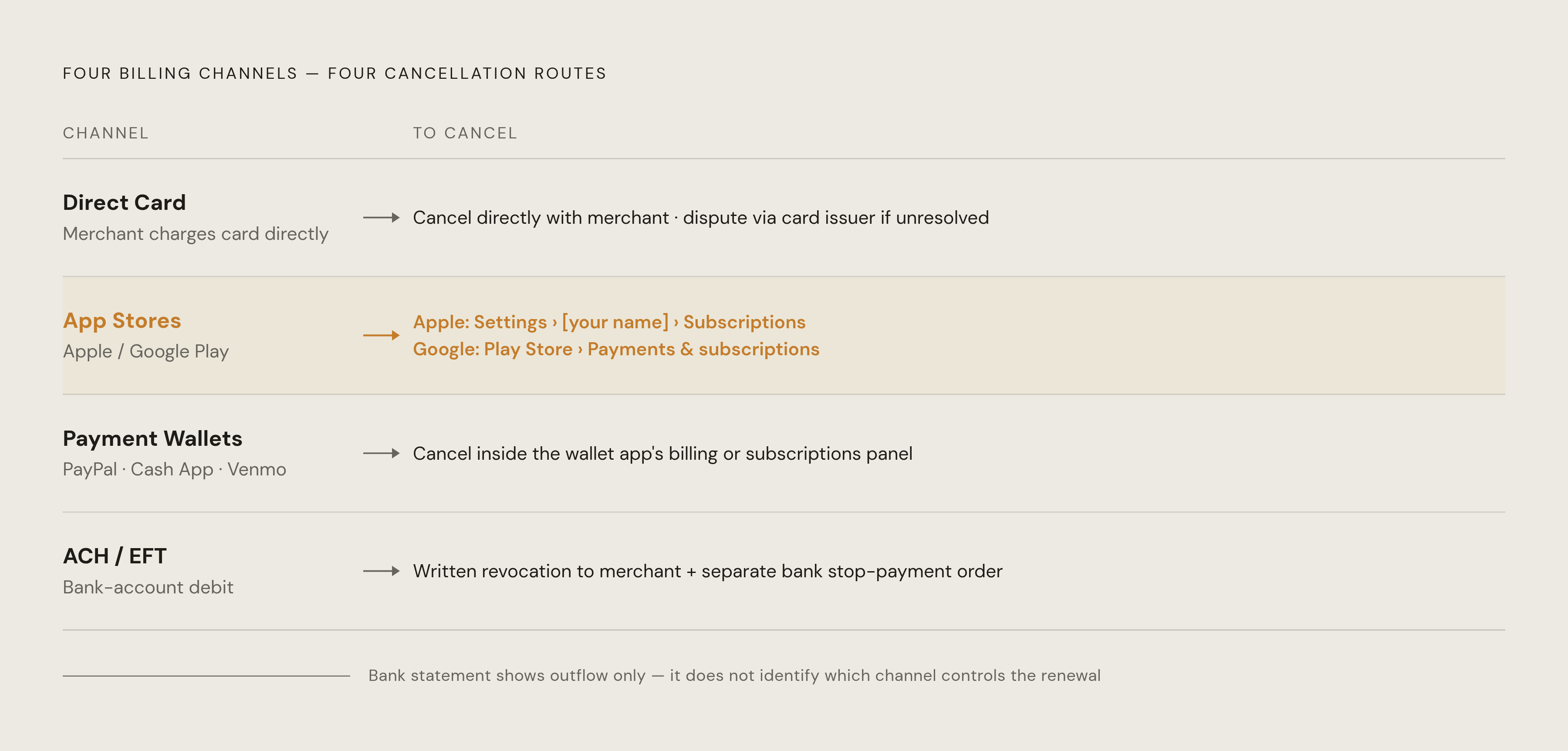
A bank statement shows money leaving an account, but it does not provide a complete map of where subscriptions are managed. Billing can run through four channels, namely direct merchant cards, app stores, payment wallets, and ACH/EFT bank-account debits. Each has a different cancellation route. Knowing the amount is not the same as knowing which party controls renewal.
Apple-billed subscriptions are managed through Settings and then Subscriptions. Google Play subscriptions are managed through Payments and subscriptions in the Play Store. Since June 2026, developers in the US, UK, and EEA may use their own billing systems for Android apps instead, so some in-app subscriptions are billed directly by the app maker. The app alone is therefore not a reliable guide to the billing party.
Wallets differ too. PayPal has Manage automatic payments under Payments in Settings. Cash App has no central subscription list, so merchant-billed charges require finding the payment in activity and cancelling with the merchant. Venmo also lacks a dedicated manager for merchant-billed subscriptions, although its payer-initiated Schedule Send payments can be cancelled in the Scheduled section under Me and Transactions.
Direct card subscriptions usually have to be cancelled on the merchant’s site under Billing or Membership. ACH/EFT debits require written revocation with the merchant and a separate stop-payment request to the bank. Cable bundles, mobile carriers, and platform marketplaces can add another intermediary whose billing relationship the original service provider cannot see. So checking by hand means looking through at least four interfaces and may still miss a charge.
Why blocking a payment is sometimes worse than doing nothing at the payment layer
A successful block can leave an unpaid obligation behind. A merchant may mark the account past-due and report the delinquency. It may retry a backup card, making the primary-card block irrelevant. It may also send the unpaid balance to collections.
The subscription remains active while its bill goes unpaid, or the charge moves to another card. A block also does not reverse charges that have already been processed. The screen may show that the card is protected without establishing that the account with the merchant is closed. That apparent finish is only a partial result.
Capital One’s subscription-block documentation makes the limits concrete. It states that a recurring-transaction block lasts 12 months and does not apply to pending transactions that occurred before the block. Capital One also says that preventing charges from resuming after 12 months requires cancellation with the service provider, or through its cancellation service where available.
What app helps find and cancel subscriptions across billing channels
A subscription management layer brings together billing channels that are spread out and the agreement behind each charge. Its purpose is to identify what remains active and bring the cancellation action within reach before renewal. That is a different job from presenting a bank’s transaction history. What counts is which channels it covers, how early it gives notice, and how clearly it shows what to do next. A long list of past charges alone does not meet that need.
Compass+ connects to bank accounts, email, and subscription services in read-only mode to surface the billing channel, amount, and next action for recurring charges. Its role is to make discovery continuous rather than dependent on a consumer opening every account to investigate. Forgotten subscriptions can then appear with their specific monthly cost and cancellation action. This does not mean that finding an agreement is the same as completing its cancellation. The value is connecting the evidence of an active subscription to the action needed to end it.
The broader management layer can also track changes in price, dates when trials turn into paid subscriptions, and shifts in the billing cycle. These changes matter before the money leaves the account. It can distinguish bill creep from a duplicate subscription, a converting trial, or a charge already flagged as unwanted.
Other tools cover different parts of this work. Chase Recurring Charges, Wells Fargo Control Tower, and Capital One’s subscription view help with charges shown in their own bank feeds, but those feeds do not show the app-store or wallet agreements behind them. Apple Subscriptions and Google Play Payments and subscriptions provide management within their respective store ecosystems, leaving direct-card and ACH billing outside their scope. ReSubs has a list of subscriptions across channels and reminders of when they renew, with no need to connect a bank account.
The data security question that any account connection has to answer
Bringing account information together gives cause for concern about how safe it is. Financial transaction data is sensitive and updated daily, so a compromised connection can expose a continuing record of behavior. More coverage creates more useful context, but it also concentrates information. Any subscription tool that asks for account access has to answer that trade-off directly. Convenience does not make the exposure disappear.
Read-only access is the important boundary. A connection that can only observe cannot move money, initiate transfers, or create obligations. Compass+ makes read-only mode its stated default. That limits what the connection can do, but it does not eliminate the risk of a breach of stored information.
The architecture to look for includes OAuth 2.0 authorization through the bank’s official page, rather than entering banking credentials into the app. Permissions should be scoped separately to each account, with a clear way to revoke access and delete stored data. Multi-factor authentication should be turned on for the accounts before they are connected. Compared with entering card numbers across many merchant sites, a read-only connection to a reputable aggregation provider reduces the payment authority being shared.
The regulatory picture: consumer protections that exist, the one that was vacated, and what that means for where the work has to happen
Consumer protections have made it easier to cancel, but a key U.S. federal protection is missing. The FTC strengthened the Negative Option Rule to require cancellation through the same medium used to subscribe, with a mechanism at least as easy to use as sign-up. The 8th Circuit vacated that click-to-cancel rule in July 2025. The decision removed that federal backstop rather than changing where subscription agreements live.
California, New York, the UK, and the EU have advanced similar protections. The EU Consumer Rights Directive requires a “withdraw from contract here” function that remains available throughout the 14-day withdrawal period. Since 19 June 2026, that requirement also applies to consumer financial services contracts made at a distance. Even a readily available button helps only when the consumer knows which agreement to end and reaches it before the relevant billing date.
How to close the gap: using the bank layer and the agreement layer in the right order
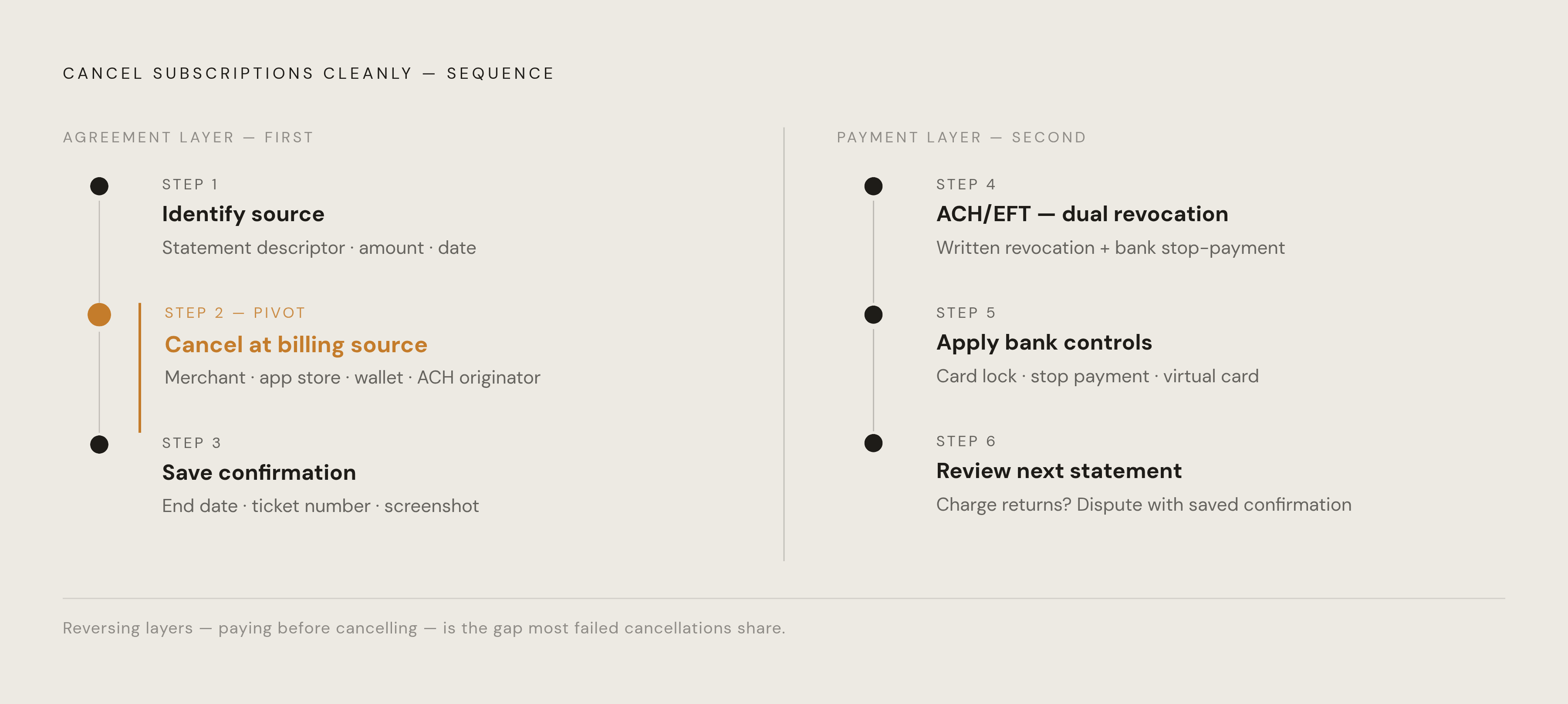
Start by identifying the billing channel from the statement descriptor, amount, and date. The agreement may belong to a direct merchant, an app store, a payment wallet, or an ACH debit arrangement. Then cancel with the party that controls billing, rather than assuming the service’s name identifies the right destination. Save the confirmation, end date, and any support ticket number. For ACH/EFT payments, written revocation to the merchant must be paired with the bank’s separate stop-payment process.
After cancellation, use the bank’s payment controls, such as a card lock, stop payment, or virtual card shutdown, as a backstop where needed. Review the next statement to see whether the charge returned. If it did, use the saved cancellation confirmation to dispute it with both the merchant and the card issuer. That sequence connects the agreement’s end to evidence that billing actually stopped.
Compass+ is designed to keep discovery passive and continuous by surfacing the channel, amount, and next action through its read-only connections. A one-time audit cannot cover subscriptions added later, trials that convert, or prices that shift between reviews. Tracking those changes over time keeps them in view, while cancellation ends the agreement and bank controls protect the payment method. The clean result comes from using each layer for its own job, in that order.