Negative Option Marketing Rules Under the FTC Act
The FTC's subscription crackdown faced a legal setback but left consumer protections intact.

A negative option feature is a contract provision under which a consumer's silence or failure to act gets treated as acceptance, or continued acceptance, of a charge. That single definition explains most of what frustrates people about subscriptions: the charge doesn't need a yes. It only needs the absence of a no.
Why subscription and free-trial structures bet on consumer inattention
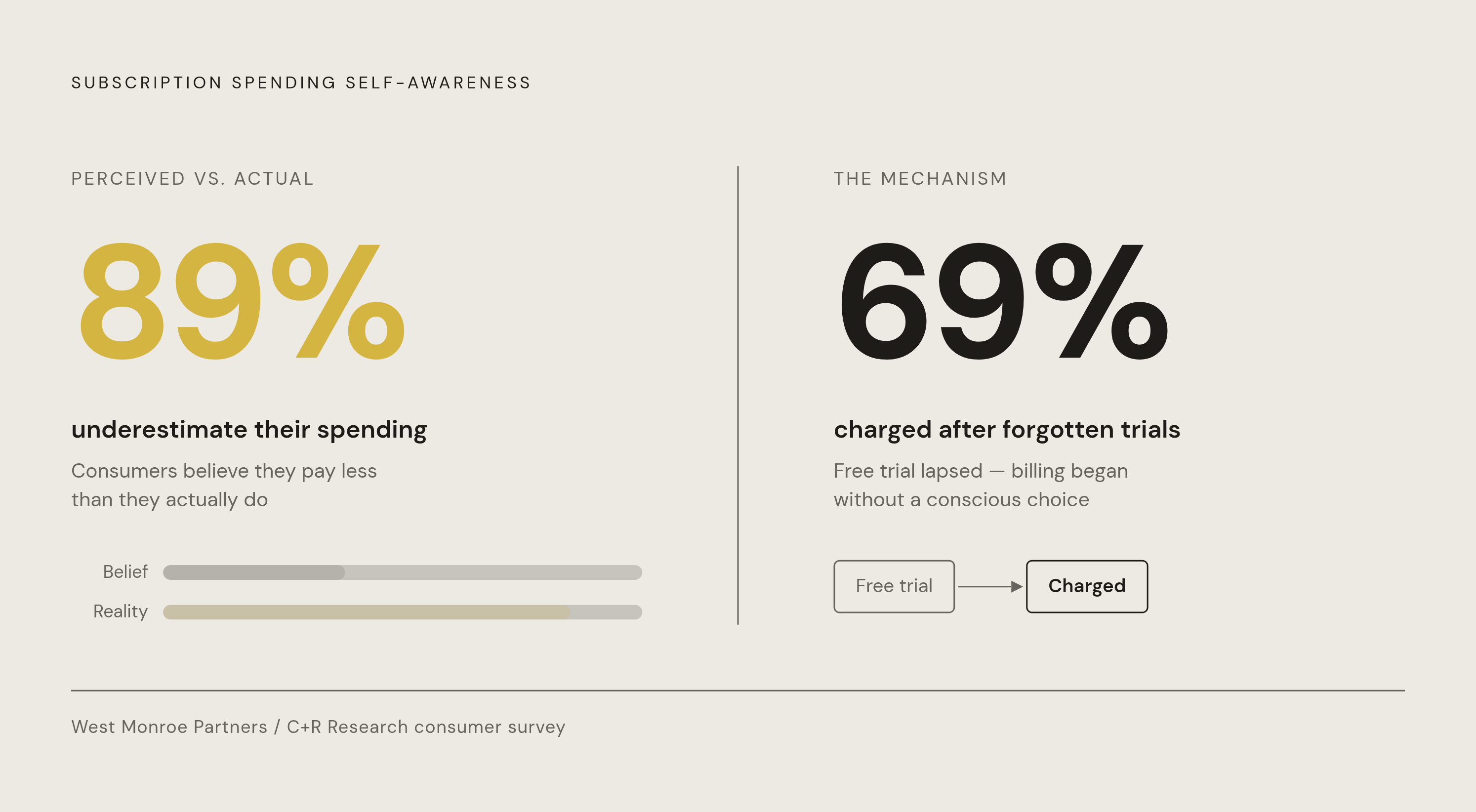
Four kinds of programs fall under this definition: prenotification plans, continuity plans, automatic renewals, and free-trial conversion offers. Different products, different billing cycles, but the same bet underneath each one is that people don't check every recurring charge on their statement. Free-trial conversions make the bet most visible. The offer is built so that doing nothing is what triggers the charge, and a Best Money analysis found that 69% of people end up charged after forgetting to cancel a free trial.
Small charges are easy to miss for a simple reason: they sit below the dollar amount that makes a person stop and check their bank statement. Staggered price increases, a few dollars here and there across a handful of services, add up across a household's full subscription list without ever crossing a threshold that feels worth questioning. The gap between what people think they spend on subscriptions and what they actually spend isn't a sign that people are bad at budgeting. That gap is what the billing model was built to produce: a total cost that's structurally hard to see, spread across enough small, separate charges that no single one looks worth tracking down.
The FTC's pre-2024 regulatory patchwork
Before 2024, the FTC's tools for this problem didn't match the problem. They were a patchwork, built for an earlier kind of commerce, and most modern subscription formats had no single, consistent standard to meet.
The original Negative Option Rule dates to 1973, and it only ever covered prenotification plans, the "book-of-the-month" style clubs that mail merchandise unless a customer actively says no in advance. It said nothing about continuity programs, automatic renewals, or the free-trial-to-paid conversions that now define online and app-based subscriptions, the formats that dominate the market today.
To cover that gap, the FTC leaned on a mix of other authorities: Section 5 of the FTC Act, the Restore Online Shoppers' Confidence Act (ROSCA) for sales made online, the Telemarketing Sales Rule for sales made by phone, the Electronic Fund Transfer Act, and a growing set of state auto-renewal laws. Each piece covered something. None of them covered everything. The FTC itself admitted, in its 2026 ANPRM, that the result was inconsistent: a business could face different rules depending only on whether a customer signed up online, over the phone, or in person. ROSCA covered internet sales but not every medium, and Section 5 allowed enforcement actions without giving businesses a clear compliance target or giving consumers a clear, codified right to point to.
The 2024 amended rule's disclosure, consent, and cancellation requirements
The FTC's 2024 amendments turned that structural problem into four specific obligations, and each one closes a specific gap the old patchwork left open.
The first was a prohibition on misrepresentations: sellers could not misrepresent any material fact while marketing a negative option product, a rule broad enough to reach beyond subscription terms into any claim likely to sway a consumer's decision. This provision took effect January 14, 2025, and it carried real civil penalties per violation, a sharp jump in exposure compared to a standard Section 5 case, which had offered no monetary relief at all.
The second was disclosure before billing. Before a seller could take a consumer's billing information, it had to clearly state that charges recur, including any price hike after a trial or discount period ends, the amount of the charges, the deadline to act in order to stop them, and how to find the way to cancel. For online and mobile offers, those disclosures had to sit where a consumer could not avoid seeing them, not hidden behind a small icon or a link a person could scroll past without noticing.
The third was consent. Sellers had to get consent to the negative option feature that was unambiguous and separate from consent to the rest of the purchase. A single checkbox that buried subscription terms inside a broader terms-of-service agreement would not count. Sellers also had to keep records proving that consent for at least three years.
The fourth was cancellation, the "click-to-cancel" requirement. Canceling had to be at least as easy as signing up, available through the same channel used to enroll, and it could not force a consumer to talk to a live agent or a chatbot unless that was how they signed up. Someone who subscribed online could cancel online, full stop on the method, no phone call required and no in-person visit required.
The rule also named a specific tactic directly: it barred sellers from using "Saves", meaning discount offers or retention pitches, to slow down or block a cancellation request, calling that kind of friction a practice that made canceling unduly difficult. And it reached wide: nearly every business-to-consumer and business-to-business transaction involving a negative option feature, across every medium, whether the seller was based in the US or was a foreign seller doing business with US consumers. A short list of entities fell outside the FTC's reach entirely, among them most depository institutions, charities, transportation and communications common carriers, and the business of insurance.
How the rule was struck down
The Eighth Circuit threw the amended rule out, but it did so on procedural grounds, and the consumer-protection goals behind the rule were never the issue. The enforcement floor today still sits higher than it did in 2023.
The timeline matters here. The misrepresentation prohibition took effect January 14, 2025. The rest of the rule's substantive requirements were set to start May 14, 2025, and the FTC pushed that start date to July 14, 2025. Then the U.S. Court of Appeals for the Eighth Circuit vacated the entire amended rule in July 2025, days before that enforcement date, on the grounds that the FTC had skipped the preliminary regulatory analysis Section 22(b)(1) of the FTC Act requires during rulemaking. The court never found that the FTC's consumer-protection goals were wrong. The defect was procedural, a missing analysis, not a ruling that disclosure, consent, or cancellation requirements were unlawful on the merits.
A good deal survived the vacatur. Section 5 of the FTC Act still bars unfair and deceptive practices across every channel. Since January 2025, the FTC has opened five cases and approved six settlements tied to alleged negative option misconduct, most of them built on these general powers. And the agency has made its intentions clear: in the NextMed complaint, it alleged conduct that the vacated Click-to-Cancel Rule would have prohibited, and charged it as a Section 5 violation instead. The vacatur did not open a safe harbor for sellers. State law adds another layer on top: state automatic renewal laws, with California's among the strictest, often impose requirements stricter than anything the federal rule demanded, and the FTC rule was explicit that it does not preempt state laws offering consumers more protection.
Enforcement cases that show what violations look like in practice
The FTC's actions against Match.com, Chegg, Amazon, and NextMed line up around the same two failure points: cancellation that's hard to find or hard to finish, and disclosure that's technically present but practically useless.
Chegg's settlement required the company to build a cancellation process at least as easy to use as signing up, and to stop charges immediately once a consumer cancels, a direct fix aimed at a cancellation flow that had been slow and hard to locate.
Amazon's FTC order demanded clear disclosures before billing, express informed consent, and simple cancellation, the same three pillars the amended rule laid out, delivered this time through a consent order instead of a codified regulation.
Match.com appears alongside Chegg and Amazon as part of the FTC's renewed push against confusing or burdensome cancellation procedures that trap consumers in subscriptions they're trying to leave.
NextMed is the case that tells the clearest story. The FTC filed its complaint after the Eighth Circuit had already struck the amended rule down, and it alleged the same cancellation and disclosure failures the rule would have covered, charged as violations of Section 5 instead. The agency is using its general unfair-and-deceptive-practices authority to fill exactly the gap the vacatur left behind.
It's a seller putting the charge somewhere technically disclosed but practically invisible, and making cancellation technically available but practically exhausting to finish.
Where the FTC's rulemaking stands now
The FTC is pursuing this issue through a new rulemaking. It's redoing the rulemaking correctly, and the four core requirements from the vacated rule remain the agency's target, alongside one notable new question about whether "Saves" themselves are unfair.
On March 11, 2026, the FTC issued an ANPRM asking consumers and businesses to weigh in on whether and how to amend the Rule Concerning the Use of Prenotification Negative Option Plans, the same 1973 rule the 2024 amendments had tried to bring up to date. The agency laid out its options: keep the 1973 rule as is, expand it to cover the full range of negative option programs the way the vacated 2024 rule did, adopt some or all of those 2024 provisions after completing the required procedural analysis, or skip a new rule in favor of guidance and consumer education.
The four requirements from the vacated rule, the broad ban on misrepresentation, separate verifiable consent, disclosures placed right next to the consent mechanism, and cancellation as easy as enrollment, are named explicitly as elements the FTC may build a new rule around.
The genuinely new piece is the question about "Saves". The ANPRM asks whether it's unfair or deceptive for a seller to respond to a cancellation request with a discount offer or retention pitch instead of just processing the cancellation, and it asks for economic data: how often consumers take these offers, what they cost, how they affect competition between sellers. This question got dropped from the 2024 final rule with a promise to revisit it later, and the ANPRM is that revisit. The agency also wants input on exemptions, whether certain industries, business sizes, or transaction types deserve full or partial relief from a new rule, and what evidence would justify that. The comment period closed April 13, 2026, and the FTC pointed to thousands of consumer complaints filed every year from every state as evidence that unfair or deceptive negative option practices are still, in its words, "prevalent".
Permanent monitoring instead of reliance on regulatory timing
The vacatur left a stretch of time where the specific click-to-cancel and disclosure requirements simply couldn't be enforced. The ANPRM may eventually produce a new rule, but rulemaking takes time, and the Eighth Circuit's procedural objection must be satisfied first. Charges keep running on their own schedule the entire time.
Subscription sprawl doesn't happen once and stop. New services get added, prices tick up quietly, free trials convert into paid plans, duplicate charges slip through, all on separate timelines that have nothing to do with when a person happens to be paying attention. Most consumers badly underestimate what they actually spend on subscriptions: 89% of consumers underestimate their subscription spending, and that gap isn't a one-time miscalculation. It resets every billing cycle, because the structure producing it never stops running.
AI agents are starting to move into this space directly. An AI-powered financial assistant launched in August 2026, built to manage finances and take action on a user's behalf through text message. Meta showed off Muse at its 2026 Connect conference, having launched it September 8, 2026, claiming it can handle shopping, find insurance savings, and negotiate utility bills. Taken together, these launches point to agent-mediated subscription management reaching ordinary consumers at real scale within 2026.
Subscription billing doesn't move in cycles. It runs every single day, on every account, whether or not a rule is currently in force. A consumer protected by yesterday's enforcement action still needs protection today. The only real defense is something that watches every charge, continuously, regardless of where the rulemaking process happens to stand.
Sources
- FTC Issues New Advance Notice of Proposed Rulemaking on Negative Option Marketing // Cooley // Global Law Firm
- FTC Reopens “Negative Option” Rulemaking After Eighth Circuit Vacates 2024 Amendments
- Federal Register :: Rule Concerning the Use of Prenotification Negative Option Plans
- Federal Register :: Negative Option Rule
- Eighth Circuit Vacates FTC's Negative Option Rule for Procedural Violations
- Federal Trade Commission Announces Final “Click-to-Cancel” Rule Making It Easier for Consumers to End Recurring Subscriptions and Memberships
- No more click to cancel rule—but FTC enforcement actions keep coming - Winston Taylor
- Eighth Circuit Vacates FTC’s Click-to-Cancel Rule Days Before Compliance Deadline