Digital News Subscription Growth and the Paywall Proliferation Effect
Publishers are quietly raising prices on existing subscribers as growth stalls.
Digital news subscription growth has made paywalls an overlooked driver of subscription sprawl. Each outlet sells access as a separate, reasonable purchase, but those purchases accumulate like streaming subscriptions. Few readers see the whole growing bill. Continuous monitoring makes changing costs visible while there is still time to act.
How the news industry arrived at a world of many paywalls
Publishers’ move away from dependence on advertising put readers at the centre of their revenue strategy. Publishers began charging the people who read their work as they moved away from relying on advertisers to pay for access. A paywall turned that strategy into a recurring payment.
The important change was not simply that news cost money. It was that each publisher built its own direct relationship with paying readers, with access tied to its own subscription. What made sense as a revenue model for one outlet became the model for many. The proliferation of paywalls was therefore not an accident or a temporary experiment. It was the predictable result of an industry turning towards the same source of revenue.
The scale of paying news subscribers today and who is driving growth
Paid digital news is no longer confined to a handful of national titles. The Wall Street Journal reported that it had several million digital subscribers and that the number was growing year on year. That establishes the scale at the top of the market, but the spread below it matters just as much. Readers now face ongoing fees for regional, international, local and creator-led publishing. The landscape is much broader than a choice between the Times and the Journal.
Irish Times Group, Atlanta Journal-Constitution and Goalhanger illustrate that breadth. They put regional, international and podcast-adjacent publishing within the same paid-access landscape as the national flagships. Reach extended the model to local news by launching its first paywall on the Manchester Evening News in late 2025. It had reached a modest early base of paid digital subscribers by the end of 2025 and had an ambitious target for 2026.
Substack has millions of paid subscriptions spread across individual publications, rather than a single shared subscription covering everything on the platform. Its growth expands both the range of paid work available and the number of separate purchasing decisions readers face. More kinds of journalism now come with their own recurring charge.
Why the paywall ceiling hasn't stopped publishers from extracting more per subscriber
That expansion does not mean publishers have an unlimited supply of new people willing to pay. The Reuters Institute’s 2025 Digital News Report states that “Publishers have already signed up many of those prepared to pay and in a tight economic climate it has been hard to persuade others to do the same”. This is a ceiling on recruitment, while what existing subscribers can be charged remains uncapped. For paying readers, those are very different outcomes.
When acquisition gets harder, price increases and more expensive tiers offer another route to growth. The publisher does not need to win another subscriber to collect more from an existing one. A reader who keeps the same publications can end up with a higher bill without buying anything else. The number of subscriptions stays still while the cost moves. That is the mechanism a simple count of active subscriptions misses.
From the consumer’s side, a mature subscription market offers no promise of a stable price. Publishers’ response to a limited pool of willing payers is to seek more revenue from that pool. Across several subscriptions, separate price increases add to the same household bill. When subscriber growth slows, the pressure shifts towards people who are already paying.
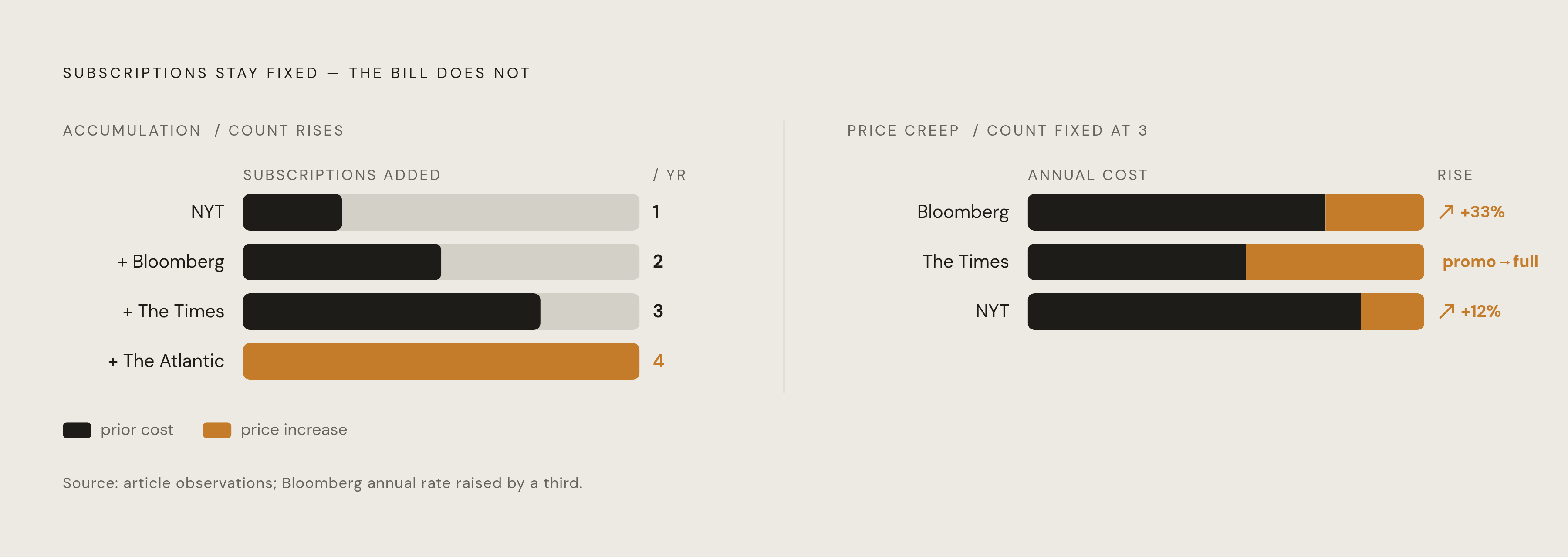
How news subscriptions accumulate into sprawl the same way streaming services did
Those publisher decisions meet readers at moments when a subscription has a clear purpose. A particular story, breaking news or a sporting event can make access worth buying. The reader decides to pay for something they want to read now, while the payments carry on. Another outlet later offers something different that is worth reading. Each purchase can make sense on its own without making the combined cost easy to see.
This is the structural link with streaming sprawl. A streaming service can sell access around a single tentpole, just as a publication can sell access around a specific piece of coverage. Buyers can make either choice without looking again at every subscription they already have. The collection grows as readers buy subscriptions one by one, without choosing to buy a large package all at once. Its full cost becomes clear only in retrospect.
Substack makes that separation especially plain. A reader following several paid writers is not buying one bundled service, but maintaining several recurring charges at prices set by individual publications. Local and specialist paywalls create the same problem across other parts of the news market. Geographic or topical breadth can require more subscriptions.
The obvious objection is that readers could choose one or two publications and stop. They could, but that means accepting limits on coverage. No single outlet covers local news, sports journalism, financial news and national politics in the same depth. A fragmented news product makes a fragmented subscription bill a rational outcome.
Why the cost of news subscription sprawl stays invisible until it doesn't
The recurring charge is designed to demand less attention than the original buying decision. Small monthly amounts, promotional prices and incremental increases keep each payment below the threshold of active review. The reader remembers deciding that the publication was worth the price when they signed up. That memory can outlast the price itself. A subscription that still feels like the same purchase may now cost more.
The Washington Post’s onboarding research found that most new monthly subscribers churn within three months. Readers who remain are the group publishers can then move through price steps. Someone who forgets to cancel can become someone who pays more over time. No new act of buying is needed for the bill to grow.
Bundles make the cost harder to interpret in a different way. A Times bundle containing Games, Cooking and The Athletic feels like a single product, but its price has risen and continues to rise. Recognising the subscription’s name is not the same as knowing its current cost. Bundling can simplify the product in the reader’s mind without stabilising the payment.
Across a collection of news subscriptions, these mechanisms reinforce one another. Each charge looks small, each increase looks incremental and each familiar publisher still looks like an old decision. Yet the household pays the sum. The cost stays out of focus because the market presents it in pieces.
What consumers actually have rights to when a news subscription price increases
A quiet price increase is not simply something subscribers must accept. Consumer protections can require advance notice and provide a route to cancellation or a refund when a provider fails to give proper notice. The exact protection depends on the applicable law and the circumstances. These enforceable rights depend partly on timing for their usefulness.
New York’s 2025-26 budget requires companies to take one of two routes before charging an increased price. They must obtain affirmative consent or allow cancellation within a defined window with a pro-rata refund. The requirement covers digital subscriptions, including news. California, Colorado and Minnesota have separately tightened auto-renewal laws. These measures create a patchwork of state-level protections.
That patchwork leaves a practical gap between having a right and exercising it. A cancellation window only helps someone who learns about the change while the window is open. A subscriber who notices an increase two or three billing cycles later may already have missed the opportunity to claim a refund under that protection. Advance notice requirements matter, but so does the subscriber’s awareness of what changed.
A price increase must become visible early enough for the subscriber to decide what to do about it. Otherwise, a protection that exists on paper can deliver little practical help.
Why manually auditing your own news subscriptions is an unrealistic standard
Readers have a lot of work to do if they must spot those changes in time themselves. Each publication has its own billing date, promotional expiry, price tier and cancellation process. Tracking the current total is only part of the work. The reader must also track what will change next and when action is required. Every additional subscription adds another moving part.
Avoiding a conversion to the full rate requires attention before a specific date. Another publication’s promotion ends on a different cycle, with a separate decision to make. A periodic spending review looks backwards, but these decisions depend on knowing what is about to happen. The task is not just bookkeeping.
Cancellation can add work after the reader has already decided to leave. Research auditing six major subscription services found dark patterns including loss aversion manipulation, emotional exploitation, hidden options and navigation barriers. That research does not establish that every news publisher uses those tactics.
Stanford researchers estimated that consumer inertia and cancellation friction can roughly double the money sellers bring in. The finding applies to subscription sellers more broadly, but it shows how they can make money from the gap between what people intend to do and what they do. News publishers benefit from that gap like other subscription businesses. A system that is easy to enter, easy to accumulate and harder to exit does not become manageable simply because readers are told to pay closer attention. Manual vigilance places the burden on the side least equipped to sustain it.
How passive monitoring closes the gap between news subscription rights and consumer awareness
A better approach moves routine attention into the background and brings the reader back when a decision is needed. Passive monitoring means continuously watching for changing charges and surfacing events that call for action. It is different from displaying a history of spending and leaving the consumer to interpret it. A dashboard describes the bill. Useful monitoring identifies what changed, why it matters and what the subscriber can do next.
For news subscriptions, those events match the sources of sprawl. A promotional rate on a local news site may be about to convert, or an annual subscription may have become more expensive. Bloomberg raising its annual price by a third is the kind of change that warrants attention. An unused subscription presents a different decision, but it also needs to become visible. Surfacing the relevant event spares the subscriber another full audit.
That distinction also sets a standard for what monitoring must actually know. Detecting a charge increase is not the same as knowing that a free trial converts in three days or that a subscription has not been used in some time. Monitoring is useful when it draws on what it knows to suggest a clear next step, such as reviewing an increase while there is still time to cancel or claim a refund.
Continuous monitoring is the only way to reliably keep up with separate charges, changing prices and deadlines that fall at different times without someone having to check them all the time. It leaves the choice of journalism with the reader while taking on the repetitive work that choice creates. Paying for several publications can be entirely reasonable. Paying more without noticing should not be the price of staying informed.