How Cable and Telecom Bills Grow Through Add-On Fees
Sneaky fees hide the true cost of cable until the first bill arrives.
The advertised price on a cable bill covers maybe 60 to 70 cents of every dollar a household actually pays. Broadcast fees, sports surcharges, equipment rental, taxes, and a rate hike written into the contract before the customer ever signed it appear as separate line items on the bill. None of it arrives as one big, obvious price hike. It arrives through layering, one small charge stacked on another until the total barely resembles the number in the ad.
Wikipedia's entry on junk fees covers charges that get tacked on after the initial price, separate from whatever number drew the customer in. Mandatory costs get tacked on after the fact, separate from whatever number talked the customer into saying yes. Cable TV sits on that list next to event ticket sellers, airlines, and hotels, industries where the sticker price and the real price rarely match. None of this is illegal. Nearly every fee sits in the service agreement somewhere, in language a lawyer would call adequate disclosure. But there's a wide gap between a fee being technically disclosed and a fee being something a customer notices at the moment of purchase, and cable providers have built their pricing around that exact gap.
What follows walks through each layer: what it is, where it came from, and what it costs. By the end, nothing on a cable bill should feel like a mystery.
The broadcast TV fee: how retransmission costs became a permanent line item on consumer bills
Cable providers pay local broadcast affiliates, the ABC, CBS, NBC, and FOX stations in a given market, for the right to carry their signal. That cost is called retransmission consent, and providers don't absorb it. They itemize it and hand it straight to subscribers.
The scale of this fee category has exploded. Industry-wide retransmission fees are projected to hit $15.52 billion in 2025, up from under $1 billion a year in 2010. A cost that barely existed fifteen years ago now anchors most cable bills.
The broadcast TV fee runs anywhere from $10 to over $30 a month per subscriber depending on the provider and market, CableCompare's analysis found. Xfinity's version climbs as high as $27.25 a month, Cabletv.com's reporting found.
Why does it keep climbing? Two forces, both structural, not arbitrary. Programming contracts between cable providers and broadcast networks renew annually, and retransmission fees renegotiate upward nearly every cycle. That's why so many bills tick up every January. At the same time, cable subscriber counts keep shrinking, so the fixed cost of carrying this programming spreads across fewer paying households each year. Fewer subscribers, higher cost per subscriber. Simple math, working against the customer.
The FCC's Broadband Facts label rule makes providers disclose when a promotional price ends. It says nothing about disclosing the broadcast fee upfront in advertising, so providers don't bother. The subscriber owes this fee even without ever tuning in to a local affiliate. It runs on nearly every package, non-negotiable, and invisible until the first bill lands.
The regional sports surcharge: a fee every subscriber pays for programming most don't watch
ESPN alone costs cable providers somewhere around $9.42 to $9.50 per subscriber per month, according to S&P Global Market Intelligence figures cited in CableCompare's analysis. That single network ranks among the most expensive line items in any provider's programming budget, and the bill for sports doesn't stop there.
MoffettNathanson's research shows sports programming makes up 60% to 90% of the total affiliate fees cable operators pay to programmers overall. Most of what a provider pays just to carry channels traces back to sports rights, and that cost spreads across every subscriber on a video package, including households that have never watched a single inning, quarter, or match. Non-sports households end up subsidizing sports programming for everyone else, with no opt-out built into the package structure.
The line items make this concrete. Xfinity's regional sports fee can reach into the tens of dollars a month depending on market. Optimum lists a regional sports network fee of $10.47 a month as of August 2026, marked mandatory on most TV packages. The only way around it on Optimum is downgrading to a Basic TV bundle, a limited lineup made up mostly of stations already free over the air with an antenna.
Stacking the broadcast fee from the last section on top of the sports surcharge here can push a household to $30 to $55 a month in fees before a single piece of equipment enters the picture. Disclosed upfront, either fee alone would change plenty of buying decisions. Buried in the fine print, both barely register until the bill lands, and by then the subscriber has already committed to a contract term.
Equipment rental, DVR fees, and the charges that multiply by the number of TVs in your home
Equipment rental doesn't scale like a flat fee. It scales with how many TVs sit in the house. Cable box rental runs $10 to $20 per box across major providers. A household running three televisions can pay $30 to $60 a month just to keep boxes plugged in.
Xfinity splits its equipment charges into several separate lines. DVR service runs $10.00 a month for 150 additional hours of storage (300 hours total), an additional DVR box adds $14.00 a month, and upgrading to the Xfinity Pro Gateway costs another $15.00 a month. Modem and gateway rental sits on top of all that as its own charge, one that only disappears if the subscriber buys their own equipment.
Optimum's list runs longer still. An Optimum TV Box costs $10.00 a month, a standard cable TV box runs $11.00, and a standard DVR adds $12.95. Cloud DVR comes in multiple tiers, with the entry level at $9.99 a month for 25 hours and higher tiers available at additional cost. The Optimum One combo device runs $20.00 a month on its own.
None of these charges tie to a promotional window. They run indefinitely, month after month, year after year, whether or not the subscriber ever upgrades a single piece of hardware. This layer resists negotiation harder than any other, because the provider controls the entire hardware ecosystem. Buying a personal modem kills one charge. It rarely touches the rest, and that's the trap: subscribers who think they've stopped paying extra for equipment by owning their modem still pay full rental on the cable box and DVR.
Installation adds a one-time hit most people forget to factor into a first-year cost comparison. Xfinity's professional installation typically runs $100. Self-installation can be free with in-store pickup or $15 with standard shipping, and the Self-Install Plus option costs $39.99.
Stack it up: base rate, broadcast fee, sports surcharge, and equipment rental on a three-TV household, and the real monthly bill is already running well past the number in the original ad, before taxes or premium add-ons push it higher still.
Post-promotional rate jumps: the increase built into the contract from day one
Promotional pricing wins new customers. The advertised rate holds, but only temporarily, and every fee covered so far sits outside that promotional window from the start.
Xfinity guarantees its promotional price for 12 months. After that, the account rolls onto what the company calls the "regular rate," typically $20 to $30 a month higher. That jump sits in the offer terms at signup, buried in the fine print almost nobody reads before clicking accept.
Optimum runs a similar structure with an extra step. TV prices hold steady for the first year, then jump by up to $45 a month in year two, at least in the West region. A Value TV plan advertised at $100 a month in year one climbs to $145 in year two. After two years, the account shifts again, this time to an "ongoing rate," a third pricing tier stacked on top of the first two. Internet plans get a longer runway, most locked for five years (three years on the 1 Gig plan), but once that lock ends, the price rises annually by up to $15.
Put a real scenario next to those numbers. A typical Xfinity promotional bundle advertises $60 a month for the first 12 months. By month 13, in a market carrying a regional sports network, the actual bill lands closer to $159 a month. That $99 gap comes from the broadcast fee, the sports surcharge, equipment rental, taxes, and the base rate increase, all hitting the account in the same billing cycle.
None of this violates disclosure rules. The increase was spelled out at signup. The timing does the real work, though: by month 13, most customers have long since stopped reading their bill line by line, and the provider counts on exactly that. Cabletv.com's reporting found that calling the provider when a promo period ends sometimes gets a customer a new promotional rate instead of the default increase. It doesn't happen automatically. It happens because someone picked up the phone and asked, and the customers who never call are subsidizing the discounts handed out to the ones who do.
Government, franchise, and regulatory fees: the charges providers are required to pass through
Franchise fees exist because cable providers use public rights-of-way, the poles, conduits, and easements running through a city or county, and pay local government for that access. The Federal Cable Act explicitly permits providers to pass that cost straight to subscribers. This fee is legal, disclosed, and about as close to unavoidable as a fee gets.
Regulatory Recovery Fees work on a similar principle: providers assess a charge to cover the cost of complying with federal, state, and local rules, then pass that charge along too. Individually these run small, often just a few dollars a month, with franchise fees calculated as a percentage of the video portion of the bill. Small on their own. Cumulative once stacked against everything covered so far.
The telecom side of the business runs the same play under different labels. Verizon raised its Line Access Fee from $4 to $15 per line on multi-line shared plans in February 2025. AT&T bumped its Administrative and Regulatory Cost Recovery Fee to $3.99 per line in December 2025, up from $3.49. Verizon's combined Administrative and Telco Recovery Charge climbed to $3.78 for voice lines and $3.97 for data lines in August 2025.
None of these are hidden in a strict legal sense. They sit in the service agreement. But calling a fee "regulatory" or "government-mandated" implies an outside authority set the exact dollar amount, and that isn't how the system works: the provider sets the charge at whatever amount it wants, and chooses whether to break it out as its own line item or fold it into the base price. The label does the heavy lifting. Customers see the word "regulatory" and assume there's nothing worth questioning, which is exactly the reaction that makes this layer so effective.
Regulators have started closing this gap elsewhere. The FTC's rule requiring upfront pricing in live-event ticketing and short-term lodging took effect in May 2025. In July 2026, New York City became the first city in the country to ban junk fees. Cable TV, for now, sits outside both actions, and nothing in the current regulatory pipeline suggests that changes soon.
A real cable bill with every layer added at once
Nothing new gets introduced here. This is just what happens when every fee already covered lands on the same statement at once.
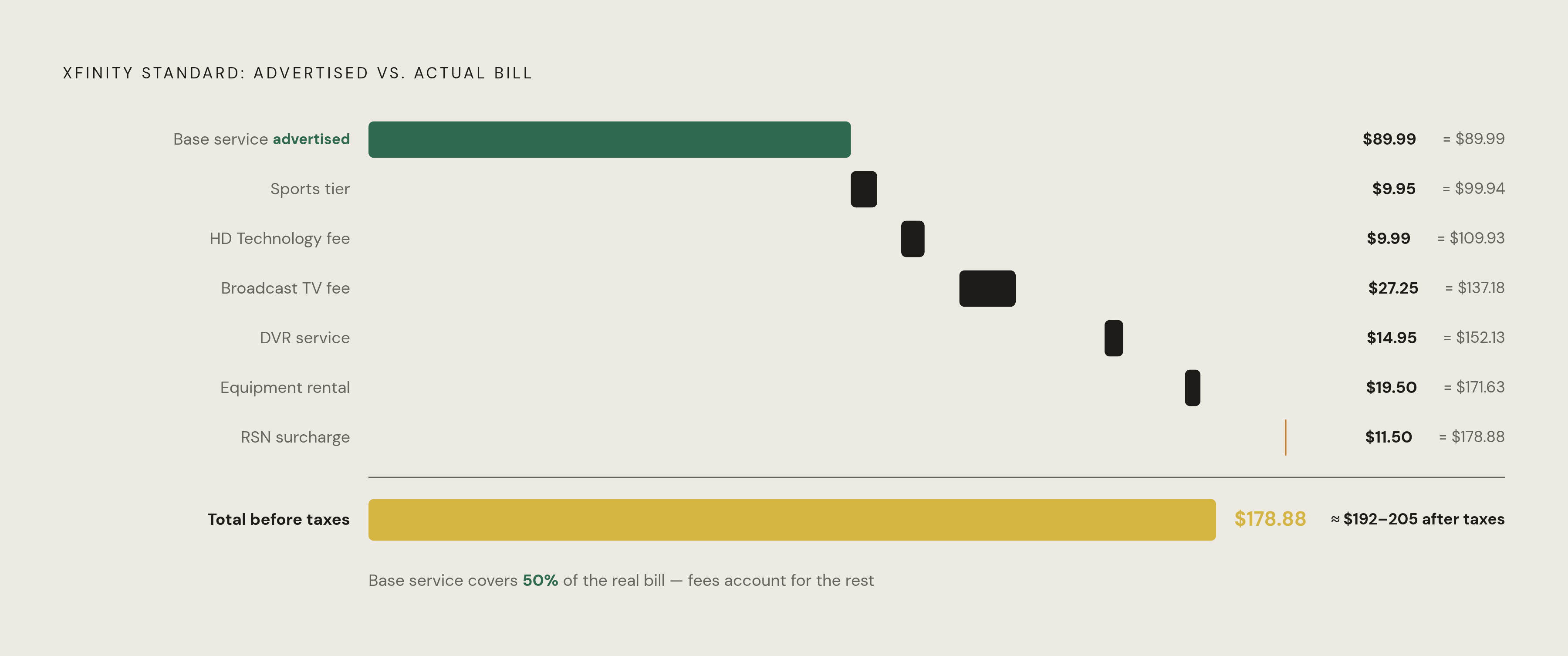
Take an Xfinity Standard-tier household, based on 2025 to 2026 pricing data:
- Base service: $89.99
- Sports tier add-on: $9.95
- HD Technology fee: $9.99
- Broadcast TV fee: about $27.25
- DVR service fee: $14.95
- Equipment rental (one receiver, one DVR): $19.50
- Regional Sports Network surcharge: $11.50
- Total before taxes: $178.88
- After taxes: roughly $192 to $205, depending on local rates
Spectrum's structure differs in naming but not in shape. Spectrum's tiers carry their own base rates, and surcharges and equipment fees stack on top before taxes even enter the picture. Optimum and Cox follow the same pattern under their own line-item names, but the totals converge in a similar band, typically $140 to $200 a month for a standard package.
The advertised rate, $89.99 for Xfinity, $74.99 for Spectrum, covers roughly 45% to 60% of what a subscriber actually pays each month. Everything past that comes from fees, surcharges, equipment, and add-ons that never showed up in the ad. Anyone shopping cable on the sticker price alone is comparing numbers that don't describe the product they're about to buy.
Run the math over five years: a household paying $178.88 a month before taxes racks up $10,732.80 in cable bills, assuming no increases. Factoring in the annual bump of $8 to $12 a month that's typical across the industry, the realistic five-year total is between $11,500 and $12,500. That gap between the "assuming no increases" number and the realistic number is the whole story of this piece in miniature.
Why these bills grow without any active decision from the subscriber
January increases aren't random. Programming contracts renew annually, retransmission fees renegotiate upward nearly every cycle, and shrinking subscriber counts spread fixed infrastructure costs across fewer paying households each year. That's the whole mechanism: a shrinking customer base absorbing rising fixed costs, year after year, on a renewal schedule nobody outside the industry ever sees.
Attention, or the lack of it, matters just as much as the mechanism itself. A $10 fee here, a $20 fee there, none of it looks like much sitting alone on a statement. But three or four of these running at once quietly add up to more than $100 a month that nobody sat down and agreed to, since no single charge ever felt worth calling in about. That's the design, not an accident of complexity.
The same dynamic drives what gets called "ghost charges": small, overlooked recurring costs that drain a household's budget without ever getting reconsidered. Cable fee creep fits that pattern exactly. Broadcast fees, sports surcharges, equipment rental, and a post-promotional rate hike all layer on slowly enough that no single moment ever feels like the one worth pushing back on. The fix is calling the provider every twelve months and asking, point blank, what the account actually costs once every fee is added in. It's calling the provider every twelve months and asking, point blank, what the account actually costs once every fee is added in.
Sources
- Junk fee - Wikipedia
- How Much Does Cable TV Cost in 2026? Average Bills, Hidden Fees, and Streaming Alternatives
- Hidden Costs of Xfinity: Fees, Installation Costs, and Price Increases
- Best IPTV vs Cable in 2026: The Hidden Costs Exposed With Real Numbers - What is iptv
- BillCreep.com - Why Every Recurring Bill in 2026 Is Designed to Creep
- Are Any of These Hidden Fees Impacting Your Cable Bill?
- Optimum Hidden Fees
- compareinternet.com